If you are taking IB Computer Science in May 2027, your examinations will follow a different structure from the one used by previous cohorts.
Older revision resources might tell you to prepare for a Higher Level Paper 3, choose an optional topic or spend most of your time studying pseudocode.
But the revised syllabus changes those expectations.
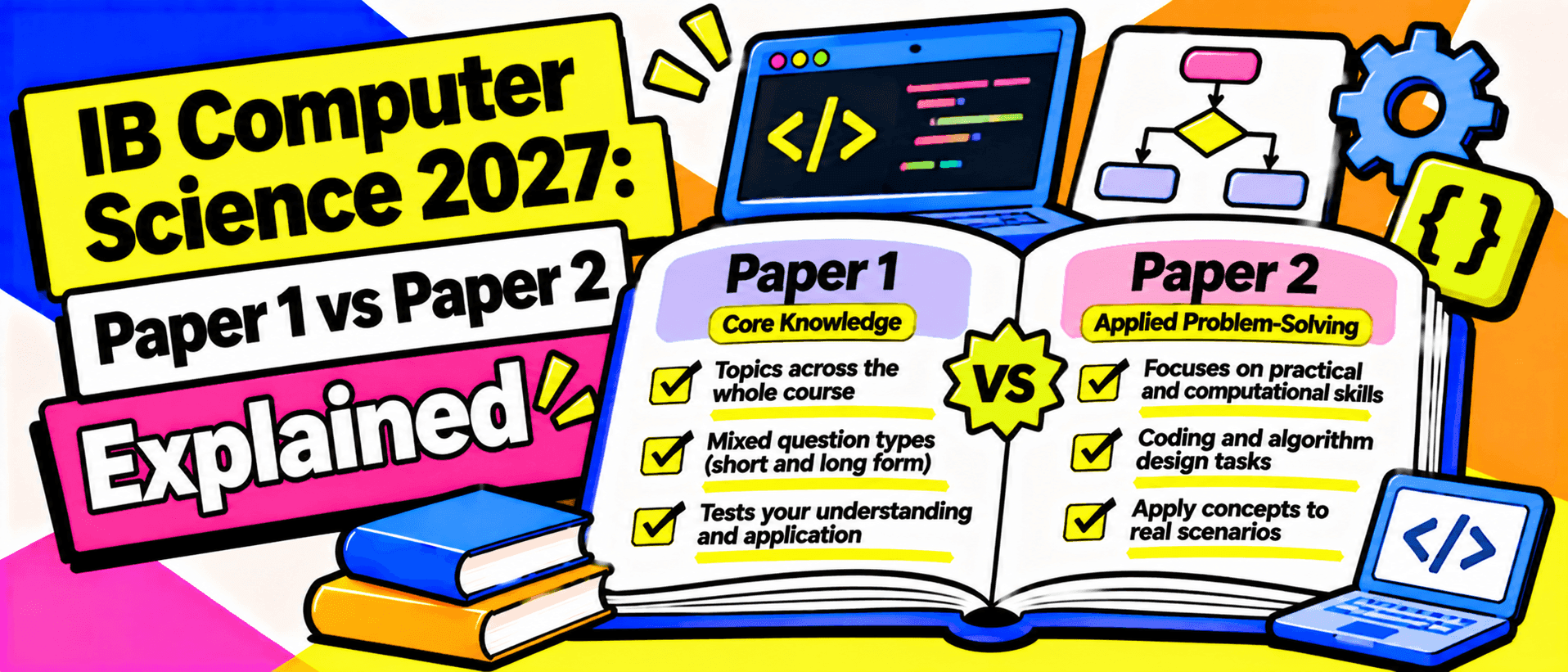
Paper 1 now assesses computing concepts and a pre-seen case study. Paper 2 focuses on computational thinking, algorithms and programming.
The previous HL Paper 3 and optional-topic examinations have been removed.
The changes affect both Standard Level and Higher Level students.
In a September 2026 r/IBO discussion, students shared revision resources for the 2027 and 2028 examination cohorts, reflecting interest in materials aligned with newer syllabuses.
This guide explains the current IB Computer Science 2027 exam structure, the differences between Paper 1 and Paper 2, and how to prepare for each without relying on outdated resources.
What Changed in IB Computer Science for 2027?
The International Baccalaureate's official Computer Science update confirms that the revised course began teaching in August 2025, with first assessment in May 2027.
The redesign places greater emphasis on understanding computer systems and applying computational thinking to real-world problems.
The syllabus now contains two major themes:
Theme A: Concepts of computer science
This examines how computing systems work, including hardware, networks, databases and machine learning.
Theme B: Computational thinking and problem-solving
This examines how students use algorithms, programming and problem-solving methods to develop solutions.
Each theme has its own examination paper.
The former optional topics have been integrated into the core curriculum where relevant, and programming is compulsory for both SL and HL students.
IB Computer Science Paper 1 vs Paper 2: Quick Comparison
The official IB Computer Science subject brief confirms the following assessment structure.
| Feature | Paper 1 | Paper 2 |
|---|---|---|
| Main syllabus focus | Theme A | Theme B |
| Core skill | Explaining and evaluating computing systems | Solving computational problems |
| Main content | Hardware, networks, databases, machine learning | Computational thinking, programming, OOP, data structures |
| Pre-seen case study | Yes | No |
| Programming questions | Not the paper's focus | Required |
| Language choice | No separate Java or Python option | Java or Python |
| SL duration | 1 hour 15 minutes | 1 hour 15 minutes |
| HL duration | 2 hours | 2 hours |
| SL weighting | 35% | 35% |
| HL weighting | 40% | 40% |
Both examinations are compulsory.
Students must answer all questions on the relevant paper, including the required sections.
The distinction is not that Paper 1 is entirely theoretical and Paper 2 entirely practical.
Both assess knowledge, application and analysis.
The difference is the content and type of problem being examined.
How Many Marks Are Available?
The revised papers have different maximum marks at SL and HL.
| Assessment component | SL | HL |
|---|---|---|
| Paper 1 | 50 marks | 80 marks |
| Paper 2 | 50 marks | 80 marks |
| External assessment weighting | 70% | 80% |
| Internal assessment weighting | 30% | 20% |
The internal assessment remains a computational solution developed by the student.
It is worth 30 marks and brings together skills from both syllabus themes.
The IB curriculum update confirms that the total examination time is 2 hours 30 minutes at SL and 4 hours at HL.
A key implication is that students cannot prepare effectively by studying one theme while neglecting the other.
What Does Computer Science Paper 1 Test?
Paper 1 assesses Theme A: Concepts of computer science, together with the pre-seen case study.
Theme A contains four syllabus topics.
| Topic | What students study |
|---|---|
| A1: Computer fundamentals | Hardware, data representation, logic and system operation |
| A2: Networks | Network architecture, communication protocols and security |
| A3: Databases | Database design, relationships, data management and querying |
| A4: Machine learning | Machine learning concepts, applications and ethical considerations |
All four topics are relevant to both SL and HL, although Higher Level requires additional depth.
For example, students may need to explain how a network operates, evaluate security measures or apply database concepts to a particular situation.
The assessment rewards understanding of how systems function and why particular design decisions matter.
Simply memorising definitions may be insufficient for questions requiring application or evaluation.
Understand Paper 1 Section A and Section B
Paper 1 contains two sections.
| Section | SL marks | HL marks | Focus |
|---|---|---|---|
| Section A | 38 | 56 | Theme A syllabus questions |
| Section B | 12 | 24 | Pre-seen case study |
| Total | 50 | 80 |
Section A contains extended-response questions linked to the computing concepts in Theme A.
Section B contains questions related to the pre-seen case study.
At SL, Section B consists of shorter responses.
At HL, it includes short and extended responses requiring more developed analysis.
Both sections are completed in the same examination session without a break.
All questions are compulsory.
This means students should prepare for both the syllabus content and the case study rather than treating the case study as optional revision.
How Does the New Paper 1 Case Study Work?
The pre-seen case study is one of the most important changes in the 2027 syllabus.
Previously, the case study was associated with the HL-only Paper 3.
Under the revised structure, it is assessed in Paper 1 at both levels.
The case study introduces a scenario involving emerging technologies, computing systems or related ethical issues.
Students receive it before the examination so they can investigate the technology, relevant challenges and wider implications.
According to the IB's Computer Science guide for first assessment in 2027, the case study is released through the Programme Resource Centre approximately 12 months before the May examination session.
| Case-study feature | SL | HL |
|---|---|---|
| Included in Paper 1 | Yes | Yes |
| Section B marks | 12 | 24 |
| Specified challenge questions | Two | Four |
| Expected depth | Focused application and explanation | More extensive analysis and evaluation |
The student must understand the case study's challenges and apply relevant computing concepts.
Memorising a summary without understanding how the technologies operate is not enough.
How Should You Revise the Paper 1 Case Study?
Begin by identifying the key technologies and systems described.
Then investigate four areas.
System operation: What components are involved, and how do they interact?
Computational principles: Which concepts from the syllabus explain the system?
Challenges: What technical or practical problems does the case study identify?
Impacts and implications: What are the potential ethical, economic, environmental or social consequences?
For example, a hypothetical case study about automated hospital scheduling could involve databases, network security, access control and machine learning.
Students might consider how patient information is stored, how authorised users access the system and how incorrect automated decisions could affect services.
This is an original illustration, not a description of the official 2027 case study.
The actual questions may also introduce unfamiliar stimulus information, so students must be prepared to apply their research rather than reproduce memorised notes.
What Does Computer Science Paper 2 Test?
Paper 2 assesses Theme B: Computational thinking and problem-solving.
This theme focuses on turning problems into computational solutions.
| Topic | Main skills |
|---|---|
| B1: Computational thinking | Decomposition, abstraction, algorithm design and flowcharts |
| B2: Programming | Variables, conditions, loops, functions, data structures and algorithms |
| B3: Object-oriented programming | Classes, objects, methods and OOP principles |
| B4: Abstract data types | Additional HL content |
Paper 2 requires students to interpret algorithms, solve problems and demonstrate programming knowledge.
Unlike the previous examination structure, students at both SL and HL must be prepared for programming questions.
The IB Computer Science update explicitly confirms this requirement.
Do You Need Python or Java for Paper 2?
Yes. Paper 2 provides two programming-language options.
Option A: Java
Option B: Python
Students answer the option corresponding to the language they have studied.
They must not mix questions from the two options.
The IB states that the language options assess equivalent skills and are designed to be of comparable difficulty.
Therefore, Python is not automatically the easier examination option, and Java does not receive additional credit for more explicit syntax.
Choose and practise the language used in your course.
The examination focuses on computational thinking and problem-solving, not on rewarding one language over another.
Is Pseudocode Still Required in Paper 2?
This is a particularly important change for students using older Computer Science resources.
The IB's Computer Science FAQ for first assessment in 2027 clarifies that pseudocode is not required in Paper 2.
Students are not expected to write pseudocode, and examination questions will not present algorithms in pseudocode.
However, the paper still includes a question that assesses algorithmic thinking without requiring students to write or interpret program code.
Students must therefore be able to explain an algorithm's steps and reason about its behaviour.
Pseudocode can remain a useful classroom planning technique, but it should not replace practice in the selected examination language.
For students studying Python or Java, the priority is being able to understand and construct suitable solutions.
Original Example: How the Two Papers Differ
Imagine a fictional school introducing a digital library system.
The system allows students to search for books, reserve available copies and receive notifications.
The same scenario could support different kinds of assessment questions.
Paper 1-style question
"Explain two security considerations when implementing the school's digital library system."
A suitable response could discuss authentication and the protection of personal information.
For example, the system should verify user identities before allowing access to borrowing records.
The student would explain the underlying computing principles and their relevance to the situation.
Paper 2-style question
"Design an algorithm that checks whether a requested book is available and updates its reservation status."
This requires computational problem-solving.
Students would need to consider inputs, conditions, outputs and appropriate data structures.
A solution should handle relevant cases, such as a book already reserved by another student.
The difference is clear.
Paper 1 investigates how the system works and which design considerations matter.
Paper 2 investigates how a computational process can solve a specific problem.
These questions are original educational examples, not official IB examination questions.
What Extra Content Do HL Students Need?
Higher Level students study the shared SL content together with additional material.
In Theme A, HL students explore computing concepts in greater depth, including further operating-system, database and machine-learning content.
In Theme B, HL introduces more advanced object-oriented programming and the B4 abstract data types topic.
Additional HL areas include structures such as linked lists, binary search trees, sets and hash tables.
The precise requirements are defined by the subject guide.
The IB subject brief also allocates 240 recommended teaching hours to HL and 150 hours to SL.
HL students receive longer examinations because they must demonstrate knowledge and application across additional syllabus content.
However, SL students still study OOP, algorithms and important data structures.
These topics are not exclusive to Higher Level.
Has IB Computer Science Paper 3 Been Removed?
Yes. The previous HL Paper 3 has been removed from the revised Computer Science assessment model.
The former Paper 3 included the HL case study.
For May 2027, the case study is integrated into Paper 1 instead.
The old optional-topic examinations have also been removed.
The key changes are:
| Previous assessment feature | May 2027 structure |
|---|---|
| HL-only Paper 3 | Removed |
| HL case study assessed through Paper 3 | Case study assessed in Paper 1 |
| Case study limited to HL | Case study included at SL and HL |
| Optional-topic papers | Removed |
| Programming assessed within the previous course structure | Programming required in Paper 2 for SL and HL |
This is why older revision websites can create confusion.
A page explaining Paper 2 as an optional-topic examination is not describing the current syllabus.
Students should check the publication date and assessment session of every revision resource.
Does the New Computer Science IA Change?
The Internal Assessment remains compulsory at both levels.
Under the revised syllabus, it is called the computational solution.
Students develop a solution to a real-world problem of their choosing, using computational thinking and programming skills.
The IA is designed to bring together the two main syllabus themes.
| IA detail | SL | HL |
|---|---|---|
| Recommended hours | 35 | 35 |
| Maximum marks | 30 | 30 |
| Grade weighting | 30% | 20% |
The IA has the same assessment requirements at SL and HL.
It is separate from Paper 1 and Paper 2, but preparation for the IA can reinforce relevant computational thinking and programming skills.
The revised course also includes a collaborative sciences project, which is a learning requirement rather than a third written examination paper.
How Should You Divide Revision Time Between the Papers?
Since the two examination papers carry equal weighting within each level, neither should be neglected.
At SL, Paper 1 and Paper 2 each contribute 35% of the final grade.
At HL, each contributes 40%.
Use different revision methods for each paper.
| Revision activity | Paper 1 | Paper 2 |
|---|---|---|
| Review syllabus definitions | Important | Useful foundation |
| Explain computing systems | Essential | Secondary |
| Research the case study | Essential | Not a case-study requirement |
| Practise technical evaluation | Essential | Relevant to algorithm choices |
| Trace algorithms | Limited application | Essential |
| Write and debug code | Not the paper's focus | Essential |
| Apply unfamiliar scenarios | Essential | Essential |
A practical weekly routine could involve two sessions on Theme A, two on Theme B and one mixed practice session.
Adjust the balance based on weaknesses revealed by practice assessments.
A Practical Exam Timing Strategy
The official durations and marks imply an average of approximately 1.5 minutes per mark.
However, students should account for reading, checking and differences in question complexity.
A suggested Paper 1 allocation is:
| Activity | SL: 75 minutes | HL: 120 minutes |
|---|---|---|
| Read and organise approach | 5 minutes | 5 minutes |
| Section A | 48 minutes | 73 minutes |
| Section B: Case study | 18 minutes | 37 minutes |
| Final review | 4 minutes | 5 minutes |
These are practice recommendations, not official IB instructions.
For Paper 2, students should protect time for longer programming problems while completing the noncoding algorithmic question efficiently.
Do not allow one difficult program to prevent you from attempting remaining compulsory questions.
Where Can You Find Official 2027 Practice Papers?
The new syllabus was first taught in August 2025.
Therefore, examinations from earlier Computer Science courses are not exact models of the May 2027 papers.
The IB published specimen examination papers for the revised syllabus in February 2025.
These are available to authorised teachers through the IB Programme Resource Centre.
Students should ask their Computer Science teacher for the correct SL or HL specimens, markschemes and current syllabus guidance.
Older questions can still help with transferable skills such as programming or network analysis, but they should be selected carefully.
Do not use a removed Paper 3 or optional-topic paper as the basis for predicting the 2027 assessment structure.
Final IB Computer Science 2027 Revision Checklist
Before your examinations, confirm that you can:
- Distinguish Theme A from Theme B.
- Identify which topics belong to Paper 1 and Paper 2.
- Explain computing systems, networks, databases and machine learning.
- Apply relevant knowledge to the Paper 1 case study.
- Understand the additional HL content where applicable.
- Trace and explain algorithms.
- Construct solutions in Python or Java.
- Recognise and correct programming errors.
- Answer all compulsory questions within the official time limits.
- Use specimen materials aligned with the first-assessment-2027 syllabus.
Final Verdict: How Are Paper 1 and Paper 2 Different?
The revised IB Computer Science assessment separates two closely related abilities.
Paper 1 tests your understanding of computing systems and your ability to apply that knowledge to real-world contexts, including the pre-seen case study.
Paper 2 tests your ability to use computational thinking, algorithms and programming to solve problems.
The previous HL Paper 3 and optional-topic examinations are no longer part of the assessment structure.
Both SL and HL students now study programming and the case study, although HL demands greater breadth and depth.
Preparing effectively therefore means using different revision methods for the two papers while recognising the connections between them.
Do not rely exclusively on theory notes or programming exercises.
Understand how computing systems operate, and practise designing solutions that use them.
For definitive assessment details, consult the official IB Computer Science curriculum update, the Computer Science subject brief and the updated guide and specimen papers available through the IB Programme Resource Centre.
Table of contents
Share
Related reading
- IB Computer Science 2027 Paper 2: Python or Java?Prepare for IB Computer Science Paper 2 2027 with Python and Java examples, algorithm tracing, debugging, OOP guidance and a practical exam revision plan.
- IB Computer Science Case Study 2027: AI Image CreationPrepare for the IB Computer Science case study 2027 with clear explanations of diffusion models, GANs, AI image ethics and practical Paper 1 exam advice.
- IB Computer Science IA 2027: Criteria, Format and ExamplesUnderstand the IB Computer Science IA 2027 rubric, 2,000-word report, video and code appendix. Explore a worked project example and practical evidence tips.
- Can IB Math AI HL Get You Into Computer Science in 2027?Can IB Math AI HL get you into Computer Science? Compare 2027 university entry rules at Oxford, UCL, Cambridge and more to choose your subjects confidently.
- IB Computer Science: What You Really Study and BuildIs IB Computer Science right for you? Explore the 2027 syllabus, SL and HL papers, coding expectations and IA requirements before choosing your DP subjects.
- IB Grade Boundaries 2026: Marks and Myths ExplainedUnderstand IB grade boundaries 2026, raw versus weighted marks, Math AA HL and Physics myths, and why unofficial grade 7 predictions mislead. Read our guide.