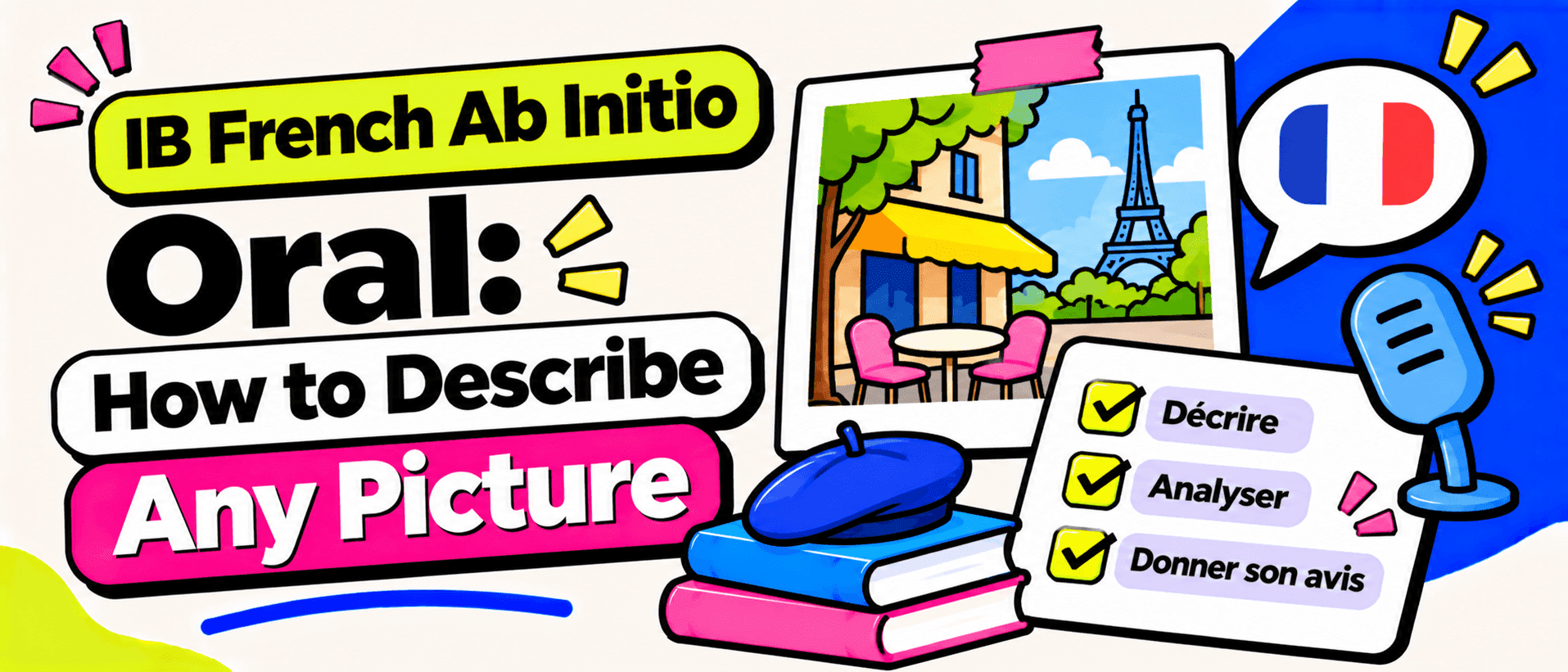
You receive an unfamiliar photograph for your French ab initio oral. Perhaps it shows a market or a classroom. What should you say first, and how will you handle unexpected questions?
The IB French ab initio oral does not require a sophisticated speech. It assesses whether you can communicate relevant ideas in beginner-level French, connect the visual stimulus with a course theme and a French-speaking culture, and sustain a short conversation. In a July 2026 r/IBO discussion, a student approaching the assessment asked which vocabulary and topics to practise when their spoken French felt weak.
Here is a flexible method, three original picture prompts and responses to adapt.
How Does the French Ab Initio Individual Oral Work?
French ab initio is offered at Standard Level only. The IB's 2027 examiner instructions describe 15 minutes of preparation followed by an individual oral lasting up to 10 minutes.
| Component | Approximate duration | Your task |
|---|---|---|
| Picture presentation | 1 to 2 minutes | Describe the image and link it to a theme and French-speaking culture |
| Follow-up discussion | 3 to 4 minutes | Respond to questions about the picture's theme |
| General conversation | 3 to 4 minutes | Discuss at least one additional course theme |
During preparation, you may make brief working notes of approximately ten short points. These are memory aids, not a script to read aloud. Your teacher assesses the oral, which contributes 25% of the course grade.
The IB has announced an enhanced ab initio course for first assessment in May 2029, but its update confirms the oral assessment structure is retained. Check your school's session-specific instructions.
A Simple Five-Step Picture Description Framework
Use this adaptable sequence, not a memorized script.
Step 1. Identify the setting. Start with Sur la photo, je vois... (In the photo, I see...) or La scène se passe... (The scene takes place...). If the location is uncertain, say C'est peut-être... (Perhaps it is...).
Step 2. Describe people and objects. Use Il y a... (There is/are...), à gauche (on the left), à droite (on the right) and au premier plan (in the foreground). Prefer accurate details to guesses.
Step 3. Explain an action. Use present-tense verbs: Ils mangent (They are eating), elle parle (she is speaking), ils font du vélo (they are cycling). The present tense is useful for still images.
Step 4. Give a simple interpretation or opinion. Try Ils ont l'air contents (They look happy), or À mon avis, cette activité est importante parce que... (In my opinion, this activity is important because...). Separate observation from inference.
Step 5. Connect the photo to its theme and a French-speaking culture. Say Cette photo est liée au thème... (This photo is linked to the theme...). Add one relevant, accurate cultural link, such as a market in France or transport in Montréal. Do not claim a photograph was taken in France unless its context supports that statement.
This is not a compulsory order.
Practice Picture 1: A Saturday Market in Lyon
Original picture prompt: Imagine a daylight photograph of an outdoor food market. A visible sign reads Marché du samedi, Lyon. At the front, a woman chooses red apples. A vendor weighs vegetables. Two customers talk beside a stall displaying bread and cheese. Reusable bags hang from a nearby cart.
Possible theme: Identities, through eating and drinking. The prompt explicitly places the scene in Lyon, France, allowing a relevant cultural connection.
Beginner-level model response:
Sur cette photo, je vois un marché à Lyon, en France. Au premier plan, il y a une femme avec des pommes rouges. À droite, un vendeur vend des légumes. Il y a aussi du pain et du fromage. Les personnes font leurs courses et elles parlent. Je pense que le marché est animé. J'aime cette photo parce que les produits sont frais. Cette image est liée au thème des identités, surtout l'alimentation. En France, on peut acheter des aliments au marché. Dans ma ville, j'aime aussi acheter des fruits. Pour moi, manger des produits frais est important.
Why it works: It combines details, simple verbs, a theme, an explicit French cultural link and a personal comparison. Do not reuse it for an unrelated image.
Practice Picture 2: Cycling in Montréal
Original picture prompt: A city photograph shows a cycle lane beside a street. A sign says Montréal. Two people wear helmets and ride bicycles, a bus approaches the junction and several bicycles are parked beside a station. Trees and apartment buildings appear in the background.
Possible theme: Human ingenuity, through transport.
Start with: Sur la photo, deux personnes font du vélo dans une ville. Il y a aussi un autobus et des arbres. (In the photograph, two people are cycling in a city. There is also a bus and there are trees.)
Then develop an opinion: À mon avis, le vélo est pratique parce qu'il ne pollue pas directement quand on l'utilise. (In my opinion, cycling is practical because it does not directly pollute while being used.)
For a cultural connection, the labelled city gives you a factual anchor: Cette photo montre Montréal, une ville francophone du Canada. You could compare travel in your own town without pretending to know the exact transport policies shown in the photograph.
Practice Picture 3: A School Recycling Club
Original picture prompt: In a school courtyard, four students place paper and plastic into clearly labelled recycling bins. A poster in French says Protégeons notre planète. A teacher stands nearby, and plants grow against the wall. The location is not identified.
Possible theme: Sharing the planet, through the environment. A second possible link is social organization, through education.
Say: Je vois quatre élèves dans une école. Ils recyclent du papier et du plastique. Il y a une affiche sur l'environnement. Je trouve cette activité utile parce qu'elle aide à protéger la planète.
Do not invent a French location. Instead, make a specific cultural comparison: En France, les élèves apprennent aussi à trier les déchets et à protéger l'environnement. This is supported by France's Ministry of Education guidance on sustainable development in schools, without assuming the picture was taken in France.
Essential French Phrases for Almost Any Photo
| Purpose | Useful French | Meaning |
|---|---|---|
| Begin | Sur la photo, je vois... | In the photo, I see... |
| Locate | À gauche / à droite... | On the left / on the right... |
| Describe | Il y a plusieurs personnes. | There are several people. |
| Explain actions | Ils sont en train de... | They are in the process of... |
| Qualify | Je pense que... / Peut-être que... | I think that... / Perhaps... |
| Give a reason | ...parce que c'est important. | ...because it is important. |
| Link to a theme | Cette image est liée au thème... | This image is linked to the theme... |
| Compare | Dans mon pays / dans ma ville... | In my country / in my city... |
Learn to adapt these phrases. A memorized paragraph may not match the photograph.
Connect the Picture to the Five IB Themes
The IB language ab initio curriculum uses five prescribed themes: identities, experiences, human ingenuity, social organization and sharing the planet. Everyday vocabulary helps you move between them.
For identities, practise family, food and health. For experiences, learn holidays, routines and leisure activities. For human ingenuity, focus on technology, transport and media. For social organization, prepare school, work and neighbourhood language. For sharing the planet, practise environment, geography and global issues.
Avoid learning only one theme. The final conversation involves at least one additional theme, so a student whose picture concerns transport may then be asked about family routines or celebrations.
How to Answer Follow-Up Questions Naturally
The teacher may ask Pourquoi est-ce important ? (Why is it important?), Qu'est-ce que tu fais le week-end ? (What do you do at weekends?), or Tu préfères voyager en voiture ou à vélo ? (Do you prefer to travel by car or bicycle?). Respond with an answer and a reason.
Teacher: Tu aimes aller au marché ?
Student: Oui, j'aime aller au marché avec ma famille parce que j'aime les fruits frais.
Teacher: Et qu'est-ce que tu achètes ?
Student: J'achète souvent des pommes et des légumes. Parfois, j'achète du pain.
If you do not understand, you can say Vous pouvez répéter, s'il vous plaît ? (Could you repeat, please?) or Que veut dire ce mot ? (What does this word mean?). Asking for clarification is better than answering an unrelated memorized question. Listen for key verbs and respond to the question actually asked.
What the Oral Marking Criteria Reward
The current IB examiner instructions describe 30 available marks: language (12), message in the visual presentation (6), message in the conversation (6), and interactive communication (6).
This means that vocabulary and pronunciation matter, but so do relevant details, a meaningful link to French-speaking culture, and responsive interaction. In the visual-stimulus criterion, an absent explicit connection to the target culture caps the mark at 3 out of 6. A vague or weak link also limits the available marks.
Aim for clear beginner-level French. Join simple sentences using et, mais, parce que and aussi.
A 15-Minute Preparation and Weekly Practice Plan
During the official preparation period, first identify the theme and four visible details. Next, select two actions, an opinion and one specific French-speaking cultural connection. Then practise an opening aloud and think of possible follow-up questions. Use your remaining time to write around ten short cues rather than a full script.
Practise with unfamiliar pictures for one to two minutes, followed by unpredictable questions. Record yourself, rotate the themes and correct recurring errors.
Final Thoughts
For the IB French ab initio oral, begin with visible details, describe actions, offer a simple opinion, connect the image to a theme and French-speaking culture, and respond to questions.
Practise flexible sentence patterns with varied images. Confidence grows from making your own understandable responses, not from reciting a speech designed for a photograph you have never seen.
Table of contents
Share
Related reading
- From IGCSE Spanish to IB Spanish B: A Study RoadmapMoving from IGCSE to IB Spanish B? Compare assessments, learn writing formats, strengthen listening and speaking, and follow a practical four-week study plan.
- IB Language Ab Initio 2029: What Actually Changes?IB Language ab initio 2029 keeps the same exams and five themes. Learn what changes in teaching guidance, critical thinking, oral criteria and DP1 preparation.
- IB English Individual Oral: Choosing a Global IssueChoose a strong IB English IO global issue with practical narrowing examples, literary and non-literary extract guidance, authorial analysis and an oral plan.