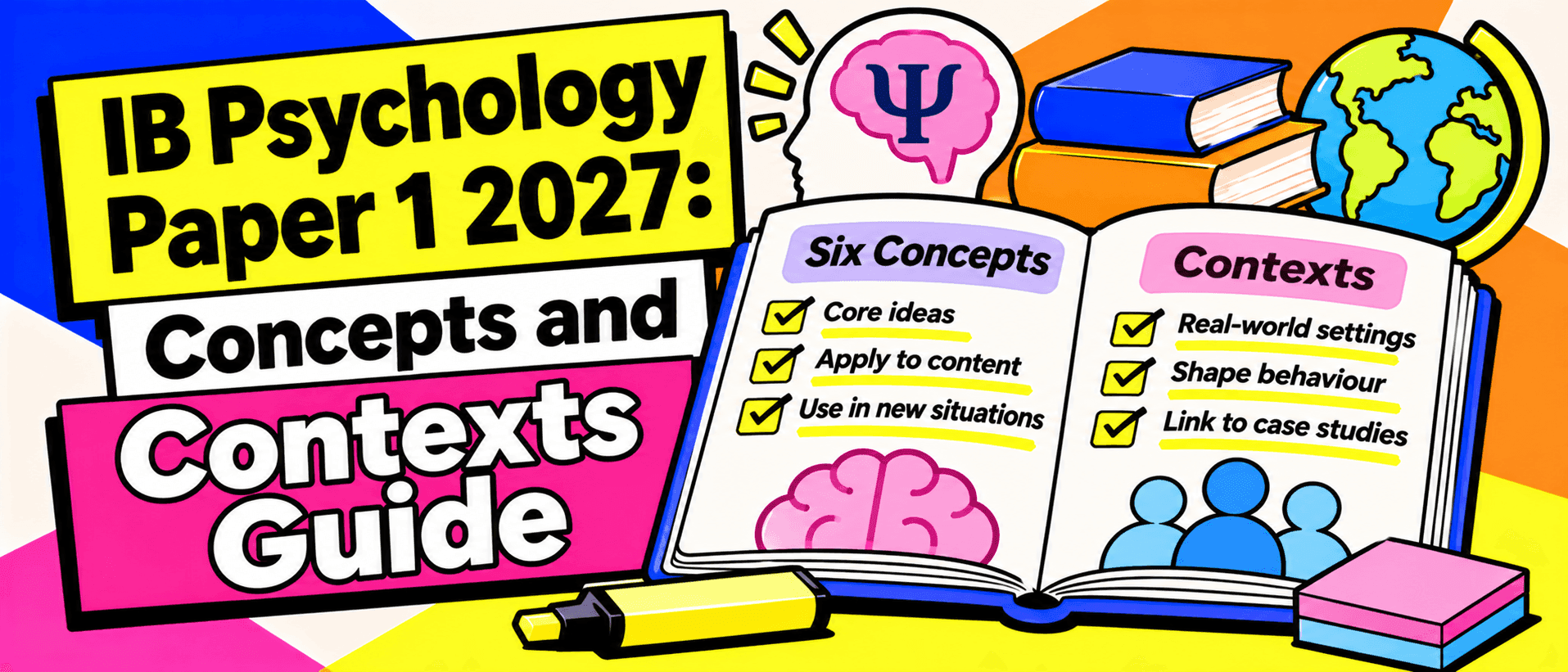
If you are preparing for IB Psychology Paper 1 in May 2027, your examination will look different from the papers used by previous cohorts.
The revised syllabus places psychological concepts, theories and real-world contexts at the centre of assessment. Instead of relying heavily on memorised research studies, students must explain psychological knowledge, apply it to unfamiliar situations and evaluate how different concepts influence our understanding of behaviour.
This change has created uncertainty among students.
In a May 2026 r/IBO discussion, a student preparing for the 2027 examinations asked how to study effectively when most available resources still reflected the previous syllabus.
The most useful approach is to understand how psychological concepts, content and contexts connect.
This guide explains the new Paper 1 format, introduces the six concepts and four contexts, and demonstrates how to approach short-answer and extended-response questions.
What Changed in IB Psychology for 2027?
The IB Psychology curriculum update, published in February 2026, confirms that the revised course began teaching in August 2025, with first assessment in May 2027.
The previous syllabus organised much of the course around psychological approaches and selected options.
The revised curriculum introduces three integrated elements:
Concepts: Six broad ideas that help students critically examine psychological explanations and research.
Content: Psychological theories and terminology from biological, cognitive and sociocultural approaches, together with research methodology.
Contexts: Four areas of applied psychology in which students investigate behaviour.
The revised approach places greater emphasis on using psychological knowledge to understand problems rather than reproducing memorised studies.
The assessment structure has also changed, including a redesigned Paper 1, a new Paper 2 and an additional data-analysis Paper 3 at HL.
IB Psychology Paper 1 2027: Official Exam Format
According to the official Psychology guide for first assessment in 2027, Paper 1 lasts 1 hour 30 minutes at both SL and HL.
| Examination detail | SL | HL |
|---|---|---|
| Duration | 90 minutes | 90 minutes |
| Maximum marks | 35 | 35 |
| Section A | Two compulsory 4-mark questions | Same |
| Section B | Two compulsory 6-mark questions | Same |
| Section C | One 15-mark question chosen from two | Same |
| Final grade weighting | 35% | 25% |
The examination tests the integration of psychological concepts, content and contexts.
However, each section has a different purpose.
Section A focuses on psychological knowledge.
Section B tests application to unfamiliar scenarios.
Section C assesses conceptual understanding, critical analysis and evaluation.
Preparing for these different demands is more effective than memorising one standard answer structure.
Understand the Six Psychology Concepts
The revised syllabus identifies six core concepts: bias, causality, change, measurement, perspective and responsibility.
These concepts can be applied across the course.
| Concept | Central question | Example application |
|---|---|---|
| Bias | What might distort judgement or research findings? | Sampling bias in research on adolescent behaviour |
| Causality | Can we establish that one factor produces another? | Whether sleep deprivation causes reduced concentration |
| Change | How and why does behaviour develop or respond to intervention? | Behaviour change following a health programme |
| Measurement | How can psychological variables be measured accurately? | Using memory tests to investigate learning |
| Perspective | How do different explanations influence understanding? | Biological and sociocultural explanations of stress |
| Responsibility | What ethical obligations arise in research and application? | Protecting participants' privacy and well-being |
The official Psychology guide explains that the concepts are interconnected rather than isolated topics.
For example, a study investigating the relationship between sleep and academic performance raises questions about causality, measurement and potential bias.
Recognising these connections is particularly valuable for Section C.
The Four Contexts You Need to Study
Both SL and HL students study all four contexts.
| Context | Possible areas of inquiry |
|---|---|
| Health and well-being | Stress, health behaviour, psychological disorders and interventions |
| Human development | Cognitive, social and emotional development across the lifespan |
| Human relationships | Social influence, group behaviour, interpersonal relationships and identity |
| Learning and cognition | Memory, thinking, learning processes and decision-making |
Students use biological, cognitive and sociocultural content to explore these contexts.
For example, stress within health and well-being can be considered through physiological responses, cognitive appraisal or social support.
The context gives the question a real-world focus.
The psychological content provides the theories and mechanisms needed to explain it.
The concepts encourage critical consideration of those explanations.
Section A: Explain Psychological Knowledge Clearly
Section A contains two compulsory short-answer questions worth four marks each.
The questions assess knowledge drawn from two of the three content areas: biological, cognitive and sociocultural.
The IB's 2027 examiner instructions clarify that Section A focuses on understanding psychological theories and terminology.
Detailed knowledge of named research studies is not assessed in this section.
Consider this original practice question:
"Explain schema theory using an example." [4]
A developing response might say:
Schema theory explains how people organise knowledge. Schemas affect memory.
This is relevant but underdeveloped.
A stronger response would explain:
Schema theory proposes that people organise knowledge into mental frameworks that influence how information is interpreted and remembered. These frameworks can help individuals process familiar situations efficiently, but they may also influence the reconstruction of memories. For example, someone who expects a classroom to contain a whiteboard may incorrectly remember seeing one when recalling an unfamiliar classroom.
This explanation identifies the theory, describes its mechanism and provides a relevant example.
It demonstrates understanding rather than simply naming a concept.
Section B: Apply Psychology to Unseen Situations
Section B contains two compulsory questions worth six marks each.
Students must apply psychological content to an unfamiliar situation drawn from one of the four contexts.
A strong answer must refer directly to the scenario.
Original practice scenario:
A school notices that students who frequently listen to spoken podcasts while revising tend to perform less well on subsequent memory quizzes than students who revise without additional audio.
Practice question:
Explain how cognitive load theory could be applied to understand this situation. [6]
A weak answer might simply define cognitive load theory.
A stronger response applies its mechanism.
Cognitive load theory proposes that working memory has limited processing capacity. If students are trying to read and understand complex material while also processing unrelated spoken information, the two tasks may compete for cognitive resources. This additional processing demand could reduce the resources available for organising and encoding the revision material, helping explain the lower quiz performance reported in the scenario.
The response identifies relevant theory and applies it to specific circumstances.
However, the observed difference does not prove that podcasts caused the lower scores.
Other differences between the students, such as prior knowledge or revision duration, may influence the results.
That qualification can demonstrate understanding, but the main priority remains answering the precise question.
How to Approach Any Section B Scenario
Use this four-step method.
Step 1: Identify the behaviour or psychological problem described.
Step 2: Select a relevant theory, model or psychological process.
Step 3: Explain how that knowledge applies to specific details in the scenario.
Step 4: Clarify the resulting behaviour or outcome without making unsupported claims.
For example, a scenario about peer pressure might be understood using conformity or social identity processes.
A scenario about learning difficulties could require cognitive explanations.
A situation involving physiological responses to stress may be approached through biological knowledge.
Do not force a favourite theory into a scenario where it does not explain the relevant behaviour.
Section C: The 15-Mark Concept-Based Response
Section C is the largest component of Paper 1.
Students choose one of two extended-response questions, each based on a different context.
The official examiner instructions confirm that Section C uses higher-order command terms such as discuss, evaluate, examine and to what extent.
The section rewards conceptual understanding and critical thinking.
The highest markband requires developed analysis, fully explained links between concepts, precise psychological terminology and a reasoned conclusion.
Detailed memorisation of specific research-study procedures is not itself assessed.
Instead, students must demonstrate how relevant psychological knowledge supports an analytical argument.
Worked Example: Measurement and Bias in Learning
Consider this original Section C-style question:
"Discuss the importance of measurement and bias when investigating learning and cognition." [15]
A basic response might define measurement and bias, then describe one study.
That would provide limited conceptual analysis.
A stronger response examines how the concepts interact.
For example:
Psychologists may investigate learning by measuring recall accuracy through a memory test. Such a test provides an observable measure of performance, but recall scores may not capture every dimension of learning, such as long-term understanding or the ability to apply knowledge.
Measurement also raises questions about bias. If participants are recruited from a narrow educational background, the findings may not represent learners with different experiences. Furthermore, students familiar with the test format may perform better for reasons unrelated to the psychological process being investigated.
Therefore, understanding learning requires consideration of both how cognition is measured and how research design may influence the results.
This is an original analytical excerpt, not a complete 15-mark answer.
A full response could develop further connections with perspective and causality, evaluate competing approaches and reach a more comprehensive conclusion.
How to Structure a Strong Section C Answer
A practical response structure is:
Introduction: Identify the main psychological issue and establish a relevant argument.
First analytical paragraph: Explain a psychological theory or approach and connect it to the specified concept.
Second analytical paragraph: Examine another relevant explanation or a limitation.
Third analytical paragraph: Develop connections between concepts and evaluate their significance.
Conclusion: Present a reasoned judgement that follows from the analysis.
This is a suggested planning structure, not an official IB template.
For example, a question about stress and perspective could discuss biological and cognitive explanations, evaluate their different contributions and consider how sociocultural influences complicate a single-cause account.
Strong answers explain these relationships rather than listing multiple approaches without connecting them.
What Do the Section C Markbands Reward?
The IB Psychology guide divides Section C performance into five markbands.
| Markband | Main characteristics |
|---|---|
| 1 to 3 | Limited understanding and largely descriptive content |
| 4 to 6 | Some relevant knowledge but limited analysis |
| 7 to 9 | Partially developed explanation and conceptual links |
| 10 to 12 | Relevant analysis and a supported conclusion, with some limitations in development |
| 13 to 15 | Well-developed critical analysis, fully explained conceptual connections and a reasoned conclusion |
These are simplified descriptions of the official assessment descriptors.
An answer does not reach the highest band by mentioning all six concepts.
It needs to select relevant concepts and explain their significance accurately.
Depth of analysis matters more than the number of psychological terms included.
A Practical 90-Minute Paper 1 Strategy
Because Section C is worth 15 of the 35 marks, it deserves substantial writing time.
| Task | Suggested time |
|---|---|
| Read the paper and identify Section C choice | 5 minutes |
| Section A: Two short answers | 15 minutes |
| Section B: Two scenario applications | 27 minutes |
| Section C: Plan and write the extended response | 38 minutes |
| Final review | 5 minutes |
| Total | 90 minutes |
These timings are suggested practice targets, not official IB allocations.
If Section B becomes difficult, avoid spending so long on one unfamiliar scenario that you leave Section C incomplete.
During practice, record which section causes the greatest delays and adjust your approach accordingly.
How to Revise the New Psychology Syllabus
Older revision materials can still help explain relevant psychological theories.
However, they should not determine your examination preparation.
The new syllabus places greater emphasis on conceptual understanding and application across contexts.
Create a revision matrix that connects content, concepts and context.
| Psychological content | Context | Concept to investigate |
|---|---|---|
| Cognitive load theory | Learning and cognition | Measurement |
| Social identity processes | Human relationships | Perspective |
| Stress responses | Health and well-being | Causality |
| Developmental theories | Human development | Change |
| Research methodology | Across all contexts | Bias and responsibility |
For every connection, practise explaining a theory, applying it to a realistic scenario and identifying a relevant limitation.
This builds transferable understanding rather than memorised responses designed for one question.
Common Psychology Paper 1 Mistakes to Avoid
Students should avoid:
- Revising exclusively from the pre-2027 assessment format.
- Memorising studies without understanding the underlying theories.
- Treating the six concepts as unrelated definitions.
- Describing a Section B scenario without applying psychology.
- Writing a Section C essay that lists theories without evaluating them.
- Claiming causality from evidence that only establishes an association.
- Adding concepts that do not help answer the question.
- Spending too long on short answers and leaving Section C unfinished.
The strongest revision sessions combine content knowledge, scenario application and critical evaluation.
Final IB Psychology Paper 1 2027 Checklist
Before your examination, confirm that you can:
- Explain the biological, cognitive and sociocultural approaches.
- Define and apply all six psychological concepts.
- Connect psychological content to all four contexts.
- Answer short questions using accurate theories and relevant examples.
- Apply psychological explanations to unfamiliar situations.
- Develop and evaluate links between concepts.
- Use psychological terminology accurately.
- Construct a reasoned 15-mark response within the available time.
IB Psychology Paper 1 2027 is designed to assess how well you understand and apply psychology, not how many research studies you can memorise.
The most effective preparation is to study theories through their applications, practise identifying relevant concepts and develop the ability to evaluate psychological explanations.
When you understand how concepts, content and contexts work together, unfamiliar questions become opportunities to demonstrate knowledge rather than obstacles to memorised answers.
For authoritative preparation, consult the IB Psychology curriculum updates, the official Psychology guide for first assessment in 2027 and the 2027 examiner instructions.
Table of contents
Share
Related reading
- IB Psychology Paper 3 2027: HL Research Evaluation GuidePrepare for IB Psychology Paper 3 2027 with the 30-mark HL format, source analysis, annotated practice answers, research evaluation and effective timing.
- IB Psychology Paper 2 2027: How to Answer Every QuestionMaster IB Psychology Paper 2 2027 with annotated sample answers, class practical guidance, unseen study evaluation and practical exam timing advice for 2027.
- IB Global Politics Paper 2: New Syllabus Essay GuideMaster IB Global Politics Paper 2 with the 2026 exam format, original essay plans, cross-theme arguments and case study tips. Build stronger answers today.
- IB Global Politics Paper 3: Case Study Strategy GuideMaster Global Politics Paper 3 with a practical case study matrix, reliable sources, six lines of inquiry and original practice questions. Start preparing.