MYP Design is not assessed only on whether your final product looks impressive.
A polished app, prototype, model or physical product can still leave important assessment evidence missing. The subject is built around the process that led to the solution: the problem you identified, the research you used, the ideas you developed, the decisions you made, the way you created the solution and the evidence you used to evaluate it.
The IB describes inquiry and problem solving as central to MYP Design. It also makes an important point:
“MYP design focuses a holistic design process rather than final products and solutions.”
That is why the design folder matters. It is not a scrapbook of project screenshots. It is the evidence trail showing how your thinking moved through the design cycle.
Source: IB MYP Design
The Four MYP Design Criteria
MYP Design uses four equally weighted criteria, each with a maximum achievement level of 8.
Source: IB MYP Design Subject Brief
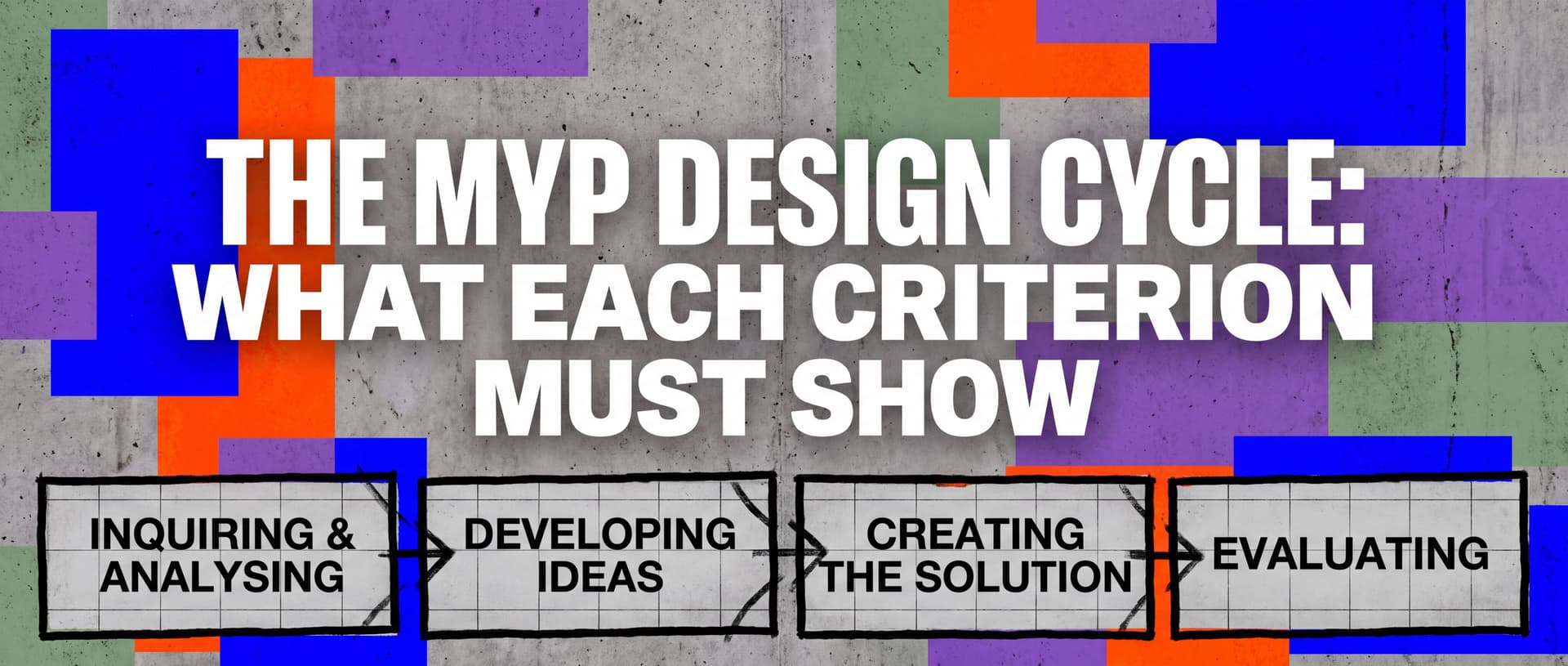
- Criterion A: Inquiring and analysing
- Criterion B: Developing ideas
- Criterion C: Creating the solution
- Criterion D: Evaluating
These names are specific to Design. Do not borrow the criterion names from Sciences, Mathematics or another MYP subject simply because those subjects also use A to D.
For students completing IB validated MYP Design assessment in Year 5, achievement is demonstrated through an ePortfolio rather than a written on screen examination. The submitted work documents the design process as a complete design folder.
Which Year Rubric Should You Use?
The Design framework sets out expectations at Years 1, 3 and 5.
The same four criterion names remain, but the level of independence and detail increases.
For example, Year 1 students may describe one existing product and identify the main research needed. By Year 3, students analyse a group of similar products and construct a research plan involving primary and secondary research. By Year 5, they analyse a range of products, prioritise research more independently and produce a detailed design brief.
Source: MYP Design Assessment Criteria
The progression matters because a Year 5 student should not use a simplified Year 1 checklist as the standard for a top band response.
If you are in Year 2 or Year 4, use the rubric and task specific clarification supplied by your teacher. Your school should make clear which expectations apply to the assessment in front of you.
Criterion A: Inquiring and Analysing
Criterion A comes before the final design.
At Year 5, students explain and justify the need for a solution for a specified client or target audience, identify and prioritise primary and secondary research, analyse a range of existing products, and develop a detailed design brief from that research.
Source: MYP Design Assessment Criteria
Your folder should make it possible to see:
- Who the client or target audience is.
- What problem they experience and why it matters.
- What you need to research before designing.
- Which research questions deserve priority.
- What primary and secondary evidence you collected.
- What existing products teach you about possible solutions.
- What conclusions from the research will guide your design.
A common mistake is collecting information without analysing it.
If you study five existing apps, do not stop after listing their colours, features and navigation. Explain which choices are useful for your own problem, which are unsuitable for your audience and what the comparison means for the solution you will develop.
Criterion A should narrow the problem and give Criterion B something concrete to work from.
Criterion B: Developing Ideas
Criterion B turns research into possible solutions.
At Year 5, students develop detailed design specifications, create a range of feasible ideas, present and justify the chosen design, and produce accurate and detailed planning drawings or diagrams.
Source: MYP Design Assessment Criteria
The specification should grow from Criterion A.
If your research shows that a product must be usable with one hand, that requirement can become a measurable success criterion. If users need high contrast text, that should influence the specification too.
Your folder should then show more than one genuinely different idea.
Changing the colour of the same design three times is not the same as developing a range of concepts.
Each serious idea should be understandable to another person through labelled sketches, wireframes, storyboards, diagrams, measurements, material notes or another format appropriate to the solution.
The selected design also needs a reason.
“I liked design two the most” is weak evidence.
A stronger justification compares the ideas against the design specification and explains why the chosen concept responds most effectively to the researched need.
At the highest Year 5 band, the rubric expects the selection to be justified fully and critically with detailed reference to the design specification.
Criterion C: Creating the Solution
Criterion C is where the solution is made, but it is not simply a reward for finishing.
At Year 5, students create a detailed and logical plan, consider the efficient use of time and resources, demonstrate technical skills, follow the plan to produce a functioning solution, justify changes made during production and present the completed solution appropriately.
Source: MYP Design Assessment Criteria
The production plan should be detailed enough for another student to follow.
Depending on the project, the folder can include the production sequence, time estimates, materials or software, technical processes, evidence of creation, changes made and clear evidence of the finished solution.
One important point is to record changes rather than hide them.
Design rarely happens exactly as planned. A dimension may prove impractical. A material may fail. An interface may become confusing. Code may need restructuring.
A change is not automatically evidence of poor design.
At Year 5, the important question is whether you can justify it. Explain what changed, why the original plan needed adjustment and why the new decision was more appropriate.
Criterion D: Evaluating
Criterion D asks whether the solution actually solved the problem established in Criterion A.
At Year 5, students design detailed and relevant testing methods, critically evaluate the solution against the design specification, explain how it could be improved and explain its impact on the client or target audience.
Source: MYP Design Assessment Criteria
Testing is not the same as asking a friend, “Do you like it?”
Good testing connects directly to the success criteria.
If a storage product must hold 5 kilograms safely, test whether it does.
If an interface must let a first time user complete a task within 30 seconds, test that with appropriate users and record the result.
For each important success criterion, show what was tested, how it was tested, what happened and what the evidence means.
Then move beyond the result. Explain what should be improved and why. Finally, return to the original audience. What impact did the solution have on the client or users?
Criterion D completes the cycle by bringing the project back to the need that started it.
How the Expectations Develop From Year 1 to Year 5
The Design cycle stays the same. The thinking becomes more demanding.
In Criterion A, students move from simpler research and product description towards independent research planning, broader product analysis and a detailed brief.
In Criterion B, they move from basic success criteria and feasible ideas towards research based specifications, detailed annotation and stronger justification.
In Criterion C, they move from outlining a plan and listing changes towards detailed planning, stronger technical execution and full justification of changes.
In Criterion D, they move from outlining tests and improvements towards detailed testing, authentic product evidence, critical evaluation against the specification and a clearer explanation of impact.
Source: MYP Design Assessment Criteria
Pay attention to the verbs in your rubric.
State, outline, describe, explain, justify and critically evaluate do not ask for the same depth of response.
What a Strong Design Folder Should Feel Like
A strong folder reads as one connected argument.
Criterion A says:
This is the problem, this is who experiences it, and this is what the evidence tells me.
Criterion B says:
These are the success criteria, these are the possible solutions, and this is why I selected this one.
Criterion C says:
This is how I planned and created the solution, including the changes I made.
Criterion D says:
This is how I tested the solution, how well it met the success criteria, and what should improve next.
If those sections feel unrelated, the design cycle has probably broken somewhere.
A specification should not suddenly contain requirements that never appeared in the research. Testing should measure the qualities set out in the specification. Improvements should respond to evidence from the evaluation.
More pages do not automatically mean stronger evidence.
Copied research with no interpretation, repeated screenshots with no explanation, nearly identical design ideas and vague user feedback can make a folder longer without making the design thinking clearer.
MYP Design Is Not DP Design Technology
This distinction matters when searching online.
MYP Design is a Middle Years Programme subject group. Schools can offer product design, digital design or a combination of both.
Source: IB MYP Design
DP Design Technology is a separate Diploma Programme subject within the sciences group, with its own curriculum and assessment structure.
Source: IB DP Design Technology
The IB notes that MYP Design can prepare students for later study in DP Design Technology, but the two courses are not interchangeable.
So if an online article is labelled “Design Technology IA,” check the programme before applying its advice to an MYP Design folder.
What Happens in Year 5 eAssessment?
Students seeking an IB validated MYP Design course result demonstrate their achievement through an ePortfolio.
The official MYP Design subject brief describes the submission as a design project presented through a complete design folder. Students identify a challenge, research it, develop and create a solution, and evaluate its success.
Teachers mark the ePortfolio against the published Year 5 criteria. The IB then moderates a sample of ePortfolios from each school to support consistent application of the standards.
Source: IB MYP Design Subject Brief
The assessment is therefore not looking for four disconnected pieces of work.
It is looking for evidence of a complete design process.
Start the Cycle Before You Start Making
The biggest practical lesson in MYP Design is simple: do not rush to build the solution.
A strong Criterion C becomes easier when Criterion B produced a detailed plan.
A strong Criterion B becomes easier when Criterion A produced useful research.
A strong Criterion D becomes easier when Criterion B produced measurable success criteria.
Before your next project, ask four questions:
- What evidence must I collect before designing?
- What decisions must I make visible while developing ideas?
- What evidence will show how the solution was actually created?
- How will I test the exact success criteria at the end?
Then build the folder as the project develops rather than trying to reconstruct the design process after the product is finished.
For the wider MYP grading system, see MYP Grading: Criteria A to D and the 1 to 7 Scale.
For another example of how the same A to D letters measure different skills in another subject, see MYP Mathematics Criteria A to D: Complete Guide.
You can also use the Koncepts MYP hub for subject support and assessment practice.
Related Blogs
MYP Grading: Criteria A to D and the 1 to 7 Scale
Table of contents
Share
Related reading
- MYP Individuals and Societies Criteria: A to D ExplainedLearn the four MYP Individuals and Societies criteria, how expectations develop from Years 1 to 5, and what students need to show for stronger achievement.
- MYP Sciences Criterion B: What Makes a 7 or 8 Design?Learn how to improve your MYP Sciences Criterion B investigation. Explore Year 5 descriptors, hypotheses, variables and methods for achievement levels 7 to 8.
- IB CAS: What Counts and How to Show What You LearnedDiscover what counts for IB CAS, explore project ideas, understand the seven learning outcomes, and write honest reflections that show what you learned.