You have finished the text analysis section of your MYP English eAssessment. Now you face two writing tasks.
One asks you to produce an imaginative literary response. The other requires a non-literary text for a particular audience and purpose.
You know how to write a story, article or speech. But how do you decide what the examiner expects? How creative should your response be? Does using the correct format automatically earn marks?
These are genuine concerns for MYP students.
During the April 2026 MYP eAssessment discussion, students asked specifically about Language and Literature Tasks 2 and 3, including creative responses and appropriate writing formats.
The most important distinction is straightforward.
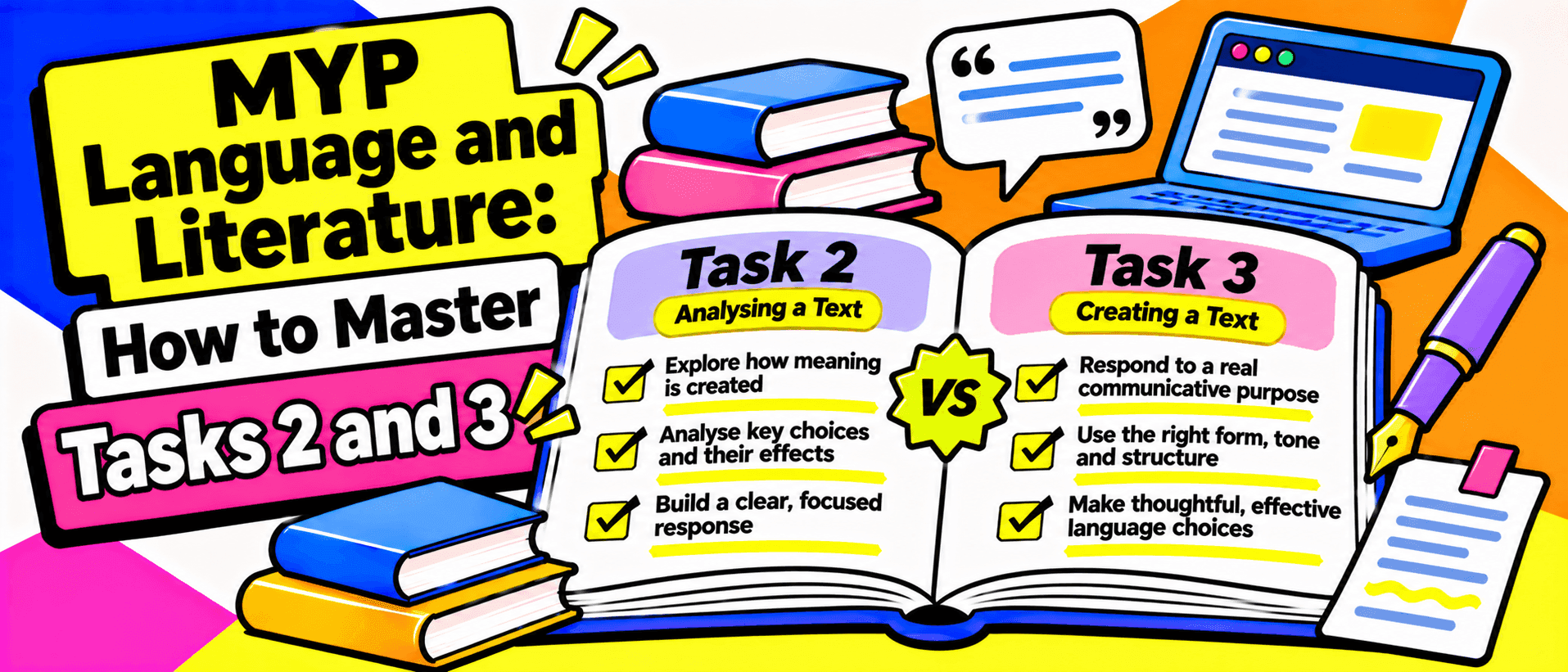
Task 2 assesses literary creativity and language choices. Task 3 assesses purposeful non-literary writing, including organisation, audience awareness and effective communication.
Both reward thoughtful writing rather than memorised templates.
This guide explains the task structure, relevant assessment criteria and practical techniques for developing stronger responses under examination conditions.
Understand the MYP Language and Literature Exam Structure
The official MYP Language and Literature guide, updated in April 2023, outlines an on-screen examination lasting 120 minutes and carrying 80 marks.
Its assessment blueprint identifies three tasks.
| Task | Main assessment focus | Marks | Criteria |
|---|---|---|---|
| Task 1 | Analysis and comparison of texts | 30 | A and B |
| Task 2 | Producing literary text | 20 | C and D |
| Task 3 | Producing non-literary text | 30 | B, C and D |
| Total | 80 |
Task 1 includes shorter analytical responses and an extended comparison.
Task 2 focuses on imaginative writing.
Task 3 focuses on producing a non-literary text connected to the examination session's prescribed global context.
The older IB subject brief published in 2015 groups the writing assessment differently. Students should therefore rely on the current examination blueprint and specimen paper provided through their school, rather than mixing instructions from different document versions.
The IB's eAssessment guidance confirms that on-screen assessments evaluate students' ability to apply their understanding, not merely recall information.
Task 2 vs Task 3: What Is the Difference?
| Feature | Task 2 | Task 3 |
|---|---|---|
| Type of writing | Literary | Non-literary |
| Main objective | Create an imaginative, engaging text | Communicate effectively for a particular purpose |
| Typical stimulus | Visual images | Issue or context-based prompt |
| Important qualities | Narrative voice, imagery, characterisation | Structure, relevant ideas, audience awareness |
| Main criteria | C and D | B, C and D |
A frequent mistake is approaching both tasks in exactly the same way.
Task 2 requires creative choices that produce an effect on the reader.
Task 3 requires deliberate decisions about content, organisation, tone and text conventions.
Both require accurate, varied language.
What Do Criteria B, C and D Actually Assess?
The official Language and Literature assessment guide identifies four MYP criteria.
Three are particularly relevant to Tasks 2 and 3.
Criterion B: Organizing
Students organise ideas coherently and use structures appropriate to their purpose.
For example, an opinion article should develop an argument logically, while a speech needs a progression that listeners can follow.
Criterion C: Producing text
Students demonstrate imagination, insight and sensitivity while making deliberate stylistic choices.
This applies to both fictional writing and purposeful non-literary communication.
Criterion D: Using language
Students use appropriate vocabulary, sentence structures, grammar, punctuation and register.
Sophisticated vocabulary is useful only when it supports meaning.
A clear, controlled sentence can be more effective than an unnecessarily complicated one.
How to Master Task 2: Producing Literary Text
The official guide describes Task 2 as an extended creative writing task using two static images as stimuli.
Students must produce a literary response showing imagination or sensitivity and awareness of its effect on the audience.
This does not mean creating the most complicated storyline possible.
A focused piece with convincing characterisation and purposeful imagery may be more effective than a story containing several unrelated events.
Before writing, identify:
- The image or prompt you want to develop.
- The central character or narrative perspective.
- The conflict, tension or emotional situation.
- The atmosphere you want to establish.
- The change or realisation that will shape the ending.
These decisions provide a foundation for coherent creative writing.
Original Task 2 Practice Exercise
Practice stimulus: Imagine a photograph showing an empty basketball court after heavy rain. A bright red umbrella rests beside the entrance. The surrounding buildings are reflected in puddles.
Original practice prompt:
Write a short literary narrative inspired by this scene in which an ordinary object becomes important to a character.
This is an independently created practice exercise, not an official IB examination question.
Example Response
The umbrella had been waiting outside the court for three days.
Every afternoon, Maya passed it on her way home. Its red fabric remained bright against the grey pavement, even as the rain washed fallen leaves into the drains.
On Thursday, she finally picked it up.
The handle was scratched. A faded strip of tape circled the wooden grip, and beneath it someone had written a name.
Dad.
For a moment, she could hear his voice again, reminding her to carry an umbrella even when the sky looked clear.
She stood beside the locked gate, holding the object as though it belonged to someone she had been searching for.
Then her phone vibrated.
Her mother was waiting.
Maya opened the umbrella. The rain had already stopped, but she carried it home anyway.
Why This Response Works
Opening: The first sentence introduces an unusual detail that creates curiosity.
Imagery: The contrast between red fabric and grey pavement establishes atmosphere without excessive description.
Characterisation: Maya's reaction communicates emotional significance through action.
Symbolism: The umbrella becomes associated with memory and loss.
Ending: Carrying the umbrella home suggests an emotional decision without explaining every feeling directly.
The passage is a short demonstration, not a full-length examination response.
In timed practice, students should develop the narrative to the length appropriate to their actual prompt and examination guidance.
Task 2: Common Creative Writing Mistakes
Overcomplicating the plot
A story does not need several dramatic twists. One meaningful conflict can provide sufficient material.
Describing without developing
Sensory details should establish atmosphere, character or meaning rather than simply fill space.
Changing perspective unintentionally
Switching between first and third person without a clear purpose may disrupt the narrative.
Forgetting the stimulus
The story should maintain a meaningful connection to the selected image or prompt.
Using impressive language without control
An awkward metaphor or unnecessarily long sentence may weaken communication.
Before finishing, ask whether every major creative choice contributes to the intended effect.
How to Master Task 3: Producing Non-Literary Text
Task 3 requires students to produce a non-literary text connected to the prescribed global context for their examination session.
The official guide links this task to Criteria B, C and D.
Students must demonstrate appropriate organisation, effective communication and awareness of their audience.
Depending on the prompt, relevant non-literary formats may include:
| Text type | Typical purpose | Useful conventions |
|---|---|---|
| Speech | Persuade or motivate listeners | Direct address, rhetorical questions, memorable conclusion |
| Opinion article | Present an argument | Headline, clear position, supporting reasons |
| Blog post | Inform or discuss an issue | Engaging opening, accessible tone, clear progression |
| Formal letter | Request or advocate action | Appropriate greeting, focused paragraphs, professional closing |
| Review | Evaluate an experience or product | Description, judgement, supporting examples |
These are revision examples, not a guaranteed list of formats for every examination session.
Students must follow the actual task instructions, particularly when a format is specified.
The Audience, Purpose and Format Method
Before beginning Task 3, identify three elements.
Audience: Who will read or hear the response?
Purpose: What should the response achieve?
Format: What conventions are appropriate to the specified text type?
Consider a prompt asking students to persuade school leaders to improve outdoor spaces.
An article for fellow students might use conversational language and relatable examples.
A formal letter to the principal would require more professional wording and a clear request.
The argument may remain similar, but the presentation should change.
This distinction demonstrates the relationship between Criterion B and Criterion D.
Original Task 3 Practice Exercise
Practice context: Globalization and sustainability.
Original practice prompt:
Your school is considering replacing a small green courtyard with additional paved seating. Write an opinion article for the school website arguing whether the plan should proceed. Consider the needs of students and the environmental implications.
This practice scenario is fictional and is not an official IB examination prompt.
Example Response
Before We Pave the Courtyard, Let's Think Again
Our school needs more places where students can sit, study and spend time together. But does creating more seating really mean removing one of our few green spaces?
The courtyard is more than an empty patch of grass. It provides shade, supports small plants and offers students a break from classrooms and concrete corridors.
Supporters of the proposal have a reasonable argument. Additional seating could make lunchtime more comfortable, especially when indoor spaces are crowded.
However, replacing the entire courtyard with paving may solve one problem while creating another.
Instead, the school could investigate a design that combines accessible seating with existing trees and planted areas. Students could contribute ideas through surveys, while school leaders examine costs, maintenance and environmental effects.
We should improve our shared spaces, but improvement should not automatically mean removing nature.
Before making a permanent decision, our school should consult the people who use the courtyard every day.
Why This Response Works
Headline: Establishes the issue and invites the audience to consider the argument.
Opening: Acknowledges the school's practical need before challenging the proposal.
Register: Uses accessible language appropriate to a school website.
Balance: Recognises a reasonable opposing perspective.
Development: Offers an alternative rather than simply rejecting the plan.
Conclusion: Ends with a relevant recommendation and call for consultation.
The response demonstrates the conventions of an opinion article without relying on a rigid memorised template.
Task 3: Why Format Alone Is Not Enough
Some students focus heavily on remembering how different text types should look.
Conventions matter, but they are only part of the assessment.
A speech containing a greeting and rhetorical questions is not necessarily persuasive.
An opinion article with a headline is not necessarily well argued.
A formal letter with the correct closing may still fail to address the reader's concerns.
The content must fulfil the task.
For example, compare these two arguments.
Underdeveloped:
Schools should protect green spaces because the environment is important.
Developed:
Retaining some vegetation while adding accessible seating could address students' need for social space without removing the courtyard's environmental benefits.
The second version explains a practical relationship and responds more directly to the decision being considered.
How Should You Manage Your Exam Time?
The official examination lasts 120 minutes.
A practical starting allocation is:
| Task | Suggested time |
|---|---|
| Task 1: Analysis and comparison | 50 minutes |
| Task 2: Literary writing | 35 minutes |
| Task 3: Non-literary writing | 35 minutes |
| Total | 120 minutes |
This is a revision recommendation, not an inflexible IB timing rule.
Within either writing task, reserve a few minutes to interpret the prompt, plan your response and check the final text.
For Task 2, plan the narrative's central development before writing.
For Task 3, establish the argument and paragraph sequence.
A brief plan can prevent unnecessary rewriting and improve coherence.
A Practical Four-Stage Writing Process
Use the following routine during timed practice.
Stage 1: Decode
Underline the command, intended audience, purpose and any required format.
Stage 2: Plan
Choose your central idea and organise the main sections.
Stage 3: Write
Develop the response with appropriate details, transitions and stylistic choices.
Stage 4: Review
Check that the response fulfils the task and maintains consistent language and organisation.
A final review should prioritise errors that affect meaning, such as unclear references, missing words or shifts in tense.
Avoid spending excessive time replacing straightforward vocabulary with more complicated alternatives.
How to Practise Tasks 2 and 3 Before the Exam
A useful weekly routine alternates between creative and non-literary writing.
| Session | Practice activity | Main focus |
|---|---|---|
| 1 | Write a narrative from an unfamiliar image | Creativity and atmosphere |
| 2 | Rewrite the narrative's opening and ending | Control of structure and effect |
| 3 | Write an opinion article or speech | Purpose and audience |
| 4 | Convert the same argument into a different format | Register and text conventions |
| 5 | Complete both writing tasks under timed conditions | Speed and adaptability |
After each exercise, assess the response using the relevant MYP criteria.
Ask a teacher to review your work when possible, especially for Criterion C, where judgements about creativity and audience impact require careful evaluation.
Final Exam Checklist
Before submitting Task 2 or Task 3, check the following.
- I have responded to the exact task rather than a memorised topic.
- My opening establishes a clear direction.
- The text develops logically.
- My language and register suit the intended purpose.
- My examples and details support the central idea.
- I have used literary or rhetorical techniques deliberately.
- The ending provides appropriate closure.
- Grammar and punctuation support clear communication.
- I have followed any specified format.
- I have reviewed the response for omissions and inconsistencies.
Where Can You Find Official MYP Practice Papers?
The IB's Starting with eAssessment guidance confirms that authorised schools can access specimen examinations, subject guides, markschemes, subject reports and marked examples of student work through the IB Programme Resource Centre.
These materials are particularly useful for understanding the examination interface and the standard expected in extended writing.
Because task wording and stimuli can vary between sessions, students should practise responding to unfamiliar prompts instead of predicting a particular story theme or article topic.
For the most accurate task requirements, use your school's current official specimen examination.
Final Verdict: How Do You Master Tasks 2 and 3?
Success in MYP Language and Literature Tasks 2 and 3 depends on making writing choices that fit the task.
Task 2 requires imagination, sensitivity and controlled literary expression.
Task 3 requires purposeful, coherent non-literary communication with clear awareness of audience and format.
Both demand accurate language, effective development and a meaningful response to the given prompt.
Students who memorise a single story or article structure may struggle when the examination presents something unfamiliar.
Students who understand how to interpret instructions, organise ideas and adapt their writing have a more flexible foundation.
Don't simply practise writing more. Practise choosing the right words, structure and style for the effect you want to create.
For definitive guidance, consult the IB MYP Language and Literature curriculum, the official Language and Literature guide and the IB MYP assessment overview.
Table of contents
Share
Related reading
- MYP Language and Literature: What Earns a Level 7 or 8? Learn how MYP Language and Literature criteria A to D are assessed, what separates levels 5 to 6 from 7 to 8, and how to improve your writing. Read more.
- MYP Mathematics eAssessment: Command Terms and CriteriaMaster MYP Mathematics eAssessment with all four criteria, clear command terms, original worked examples and practical revision strategies for MYP 5 exams.
- IB English Literature Paper 1: Analysing Drama ExtractsMaster IB English Literature Paper 1 drama analysis with an original scene, annotated techniques, and a timed commentary plan. Practise with our guide.