Slug: ``
Read time: 8 minutes
Tags: ``
SEO meta description:
Getting the correct answer is important in MYP Mathematics.
It is not the only thing being assessed.
A mathematics task can ask whether you know which method to use, whether you can investigate a pattern, whether another person can follow your reasoning, or whether your mathematical model makes sense in a real situation.
That is why MYP Mathematics uses four separate criteria.
The official names are:
| Criterion | Correct Mathematics criterion | Maximum achievement level |
|---|---|---|
| A | Knowing and understanding | 8 |
| B | Investigating patterns | 8 |
| C | Communicating | 8 |
| D | Applying mathematics in real life contexts | 8 |
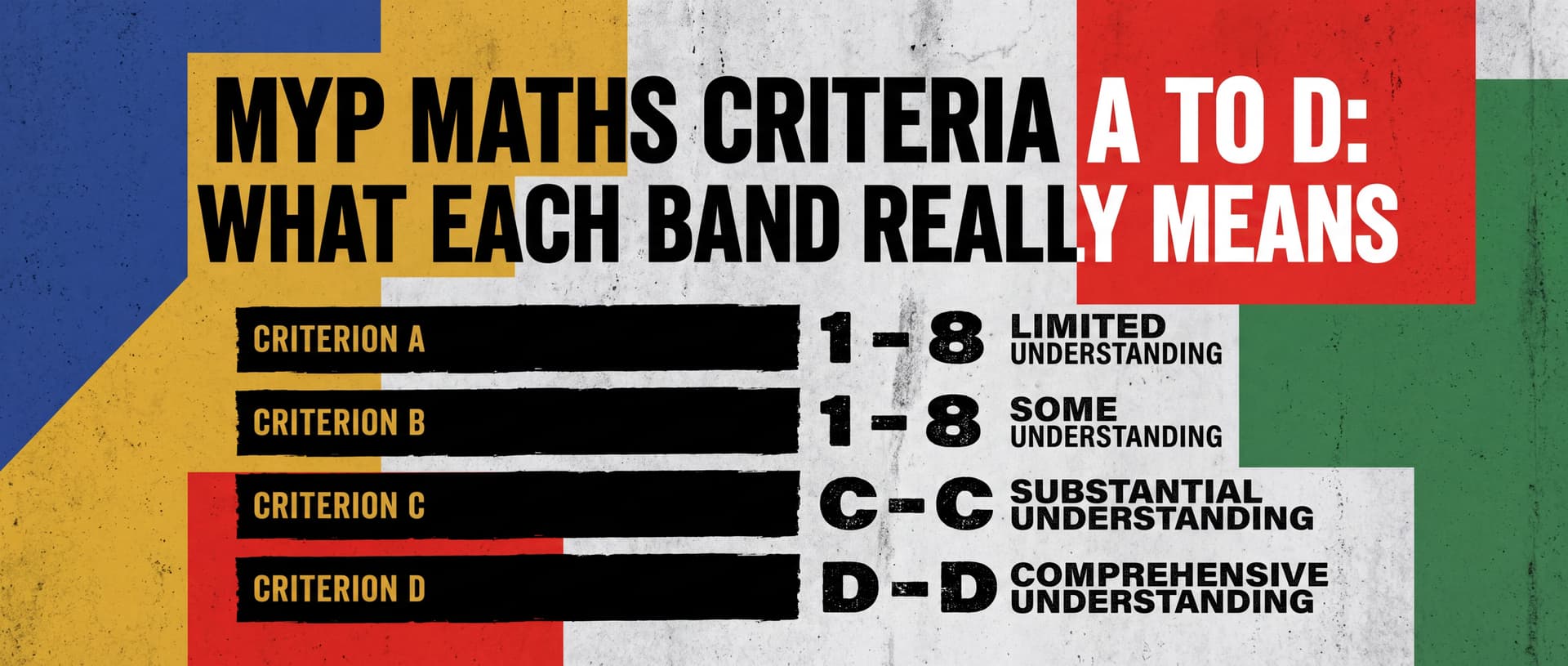
The IB states that the four criteria are equally weighted, with four achievement bands from 1 to 2 through 7 to 8.
This distinction matters because the criterion names are subject specific.
In MYP Sciences, Criterion B is Inquiring and designing, Criterion C is Processing and evaluating, and Criterion D is Reflecting on the impacts of science. Those are not the Mathematics criteria.
If your Mathematics rubric says Criterion B: Inquiring and designing, you are looking at the wrong subject rubric.
Which MYP Mathematics Rubric Should You Use?
Before interpreting any achievement band, check the year level.
The MYP Mathematics guide publishes required assessment criteria for Years 1, 3 and 5. Schools must use the appropriate published criteria when reporting achievement in those years.
The expectations become more sophisticated as students progress.
For example, a Year 1 investigation might ask a student to recognise a pattern and verify it with other examples. By Year 5, Criterion B can require students to select their own techniques, investigate complex patterns, formulate general rules and prove or justify them.
What about MYP Years 2 and 4?
The IB notes that schools often introduce the Year 3 criteria during Year 2 and the Year 5 criteria during Year 4 so students can begin working towards the next published expectations in a developmentally appropriate way.
Your teacher's task specific clarification therefore matters.
Do not assume that a Year 4 student everywhere is being assessed using identical wording. Read the rubric attached to your actual task.
The worked examples below mainly illustrate the Year 5 progression, because it shows the fullest expectations. They are Koncepts examples designed to explain the bands, not official IB exemplars.
Criterion A: Knowing and Understanding
Criterion A asks whether you can select and apply appropriate mathematics to solve problems.
At Year 5, the progression moves broadly from simple familiar problems towards challenging problems in both familiar and unfamiliar situations.
Consider this equation:
3x + 7 = 25
A student could solve it by subtracting 7 and dividing by 3:
3x = 18
x = 6
That shows correct mathematics, but the achievement band depends on the difficulty and context of the task as a whole.
What the Criterion A bands can look like
Band 1 to 2
The student can select suitable mathematics for simple problems in familiar situations and apply it with some success.
For example, after practising linear equations in class, the student solves:
2x + 3 = 11
They recognise the required procedure and reach the correct solution.
Band 3 to 4
The student successfully selects and applies mathematics to more complex familiar problems.
For example, they solve an equation containing brackets and variables on both sides because they recognise it as a type of problem already encountered.
Band 5 to 6
The student handles challenging familiar problems successfully.
A problem may require several connected steps, careful algebra or choosing between mathematical techniques rather than following one obvious procedure.
Band 7 to 8
The student can select and apply appropriate mathematics successfully in challenging familiar and unfamiliar situations.
That last word matters.
If every question is a copy of a worked example, the task may not give you an opportunity to demonstrate the highest level of independent mathematical selection.
Criterion A is therefore not simply:
Did you get the answer right?
It also asks:
Could you determine which mathematics was needed?
Criterion B: Investigating Patterns
Criterion B has one of the most distinctive names in MYP Mathematics:
Investigating patterns.
At Year 5, students are expected to select and apply problem solving techniques to discover complex patterns, describe general rules, and prove or verify and justify those rules.
Consider this sequence:
3, 6, 11, 18, 27, ...
The first differences are:
3, 5, 7, 9
The second differences are constant:
2, 2, 2
That suggests a quadratic sequence.
For a refresher on this method, review the Koncepts notes on quadratic sequences. Quadratic Sequences: MYP 4 Mathematics Notes
What the Criterion B bands can look like
Band 1 to 2
With teacher support, the student identifies a simple pattern and makes a prediction that fits it.
For example:
2, 4, 6, 8
The student predicts the next term is 10.
Band 3 to 4
The student applies a technique independently to a simple pattern and suggests a general rule.
For example:
5, 8, 11, 14
They identify a constant difference of 3 and suggest:
Term = 3n + 2
Band 5 to 6
The student selects a suitable technique for a more complex pattern, develops a general rule and verifies that the rule works.
For the quadratic example above, they might use first and second differences, derive a quadratic rule and test it against several known terms.
Band 7 to 8
The student goes further by proving the rule or verifying it and explaining why the verification is sufficient.
The difference is important.
Testing a formula for one additional value is evidence.
A strong justification explains why the relationship will continue to hold.
The Year 5 guide also contains an important warning: a task that tells students exactly which problem solving technique to use can restrict the opportunity to demonstrate the higher Criterion B bands.
Criterion B rewards investigation, not just completion of instructions.
Criterion C: Communicating
Criterion C is often underestimated.
Students sometimes assume that communication means neat handwriting.
It is much broader than that.
At Year 5, Criterion C includes mathematical language, notation, representations, movement between representations, coherent reasoning and logical organisation.
Consider a probability question involving two events.
A student writes:
0.42
The answer might be correct.
But another student writes:
P(A and B) = P(A) × P(B)
P(A and B) = 0.6 × 0.7
P(A and B) = 0.42
The second response communicates what was calculated and why.
What the Criterion C bands can look like
Band 1 to 2
The student uses limited mathematical language and representations. Their reasoning may be difficult to follow.
They might show disconnected numbers without explaining what each number represents.
Band 3 to 4
The student uses some appropriate mathematical language and suitable representations. The line of reasoning is complete enough to follow and the information has a reasonable structure.
Band 5 to 6
The student usually uses notation and terminology correctly, moves between representations where appropriate, and communicates a complete and coherent solution.
For example, they may move correctly from a table to a graph and then explain the relationship shown.
Band 7 to 8
Mathematical language is consistently appropriate. Representations are used effectively, and the reasoning is complete, coherent and concise. The work has a consistently logical structure.
Concise does not mean short at all costs.
It means the reader can see the mathematical argument without unnecessary confusion.
If you are working with statistical representations, the Koncepts notes on histograms and frequency polygons provide useful examples of correct labels, intervals and graphical conventions. Histograms and Frequency Polygons: MYP 5 Mathematics Notes
Criterion D: Applying Mathematics in Real Life Contexts
Criterion D is Applying mathematics in real life contexts.
It is not Reflecting on the impacts of science. That is the Sciences criterion.
Criterion D asks you to take a real situation and use mathematics to model, solve and evaluate it.
Imagine a school event where a venue charges a fixed fee of ₹4,000 plus ₹250 for every student attending.
You could model the cost as:
C = 4000 + 250n
where n is the number of students.
If 80 students attend:
C = 4000 + 250(80)
C = ₹24,000
But Criterion D does not necessarily end at ₹24,000.
You may also need to discuss whether the model is appropriate, what assumptions it makes and how accurate the resulting answer is.
What the Criterion D bands can look like
Band 1 to 2
The student identifies some relevant information and applies mathematics with limited success.
They may recognise the number of students and the cost per student but fail to build a complete model.
Band 3 to 4
The student identifies relevant elements and applies a mathematical strategy to reach a solution. They begin discussing whether the solution makes sense.
Band 5 to 6
The student selects an adequate model, reaches a valid solution, explains its accuracy and explains whether the answer is reasonable in context.
For the event example, they might recognise that the model assumes the venue really charges the same amount for every additional student.
Band 7 to 8
The student chooses an appropriate model, reaches a correct solution, and justifies both the degree of accuracy and whether the result makes sense in the authentic context.
The word justify separates this from simply writing:
My answer seems reasonable.
A justification gives a mathematical reason.
The Four Bands Are Not Percentages
A Criterion C level of 6 does not mean 75 percent.
A Criterion B level of 4 does not mean 50 percent.
MYP assessment is criterion related. Teachers use descriptors and make a best fit judgment about the evidence in the work. The four bands broadly represent increasing levels of achievement, but they are not percentage ranges.
This is why you should not calculate:
6 ÷ 8 × 100
and call the result your Mathematics percentage.
The number tells you which descriptor best represents the work.
For the wider reporting process, see the Koncepts guide to MYP grading. MYP Grading: Criteria A to D and the 1 to 7 Scale
How to Move From One Band to the Next
Do not revise every criterion in the same way.
For Criterion A, practise deciding which mathematics to use before looking at a worked solution.
For Criterion B, investigate patterns without being told every step. Form a rule, test it, then justify why it works.
For Criterion C, make your reasoning readable. Label graphs, define variables, use notation consistently and remove jumps another reader cannot follow.
For Criterion D, do not stop after obtaining a numerical answer. Return to the context and ask whether the model, accuracy and conclusion are reasonable.
When you receive feedback, compare the wording with the next achievement band.
The most useful question is not:
How do I get two more marks?
Ask:
What evidence appears in the next descriptor that my current work does not yet show?
That gives you something concrete to practise.
How MYP Mathematics Prepares You for DP Maths
These criteria also explain why moving from MYP Mathematics into the Diploma Programme involves more than knowing algebra and geometry.
Criterion A develops mathematical problem solving.
Criterion B develops investigation and generalisation.
Criterion C develops precise mathematical communication.
Criterion D develops modelling and interpretation.
Those habits remain valuable in both Mathematics: Analysis and Approaches and Mathematics: Applications and Interpretation.
If you are still planning your transition, read the Koncepts guide to choosing MYP 4 and 5 subjects. Choosing MYP 4 and 5 Subjects to Keep DP Options Open
For the next decision, compare the two Diploma Programme mathematics pathways in our Math AA and Math AI guide. Math AA or Math AI? Choose Right for University Success
Read the Criterion Before You Start the Task
The easiest mistake in MYP Mathematics is to focus only on the topic.
You see quadratics and revise quadratics.
You see probability and revise probability.
You see statistics and revise statistics.
That is necessary, but it is incomplete.
Before beginning the assessment, check what the task is asking you to demonstrate.
Criterion A: Can I select and use the mathematics?
Criterion B: Can I discover, generalise and justify a pattern?
Criterion C: Can another person follow my mathematical reasoning?
Criterion D: Can I use mathematics in a real situation and judge whether the result makes sense?
The same mathematical topic can produce very different tasks depending on the criterion.
Once you understand that distinction, the rubric stops looking like four letters at the top of a worksheet.
It becomes a guide to what your mathematics needs to show.
Related Blogs
MYP Grading: Criteria A to D and the 1 to 7 Scale
Table of contents
Share
Related reading
- Choosing MYP 4 and 5 Subjects to Keep DP Options OpenExplore how MYP 4 and 5 subject choices connect to DP courses. Check maths pathways, school entry rules and flexible options before choosing your subjects.
- Free MYP Revision Resources That Are Actually UsefulFind free MYP revision resources for Maths, Sciences, English and Individuals and Societies. See what each does well and build a more focused study plan.
- IB Chemistry HL vs SL: What Each Choice Really MeansCompare IB Chemistry HL and SL exam papers, syllabus depth, workload and university prerequisites. Read the facts before deciding which level works for you.
