You have spent weeks researching, collecting evidence and writing your Extended Essay. Your draft is finally ready, and you want your supervisor to tell you exactly what needs fixing.
There is one problem. Your supervisor cannot simply edit your essay until it is perfect.
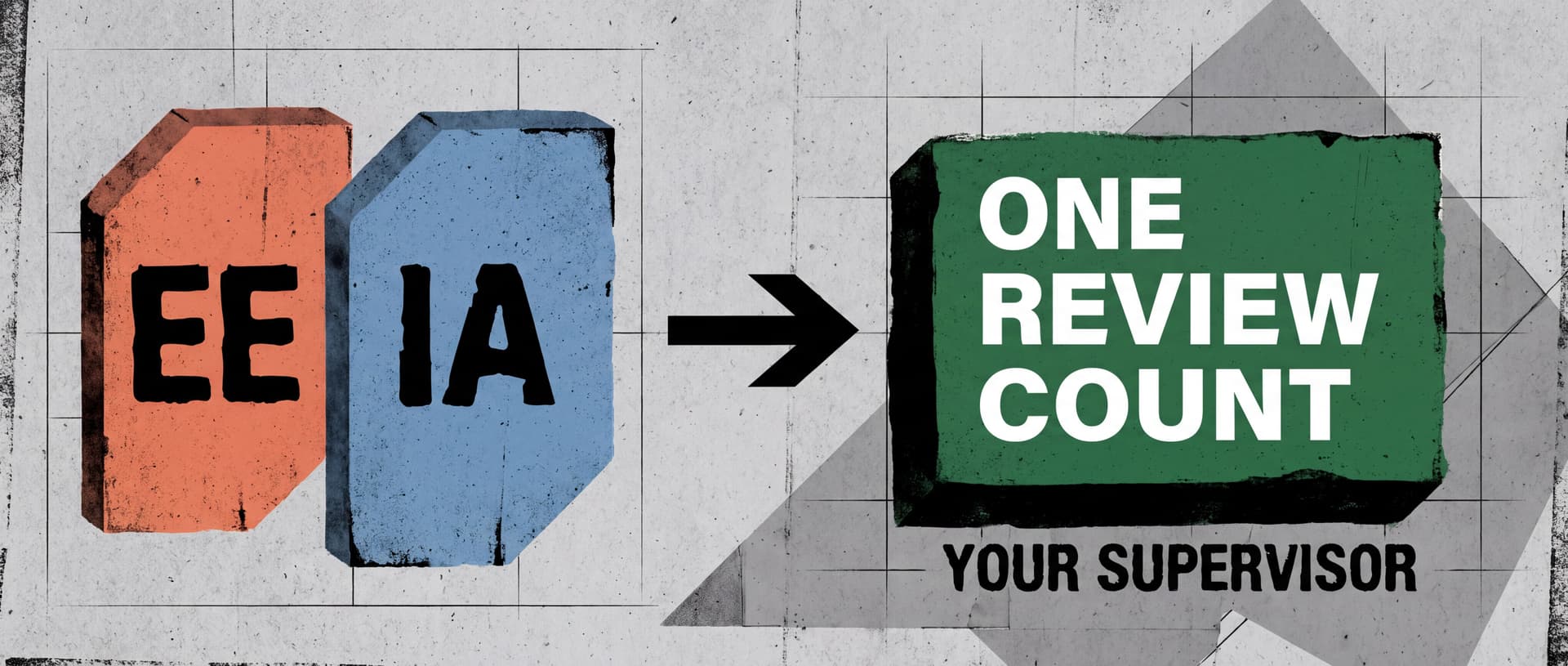
In the International Baccalaureate Diploma Programme, feedback on assessed coursework has clear boundaries. For the Extended Essay (EE), supervisors can comment on one complete draft. Many written Internal Assessments (IAs) follow a similar process, although the precise requirements depend on the subject.
That makes the timing of your feedback request important.
Submit too early, and your supervisor may spend their limited feedback opportunity identifying problems you could have found yourself. Arrive without specific questions, and a potentially valuable meeting can turn into a general conversation about your progress.
The solution is not to ask for more feedback than the rules permit. It is to make better use of the guidance available.
Here is how to work effectively with your EE or IA supervisor, understand the feedback rules and take responsibility for improving your final submission.
What Is Your EE or IA Supervisor Actually Supposed to Do?
An IB supervisor is a guide, not an editor or a second author.
For the Extended Essay, the supervisor helps students understand the research process, develop a focused research question, choose suitable methods and evaluate their progress.
According to the IB Extended Essay guide for first assessment in 2027, supervisors are expected to encourage students throughout their research and writing.
They can help you understand assessment criteria, identify potential methodological problems and consider whether your investigation is manageable.
However, they cannot take responsibility for your academic decisions.
Your supervisor can:
- Discuss whether your research question is focused and feasible.
- Explain relevant assessment requirements and research methods.
- Ask questions that help you identify weaknesses in your reasoning.
- Discuss research challenges and possible approaches.
- Provide permitted feedback on a draft.
- Guide you through required reflection sessions.
Your supervisor cannot:
- Rewrite paragraphs or construct your argument.
- Correct your calculations or research findings for you.
- Proofread your entire submission.
- Produce your analysis or conclusions.
- Repeatedly edit successive drafts until the work reaches a particular standard.
- Guarantee a grade.
These boundaries protect the independence of your coursework.
The IB assesses what you can investigate, analyse and communicate, not how effectively another person can improve your writing.
The One Draft Rule: How Much Feedback Can You Receive?
One of the most misunderstood parts of IB coursework is the distinction between ongoing guidance and formal draft feedback.
One formal feedback round does not mean you are allowed only one conversation with your supervisor.
You can discuss research decisions and seek clarification throughout the permitted supervision process. What is restricted is the extent to which your supervisor can review and improve the assessed work itself.
The rules also differ slightly between the Extended Essay, subject Internal Assessments and the MYP Personal Project.
Extended Essay Feedback Rules
The IB's Extended Essay guidance states that supervisors must:
"read and comment on one draft only of the essay"
This means your supervisor can review one complete EE draft and provide appropriate comments without directly editing it.
The revised Extended Essay framework, first assessed in May 2027, retains this restriction.
The formal draft review takes place after the interim reflection session and before the final reflection session.
Once the supervisor has commented on the full draft, the next version they receive must be the final essay submitted before the viva voce.
Students cannot treat the process as an unlimited series of revisions reviewed by the supervisor.
The earlier EE framework, applicable through November 2026, also restricts supervisors to commenting on one complete draft.
There is an important distinction between the two frameworks concerning reflection. Earlier candidates use the Reflections on Planning and Progress Form (RPPF), while candidates assessed from May 2027 use the Reflection and Progress Form (RPF), with one final reflective statement.
Always confirm which assessment guide applies to your examination session.
Internal Assessment Feedback Rules
Many written DP Internal Assessments also allow teachers to review and comment on one draft.
For instance, the IB Business Management IA guidance describes a process in which teachers provide oral or written advice on one draft without editing it.
The next submitted version must be the final version.
However, not every IA follows an identical feedback procedure.
The Diploma Programme includes written investigations, mathematical explorations, oral assessments and other subject specific tasks. Their assessment arrangements are not interchangeable.
Before submitting your draft, ask your teacher which subject guide applies and how the formal feedback process will work.
Do not assume that an arrangement permitted in one subject automatically applies to another.
MYP Personal Project Feedback Rules
The MYP Personal Project has a particularly explicit restriction on formal report feedback.
The IB Personal Project guide states that supervisors must provide only one round of formal feedback on candidates' project reports.
It also explains that appropriate guidance should be general rather than extensive annotation, detailed editing or prolonged critique.
Students should still receive formative guidance during the project process, including regular supervision meetings.
However, once the final project materials have been submitted for school assessment, they cannot normally be withdrawn and rewritten.
The practical lesson is consistent across these coursework components: use early meetings to solve planning problems and reserve your formal draft feedback for work that is sufficiently developed.
Why Students Waste Their Formal Feedback Opportunity
The biggest problem is often not the quality of feedback. It is the quality of the draft submitted for review.
A supervisor cannot provide meaningful feedback on an argument that has not yet been developed.
If your EE contains an introduction, some background research and an unfinished analysis, the most obvious feedback will concern missing material.
That may be useful, but it leaves less opportunity to discuss deeper questions about evidence, interpretation and evaluation.
In its guide to refining an Extended Essay draft, Lanterna Education recommends presenting a detailed draft so that the supervisor can respond meaningfully to its ideas, arguments and structure.
This does not mean your draft must be perfect.
It means you should complete the work you are capable of completing independently before requesting the formal review.
A complete but imperfect argument gives your supervisor something substantial to examine.
An unfinished argument may only reveal that more writing is required.
How to Prepare Before Your Supervisor Meeting
Treat each supervision meeting as a research discussion rather than a request for approval.
Before the meeting, identify what you have completed, what remains uncertain and which decisions require guidance.
A useful preparation process has four parts.
1. Review the assessment criteria
Read the criteria that apply to your assessment session.
Identify where your work provides convincing evidence of the required skills and where the connection is less clear.
For the EE, pay particular attention to the relationship between your research question, methods, analysis and conclusion.
2. Identify your most important uncertainty
Avoid arriving with a broad request to check everything.
Decide whether your main concern involves the research question, quality of evidence, methodology, structure or evaluation.
Choose the issue that could most significantly affect the work.
3. Prepare specific questions
Write down a few questions before the meeting. Prioritise those that require the supervisor's expertise rather than answers already available in the subject guide.
4. Share materials according to school procedures
If your supervisor requests an outline, draft or research notes in advance, submit them within the agreed deadline.
This allows the meeting to focus on discussion rather than introducing the entire project from the beginning.
Five Questions Worth Asking Your EE Supervisor
Good questions help your supervisor guide your thinking without writing your essay.
The following prompts are practical suggestions, not prescribed IB meeting questions.
Is my research question still focused enough for the investigation I have completed?
A question that initially seemed manageable may become too broad once research begins. Discussing its scope can help you decide whether refinement is necessary.
Does my chosen research method appropriately address my research question?
This shifts attention from the quantity of research collected to the suitability of your approach.
Where does my explanation become difficult to follow?
Clarity matters because readers must understand how evidence supports your argument. Your supervisor can identify a concern without rewriting the explanation.
Am I evaluating the evidence or mainly describing it?
Descriptive writing presents information. Analytical writing explains its significance, while evaluation considers strengths, limitations and implications.
What should I prioritise when revising independently?
This helps turn a broad discussion into a manageable revision plan.
The important distinction is that these questions invite guidance. They do not ask your supervisor to supply the missing argument, analysis or answer.
What to Do After Receiving Feedback
Receiving supervisor comments is only the beginning of revision.
Your responsibility is to interpret the comments, decide what needs changing and make those changes independently.
Start by reading all the feedback before editing individual sentences.
Then organise your revision priorities into three categories.
Research and reasoning: Problems involving the research question, method, evidence, interpretation or conclusions.
Structure and communication: Problems involving the sequence of ideas, coherence and clarity.
Presentation and referencing: Issues involving citations, formatting and subject requirements.
Address the most consequential problems first.
There is little value in polishing every sentence if your argument still fails to answer the research question.
The RevisionDojo guide to Extended Essay feedback similarly recommends prioritising research focus and analysis before presentation improvements.
Keep a brief record of important revisions and the reasoning behind them. This can also help you reflect accurately on your research process.
Remember that supervisor feedback is guidance, not a replacement for independent judgement. You remain responsible for deciding how to respond.
How to Handle an Unresponsive EE or IA Supervisor
Sometimes students prepare carefully but struggle to arrange meetings or receive feedback.
The first step is to communicate clearly and professionally.
Send a concise message explaining what you need, which coursework stage you have reached and any relevant school deadline.
If you have not received a response, follow up through the school's established communication channel.
Avoid sending repeated messages without allowing reasonable time for a response.
If the problem continues, contact the appropriate coordinator.
For an Extended Essay, this will usually be the EE coordinator or DP coordinator. For a subject IA, it may be your subject teacher's department leader or DP coordinator.
Explain the situation factually, including the relevant deadlines and attempts to arrange guidance.
The aim is not to complain about the supervisor. It is to ensure that the school's required supervision and assessment procedures can take place.
Meanwhile, continue the independent work that does not require formal feedback.
Do not let unanswered messages become a reason to stop researching, checking sources or improving your understanding of the criteria.
Can You Use External Tutors or AI Instead?
External learning resources can be useful, but they cannot replace the formal role of an IB supervisor.
A tutor, study platform or AI assistant may help you understand subject concepts, develop research skills or practise academic reasoning within the assistance permitted by your school and the IB.
They should not become unacknowledged contributors to assessed coursework.
For the Extended Essay, the IB places strict boundaries on assistance with research, writing and proofreading beyond permitted supervision. Consult the applicable guide and your school's academic integrity policy before using external assistance on an assessed draft.
At Koncepts, students can study DP subjects, practise exam questions and strengthen their understanding through guided learning.
These tools can support the subject knowledge and academic skills students need for independent coursework.
They do not replace the EE supervisor's required draft review, authenticate student work or provide an alternative route around IB feedback restrictions.
Your final research, analysis and writing must remain your own.
The Viva Voce Is Not Another Editing Meeting
For Extended Essay students, the final supervisor meeting is the viva voce.
It is a reflection and authentication conversation, not another opportunity to revise the submitted essay.
The supervisor uses this discussion to understand the student's research experience, decisions and ownership of the work.
Students should be prepared to explain what they investigated, the challenges they encountered and how their thinking developed.
Under the revised framework first assessed in 2027, students complete their final reflective statement on the RPF after the viva voce.
You can explore this process further in the Koncepts guide to EE reflection and Criterion E for 2027.
Preparing thoughtfully for the viva voce is important, but it should not be confused with preparing another draft for feedback.
Make Every Supervisor Conversation Count
The most effective supervisor relationship is not built around repeatedly asking whether an essay is good enough.
It is built around informed questions, realistic planning and independent decisions.
Use early meetings to establish a focused research direction. Use ongoing guidance to address genuine obstacles. Submit a sufficiently complete draft when the formal feedback opportunity arrives.
Then take responsibility for the revisions.
The one draft rule is not intended to leave students unsupported. It establishes a boundary between teaching someone how to conduct independent research and completing that research for them.
When you understand that difference, supervision becomes more productive.
You stop waiting for someone to correct your coursework and begin using their guidance to make better academic decisions yourself.
Related Blogs
Continue developing your IB coursework skills with these Koncepts guides:
IB Extended Essay Structure: Where the Marks Come From
Understand how to organise your argument, evidence and evaluation using the assessment criteria relevant to your examination session.
Your EE Research Question Can Make or Break the Essay
Learn how to develop a focused, researchable question before investing time in a full draft.
Extended Essay Reflection: A Guide to the 2027 RPF
Understand the revised reflection requirements and how to prepare for meaningful supervisor conversations.
Stop Chasing IA Deadlines: A Two Year Plan That Works
Explore a structured approach to managing IA milestones, draft reviews and final submissions across the Diploma Programme.
Table of contents
Share
Related reading
- IB Extended Essay Structure: Where the Marks Come FromLearn how to structure your IB Extended Essay, connect each section to the right criteria and follow the word count rules for your assessment session.
- Citing ChatGPT in IB Coursework: Where to Draw the LineLearn how to cite ChatGPT in IB coursework, compare MLA, APA, Harvard and Chicago formats, and understand where useful AI support becomes outsourced work.
- IB Timed Practice: Make Every Minute Count in ExamsMake IB timed practice work. Learn how to set question limits, simulate exam conditions, self-mark accurately and turn mistakes into a stronger final paper.
