Your DP1 biology test went well, your mathematics mock was disappointing, and your English assignments have steadily improved. Which of these results will your teachers use when predicting your final IB grades? Is the prediction an average, a mock exam grade, or an estimate of what you might achieve by graduation?
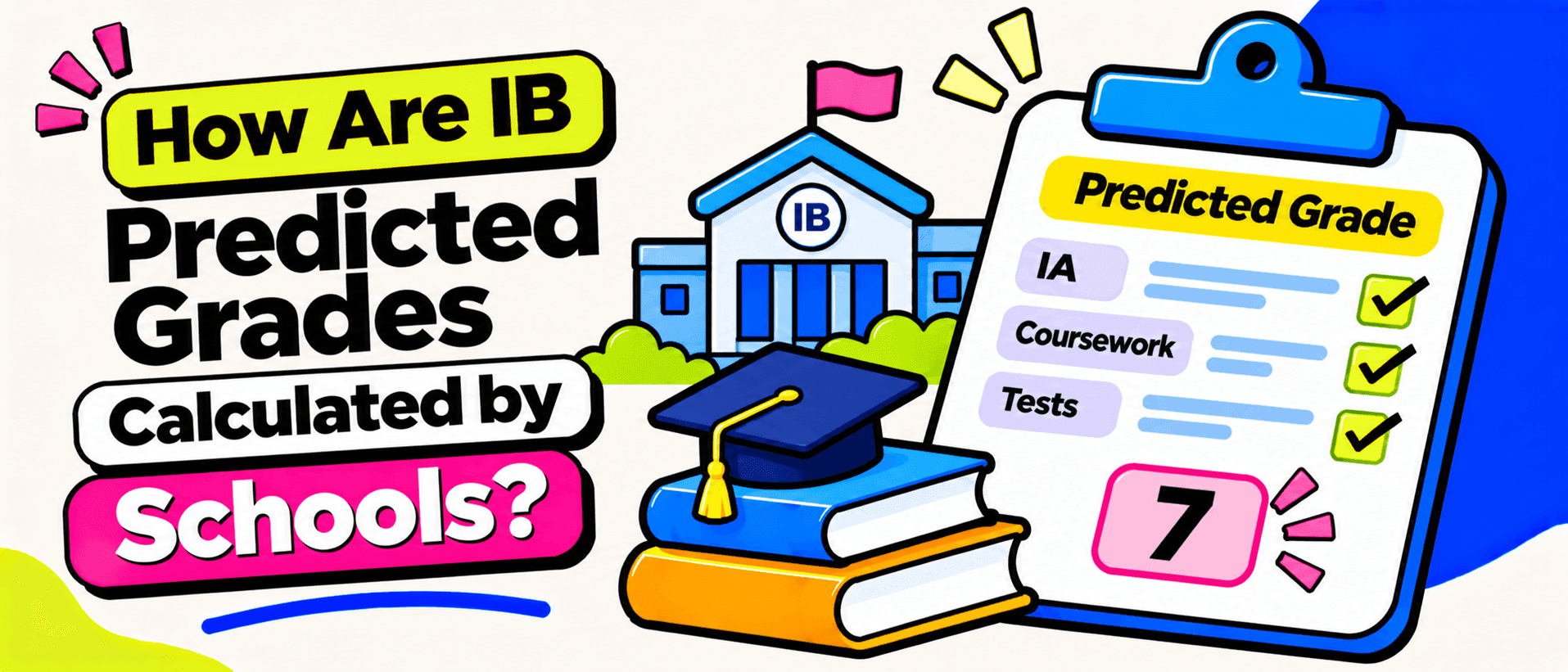
The answer depends partly on your school. IB predicted grades are evidence-based teacher judgments, not scores generated by one universal IB formula. Schools can use mock exams, classroom assessments, coursework and other indicators, but their weighting and review procedures differ.
The uncertainty is reflected in an October 2026 r/IBO discussion, where DP1 students described very different practices. Understanding those differences can help you direct your effort toward better evidence of learning instead of guessing which assignment matters most.
What Is an IB Predicted Grade?
The IB's student assessment guidance defines a predicted grade as a teacher's judgment of the subject grade a candidate is expected to achieve, based on evidence of their work and knowledge of IB standards. Each Diploma Programme subject is graded on the 1 to 7 scale, with 7 the highest.
A predicted grade is not an awarded result. Final grades depend on assessment components such as external examinations and internally assessed work according to each subject's rules. The IB explains this distinction in its Diploma Programme assessment overview.
Teachers also provide predictions for Theory of Knowledge (TOK) and the Extended Essay (EE). Together, actual TOK and EE results can contribute up to three additional diploma points. CAS is compulsory but does not contribute points. An estimate out of 42 may refer only to six subjects, while a prediction out of 45 includes an anticipated core-points contribution. Ask what your school's reported total includes.
Is There One Official Formula for Predicted Grades?
No IB-wide rule says that mock exams count 50%, assignments count 30%, and internal assessments count 20%. The IB sets assessment standards, while schools decide how to assemble sufficient evidence for a credible prediction. The IB also expects teachers to avoid systematically predicting too high or too low.
The IB assessment FAQ notes that grade descriptors help teachers judge work and make predictions. These descriptors matter because a raw percentage from a classroom test cannot automatically be converted into an IB 1 to 7 grade using one universal boundary.
Some schools use numerical weighting systems as part of their process. Others rely more heavily on moderated teacher judgment, especially where a test assesses only part of a course. Neither approach should be described as the IB's required calculation.
Which Assessments Might Your School Consider?
| Evidence | What it can show | Important limitation |
|---|---|---|
| Mock examinations | Performance under timed, exam-style conditions | One day may not represent your usual level |
| Summative tests | Understanding of taught units and application of concepts | Different tests cover different amounts of the syllabus |
| Formative work and assignments | Progress, misconceptions and consistency | Not every practice task is intended for grading |
| Internal assessment work | Subject-specific investigation, performance or analysis skills | Draft feedback is not an externally moderated final mark |
| Class participation and feedback | How students engage with ideas and respond to guidance | Participation alone is not proof of an examination grade |
| Recent progress | Whether newer evidence suggests developing mastery | Improvement still needs credible assessment evidence |
A school may place substantial emphasis on cumulative mocks because they sample many topics under controlled conditions. Another may use several standardized in-school tests rather than one major mock. For subjects with oral, practical, portfolio or written coursework components, the relevant evidence will differ.
The aim should be to predict the grade a student is likely to achieve against the assessment standards, not to reward perfect homework submission or classroom confidence in isolation.
Worked Example: How a School Might Weigh Results
Imagine a fictional student whose school has published the following internal evidence model for one subject. It is illustrative only, not an IB formula or a recommendation that schools use these weights.
| Evidence category | Example score | Hypothetical weight |
|---|---|---|
| Cumulative mock examination | 74% | 60% |
| Selected classroom assessments | 70% | 25% |
| Coursework progress measure | 80% | 15% |
The hypothetical combined percentage is (74 × 0.60) + (70 × 0.25) + (80 × 0.15) = 73.9%.
That number is an internal summary, not an official IB predicted grade. A teacher would still need to consider whether assessments matched IB difficulty and coverage, how the subject components are weighted, and what performance the student's work demonstrates against relevant standards. The figure does not automatically mean a 5, 6 or 7.
A student improving from earlier weaker tests might receive a different evidence-based prediction from another student with the same simple average but a declining trend. The school's policy should explain how it handles those cases.
Do DP1 Grades Matter More Than DP2 Grades?
There is no universal DP1-to-DP2 weighting rule. The answer depends on when the prediction is prepared and how much relevant evidence is available.
Early university predictions may draw heavily on DP1 examinations, assessments and teacher observations because the student has completed little DP2 work. Later predictions may incorporate new mocks, stronger coursework and sustained improvement. A school's deadline for university applications can determine when its evidence review closes.
If you earn a lower mark on one test, do not assume it permanently fixes your prediction. Equally, do not assume one later high score must erase months of weaker work. Ask your teacher which future assessments are included and how the school treats evidence of improvement.
University Predicted Grades vs Grades Submitted to the IB
The phrase predicted grade can refer to two related but distinct administrative purposes.
University application predictions help admissions teams assess applicants before final results exist. For applications through UCAS, the official predicted-grade guidance asks schools to make predictions achievable, objective, evidence-based and informed by professional judgment. They are generally finalized when the application is submitted. Universities can use them differently, and a predicted grade does not guarantee an offer.
Predictions submitted to the IB are teachers' expectations for registered examination candidates, including subject and relevant core predictions. The IB asks schools to predict accurately and reviews patterns of overprediction or underprediction. These predictions are not a replacement for the normal assessment of examination and coursework performance.
Because the two processes can occur at different times, the values need not always be identical. Ask your coordinator which prediction you are discussing, when it is finalized and whether school policy permits a revision.
How Can You Improve a Predicted Grade?
Start by identifying the specific evidence gap. If you consistently lose marks on evaluation in Economics, another set of memorized definitions will not demonstrate the improvement your teacher needs to see. If time management lowers your mathematics mock result, practise full timed sections and review the steps where accuracy breaks down.
Bring corrected work, recent assessments and a realistic study plan to a conversation with your subject teacher. Ask what performance at the next assessment would provide credible evidence of a higher grade. A focused request for feedback is more constructive than asking for a particular number without new evidence.
Improvement should be genuine and sustained. Teachers need to predict future achievement responsibly, and university applications should not be built around grades that available work cannot justify.
Questions to Ask Your IB Coordinator
Your school's written prediction policy is the most useful starting point. Clarify which assessments count, whether categories have fixed weights, which exam-style components are included, and how teachers review unusual results or an upward trend.
Also ask when university predictions are finalized, whether students can see or discuss them, what review process exists for factual errors, and whether the published total includes predicted TOK and EE points. School policies on disclosure and updates vary; a student should not assume there is an automatic appeal or a right to a higher prediction.
For UK applications, UCAS explains that students do not see the referee's predicted grades directly in the application system. Schools may communicate them separately according to their procedures.
Common Predicted-Grade Misconceptions
"My mock was a 6, so my prediction must be a 6." A mock can be important evidence, but teachers may consider other performance and how closely the mock matches IB assessment standards.
"Every school calculates predictions the same way." Schools vary in internal weighting, timing and review, even while using the same underlying IB grades and standards.
"My predicted 40 guarantees a final 40." Predictions estimate future results. Actual subject and core grades are awarded through the IB assessment process.
"I can raise my prediction simply by requesting it." A review may correct mistakes or consider new evidence, but a higher prediction needs defensible academic support.
Final Thoughts
How are IB predicted grades calculated? Teachers weigh available evidence against IB standards using their school's established process. Mocks, summative assessments, assignments, coursework and recent progress may all contribute, but there is no universal percentage formula.
For students, the most useful next step is to understand the local policy, identify the evidence your teachers value and demonstrate consistent improvement. A predicted grade is an informed estimate of achievement, not a permanent label or a substitute for your final examination results.
Table of contents
Share
Related reading
- IB Predicted Grades: How Teachers Actually Decide YoursLearn how IB predicted grades are decided, what evidence teachers use, when predictions are set, and how universities read them before final results today.
- IB Predicted Grades vs Conditional Offers: What Counts?Predicted 42 but your university asks for 36? Learn how IB conditional offers work, what final grades you must achieve, and how to plan your UK applications.
- UCAS Personal Statement 2027: 3 Questions for IB StudentsPlan your UCAS personal statement for 2027 with three questions, a 4,000-character limit and IB examples using HL subjects, EE and CAS. Get started today.
- IB EE 2027 Rubric: New Criteria and Marks ExplainedUnderstand the IB EE 2027 rubric, compare all five new assessment criteria with the old model, and learn how to improve your essay using practical checklists.
- IB Mock Exams: What They Predict and What They Don'tDo IB mock exams affect predicted grades? Discover what scores reveal, when a weak result matters, and how to turn feedback into stronger exam practice.
- Inside the MYP eAssessment: Tasks, Timing and MarksDiscover what an MYP eAssessment exam looks like, how tasks and timings work, and why exam marks differ from classroom levels. Read our clear student guide.
- 7 AI Tools IB DP Teachers Can Actually Use in Class Compare the best AI tools for IB DP teachers, from Koncepts and Toddle to Brisk and Diffit, and choose the right tool for planning, feedback, and assessment.
- MYP to DP: What Really Changes in Your First IB YearMoving from MYP to DP? Discover how assessment, command terms and workload change, then build a realistic first term plan to start IB DP1 with confidence.