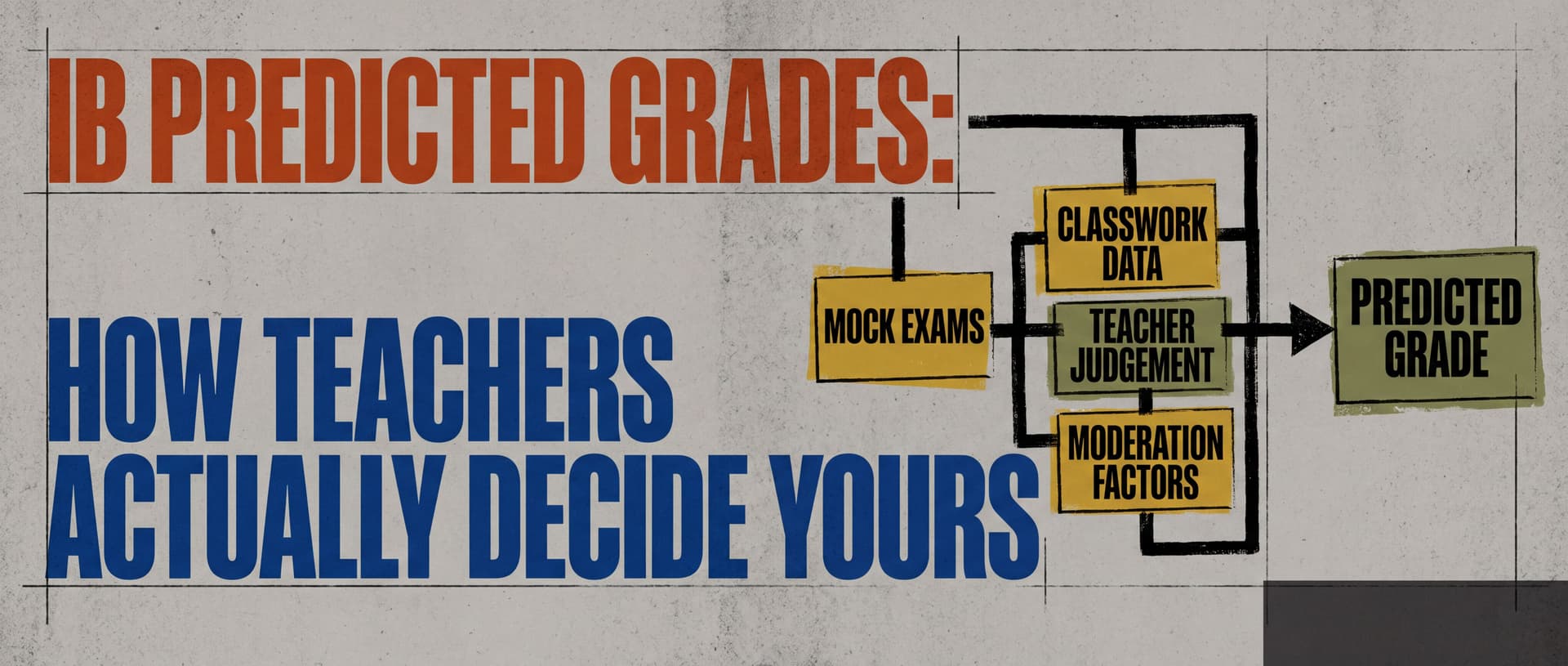
An IB predicted grade can feel unusually powerful for a number awarded before the final examinations have happened.
It may appear on a university application, shape the courses a student considers realistic and contribute to a conditional offer. Yet students are often unclear about where the number comes from.
Is it your latest mock result? Your Internal Assessment? Your average across DP1? Your teacher's view of your potential?
There is no single universal calculation used by every IB school.
The IB defines a predicted grade as a teacher's estimate of the grade a candidate is expected to achieve, based on evidence of the student's work and knowledge of IB standards. Its guidance specifically refers to “all the evidence of the candidate’s work”.
That gives schools a common principle, not one compulsory formula.
A Predicted Grade Is a Forecast, Not an Average
Suppose your recent Mathematics AA HL results are 5, 6, 5, 6 and 6.
The arithmetic average does not automatically become your predicted grade.
A teacher is trying to answer a different question:
Based on the evidence available now, what grade is this student expected to achieve by the end of the course?
A timed mock may show whether you can apply knowledge independently under pressure. An Internal Assessment may show a different part of the subject. Class tests can reveal whether your understanding is consistent across topics. More recent work can show whether an earlier weakness has genuinely improved.
The IB also provides schools with a Predicted Grades Analysis Tool using historical predicted and final grades to help improve prediction accuracy.
Your school may also have its own written policy about which evidence it uses and when.
What Teachers Commonly Look At
Because school practice varies, no responsible guide can say that mocks count for a fixed percentage everywhere.
A common evidence pattern looks like this:
| Evidence | What it can show |
|---|---|
| Topic tests and essays | Knowledge, application and subject skills |
| Mock examinations | Performance under timed exam conditions |
| Internal Assessment work | Performance on an assessed course component |
| Practical, oral or classroom tasks | Subject specific skills demonstrated over time |
| Performance across the course | Whether improvement or decline is sustained |
| Teacher knowledge of IB standards | Whether the work resembles the expected standard for a 4, 5, 6 or 7 |
Lanterna's current guidance for DP families identifies mock examinations as an important indicator and advises families to look at patterns of progress and teacher feedback rather than one isolated number.
The important word is pattern.
Teachers need enough evidence to believe that a level can be reproduced.
Does One Mock Decide Your Predicted Grade?
Not as an IB wide rule.
A school may give mocks considerable importance because they resemble final examination conditions. But the IB definition asks teachers to use all available evidence.
Our guide to IB DP mock exam planning makes the same distinction. A mock can reveal content gaps, timing problems, command term errors and examination technique. It should not automatically erase every other piece of evidence.
One poor mock does not necessarily force a lower prediction after months of stronger work.
Equally, one exceptional mock does not automatically prove that a higher level is now secure.
The teacher has to judge what best represents the student's expected final performance.
When Are Predicted Grades Decided?
There is no single date used by every IB school.
The timing depends on the school, examination session and university application system.
A common pattern is that teachers begin forming strong indications during DP1, particularly after substantial assessments or end of year mocks. University facing predictions are often finalised in DP2 before relevant application deadlines. Lanterna describes informal indications emerging around the end of DP1, with formal predictions becoming more important in DP2.
Students should also distinguish predictions used for university applications from predicted grades schools submit to the IB.
The IB requires predicted grades for Diploma Programme subjects and also for Theory of Knowledge and the Extended Essay.
Your university application may require a prediction earlier. Ask your school for its actual calendar.
Can Your Predicted Grade Change?
It can, depending on your school's process and whether the prediction has already been finalised or submitted.
The useful question is what evidence would justify the change.
If you are predicted a 5 but believe a 6 is realistic, saying “I need a 6 for university” explains why the number matters. It does not show that your current work supports a 6.
A better conversation is:
- Which parts of my recent work are keeping the prediction at a 5?
- What would grade 6 evidence look like in this subject?
- Is there still assessment evidence available before the prediction deadline?
- Does the school have a formal review process?
This keeps the discussion focused on academic evidence rather than negotiation.
What Can You Legitimately Do to Improve It?
You cannot guarantee yourself a higher prediction.
You can improve the evidence your teacher has available.
Start by identifying why marks are being lost. A student struggling with evaluation needs a different plan from one who knows the content but repeatedly runs out of time.
Then demonstrate improvement in conditions that matter:
- Complete timed questions without notes.
- Use teacher feedback to correct recurring weaknesses.
- Practise with appropriate markschemes.
- Meet Internal Assessment milestones with your own strongest work.
- Repair weak topics instead of revising only comfortable ones.
- Show that improvement repeatedly, not just once.
The aim is not to impress a teacher for one week. It is to establish a stronger academic pattern.
RevisionDojo's 2026 results analysis makes a useful distinction. It reports changes in students' self reported predicted grades but explicitly says it does not yet have a robust matched dataset showing whether those predictions matched final IB results.
A higher prediction is useful only if the performance behind it is becoming stronger too.
What Does Not Automatically Raise a Prediction?
Effort matters for learning, but effort by itself is not an IB subject grade.
Neither are attendance, politeness, an ambitious university target or the number of hours spent revising.
Those things may help you perform better. The prediction itself is meant to estimate academic achievement against IB standards.
The same applies to tutors, revision platforms and AI tools.
Koncepts can help you review course content, practise exam style questions and work with markschemes through the DP study platform. It does not issue your official school predicted grade.
Use study tools to strengthen your evidence. Do not treat an external score estimate as the prediction your school is authorised to submit.
How Universities Read Predicted Grades
Universities do not all use predictions in the same way.
In the UK application system, UCAS defines a predicted grade as the grade a school or college believes an applicant is likely to achieve in positive circumstances. UCAS says universities use predicted grades with other information to understand an applicant's potential, and that different institutions use them differently.
A prediction may help a university decide whether:
- your academic profile is competitive,
- you meet an expected subject level,
- you should receive an interview or offer,
- a conditional offer should require particular final grades.
Other admissions systems may place greater weight on transcripts, entrance tests, essays, interviews or already achieved results.
Do not assume that a predicted total of 40 has the same significance at every university. Read the admissions rules for the specific course.
Why Predicted and Final Grades Differ
A prediction is made before all final evidence exists.
A student may improve substantially after predictions are submitted. Another may underperform in the final examination. Internal Assessment marks can be moderated, and the final assessment process can produce a different result from the school's earlier estimate.
For the wider distinction, read IB Predicted Grades vs Final Results: What Actually Gets You In.
RevisionDojo similarly warns that movement in predicted grades is not proof that the later final result will be identical.
A prediction should be accurate.
It is not a promise.
What If Your Final Result Is Lower?
First identify what the final grade changes. Does it affect a university condition, one required Higher Level subject or your overall Diploma outcome?
Then speak with your coordinator about the routes available in your examination session.
A lower result does not automatically mean the original prediction was unreasonable. Predictions are estimates made from earlier evidence.
If a review or retake may be relevant, read IB Results: Remarks, Retakes and Enquiry Upon Results and discuss the decision with your coordinator before acting.
The Best Question to Ask Your Teacher
Do not begin with:
“What do I need to do to get predicted a 7?”
Begin with:
“What evidence in my current work shows I am not yet consistently at a 7?”
The first question focuses on obtaining the number.
The second focuses on becoming the student whose work supports the number.
That is the part of predicted grades you can control.
Use mocks, assessments and teacher feedback to identify the next weakness to fix. Then use resources such as Koncepts DP to practise it deliberately.
A predicted grade matters during the application process.
The performance behind it matters all the way to the final examination.
Related Blogs
Table of contents
Share
Related reading
- IB Mock Exams: What They Predict and What They Don'tDo IB mock exams affect predicted grades? Discover what scores reveal, when a weak result matters, and how to turn feedback into stronger exam practice.
- IB in India: What Universities and CUET Really RequireApplying to Indian universities with the IB Diploma? Read our guide to CUET, recognition, percentage conversion and subject choices to plan your next steps.
- 7 AI Tools IB DP Teachers Can Actually Use in Class Compare the best AI tools for IB DP teachers, from Koncepts and Toddle to Brisk and Diffit, and choose the right tool for planning, feedback, and assessment.
