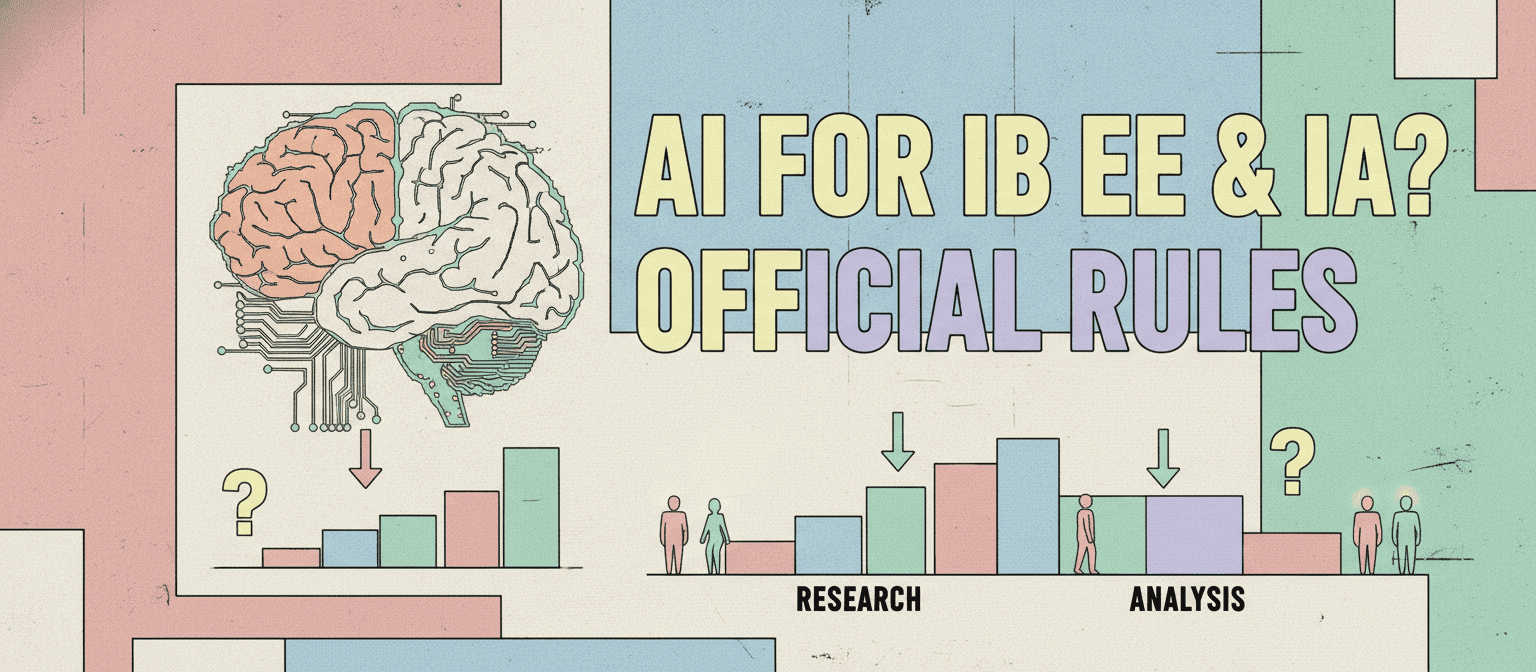
Can you use ChatGPT to brainstorm an Extended Essay research question? What about checking the grammar in your Biology IA or asking an AI tool to explain a statistical test?
The International Baccalaureate does not prohibit artificial intelligence tools outright. However, using AI responsibly and submitting AI generated material as your own work are fundamentally different things.
Confusion about this distinction has led to anxiety around AI detection scores, school investigations and academic misconduct. In a December 2025 r/IBO discussion, a student reported that their Extended Essay had been flagged as 78% AI despite claiming to have written it independently. That account describes a student's experience, not an official IB ruling.
Understanding the actual policy is more useful than guessing what detection software might flag. This guide explains what the IB permits, what requires attribution and how students can demonstrate authentic research.
What Is the Official IB AI Policy for IA and EE Work?
The IB's position is clear: AI tools are not banned, but academic integrity requirements still apply.
In its official statement on artificial intelligence in assessment, updated on 19 February 2026, the IB explains that students should learn to use AI ethically rather than avoid the technology entirely.
However, AI generated work, even when used only in part, is not automatically considered the student's original work. If generated text, images, graphs or other material are incorporated into an assessment, their origin must be acknowledged.
The distinction is between using AI to support learning and using AI to replace the work being assessed.
The IB Academic Integrity policy, particularly Appendix 6, provides more detailed guidance on attribution, authentication and appropriate assistance.
What AI Assistance Is Acceptable in IB Coursework?
Different uses of AI create different academic integrity considerations.
| AI activity | Practical guidance |
|---|---|
| Brainstorming possible EE topics | Generally suitable for exploring ideas, subject to school rules |
| Explaining an unfamiliar concept | Useful for learning, but verify explanations independently |
| Suggesting academic search terms | Appropriate research assistance when sources are checked |
| Identifying possible weaknesses in an argument | Potentially useful feedback, provided the student makes the decisions |
| Basic spelling and grammar checking | Generally acceptable when language accuracy is not itself being assessed |
| Rewriting entire IA paragraphs | High risk because the resulting language may no longer represent the student's own work |
| Generating analysis or conclusions | Must not be presented as independently produced student work |
| Creating graphs or images for submission | Requires attribution and compliance with subject requirements |
| Writing a complete EE or IA | Not acceptable to submit as the student's own work |
This table is practical interpretation, not an official IB approval list. Individual schools may impose additional requirements, and subject specific assessment rules still apply.
Importantly, citing AI generated material does not automatically make its use academically appropriate. The student must still demonstrate the understanding and independent work assessed by the relevant rubric.
Can You Use ChatGPT for Your Extended Essay?
Yes, AI can support parts of the research process without becoming the author of the essay.
The Extended Essay guide for first assessment in 2027 discusses permissible AI assistance within ethical research. It recognises that AI may help students explore information or compare research materials, provided generated information is verified and appropriately acknowledged.
For example, a History EE student investigating a diplomatic event might ask ChatGPT to suggest competing historical interpretations worth researching.
The student should then locate credible historical scholarship, evaluate those interpretations and develop an independent argument.
The problem arises when the student asks the tool to write the analysis and subsequently presents that analysis as original work.
The 2027 EE guide emphasises authentic authorship and the student's responsibility for proofreading, research accuracy and source acknowledgement.
Students should also follow the supervision and reflection requirements applicable to their assessment session. AI cannot substitute for genuine research decisions or personal reflection.
Can AI Help With an IB Internal Assessment?
The same principles apply to Internal Assessments, although acceptable assistance depends partly on the subject and task.
Consider a Biology IA investigating the relationship between temperature and enzyme activity.
A student could use AI to review the differences between correlation, regression and comparison of means. They might ask what assumptions should be examined before selecting a statistical test.
However, the student must understand the method, justify its selection, process the actual data accurately and interpret the findings independently.
Similarly, a Business Management IA student could ask AI to explain SWOT analysis or investment appraisal. The student must still select appropriate evidence, perform the analysis and reach a supported business judgement.
AI should not invent observations, experimental trials, interview responses, financial figures or references.
The crucial question is whether the work demonstrates the student's understanding and decisions rather than simply reproducing an AI response.
How to Cite ChatGPT in an Extended Essay or IA
The IB requires attribution when students incorporate AI generated text or other generated material into assessed work.
Appendix 6 of the Academic Integrity policy explains that AI material must be identified in the body of the work and referenced in the bibliography.
A reference should identify the tool, the relevant prompt and the date of generation, following the referencing conventions required by the school.
For example, suppose a student includes a short explanation generated by ChatGPT.
Illustrative in-text acknowledgement:
"Example explanation reproduced from ChatGPT" (OpenAI, [date of generation]).
Illustrative bibliography entry:
OpenAI. ([Date of generation]). ChatGPT response to the prompt: "[Insert the actual prompt used]." AI generated response.
These examples are placeholders, not a mandatory universal citation style. Use the exact prompt, date, material and format applicable to your work.
Paraphrasing generated content does not remove the attribution requirement. Neither does modifying an AI generated image.
When AI has only been used for preliminary brainstorming and no generated material is incorporated into the assessment, the general IB rule does not automatically require citation of an unused response. However, your school may require an AI use declaration covering research assistance.
Ask your supervisor which disclosure procedure applies.
Is AI Editing or Grammar Correction Allowed?
Basic proofreading and substantial rewriting are not equivalent.
The IB permits basic spelling and grammar support when those language skills are not the subject of assessment. Students should still check corrections for accuracy and preserve their original meaning.
For example, correcting a spelling error is different from asking ChatGPT to rewrite an entire discussion section in sophisticated academic language.
The second approach can change the student's expression, argument and interpretation.
The Academic Integrity policy also identifies important restrictions involving language acquisition, where language structures are assessed. It does not permit students to write essays in one language and translate them into another for submission.
Students should not assume that every automated writing feature is acceptable merely because it appears inside a familiar word processor.
When uncertain, retain your draft and ask the teacher whether the proposed editing assistance is permitted.
Why AI Generated Research Needs Independent Verification
AI tools can produce fluent explanations that contain factual errors, incorrect interpretations or references that do not exist.
This matters especially in Extended Essays and IAs, where claims must be supported by traceable evidence.
Suppose ChatGPT suggests that a scientific paper demonstrates a particular relationship. Before using the claim, locate the original publication and check its authors, methods, data and actual conclusion.
If the citation cannot be verified, do not use it.
The IB's guidance on AI in learning and assessment emphasises critical evaluation of generated content and awareness of bias.
A useful research workflow is to ask AI for possible search terms, retrieve original sources through academic databases or institutional websites, read them directly and write your own interpretation.
AI output should never replace the evidence needed to establish an academic claim.
What Happens If Your EE Is Flagged by an AI Detector?
An AI detection score is not the same as a finding of academic misconduct.
In the December 2025 student discussion, a reported 78% AI detection result led to concerns about the authenticity of an Extended Essay. The discussion does not establish that the IB investigated the case or reached any particular decision.
The IB's Academic Integrity policy explicitly cautions against relying on AI detection tools as the sole evidence of misconduct.
Its guidance gives considerable importance to teachers observing coursework development, discussing research decisions with students and assessing whether submitted work reflects their demonstrated abilities.
A detector score does not establish who wrote particular sentences or whether the student's explanations, analysis and sources are authentic.
That does not mean a flagged submission must automatically be accepted. Schools still have responsibilities to investigate concerns and authenticate work before submission.
If questions arise about your work, discuss them with your supervisor and follow your school's academic integrity procedures.
How Can Students Demonstrate Authentic Work?
Authenticity is easier to establish when research development is visible throughout the project.
Maintain a record of your research question revisions, source notes, experimental or analytical decisions, draft versions and supervisor discussions.
For an EE, your research notes and reflections can help show how your thinking developed. For an IA, original measurements, calculations and explanations of methodological choices provide relevant evidence.
If AI assisted your research, record what it was used for and what you independently checked.
You should be able to explain:
- Why you chose the research question.
- How you selected your sources or methodology.
- What your evidence establishes.
- Why you made important analytical decisions.
- Which assistance or external material contributed to the submitted work.
These records support transparency, but they are not guaranteed proof in every investigation. They should reflect genuine work rather than material assembled after an allegation.
What Is the Difference Between IB Policy and School Rules?
IB academic integrity policy establishes overarching expectations, while schools manage coursework authentication and their own procedures.
A school may require students to declare AI assistance, retain drafts or seek approval before using particular tools.
Schools also decide how to respond when work cannot be authenticated, within the requirements of IB regulations.
The IB policy states that work which is not authentically the student's own cannot be submitted for assessment. It does not establish a universal detector percentage that automatically triggers a penalty.
Before using AI for an assessed task, ask your teacher three questions: what kinds of assistance are allowed, how usage must be acknowledged and what evidence of independent work should be retained.
This is particularly important when school guidance is more restrictive than general discussions of IB policy online.
Final Checklist for Ethical AI Use in IB Coursework
Before submitting an EE or IA, confirm the following:
- Your research question, analysis and conclusions represent your own understanding.
- Every source and quotation has been independently checked.
- AI generated material included in the assessment is appropriately acknowledged.
- The bibliography contains the required information about any cited AI output.
- Your use of editing tools complies with subject and school requirements.
- Original research records and draft development are available where relevant.
- You can confidently explain and defend your submitted work.
The most useful question is not whether an AI detector will recognise a sentence. It is whether your coursework genuinely demonstrates the knowledge, research decisions and critical thinking that the IB is assessing.
AI can help students explore ideas and improve their understanding. It cannot replace academic responsibility.
For authoritative guidance, consult the IB's official AI assessment statement and its Academic Integrity guidance, then confirm your school's current procedures before using AI in assessed work.
Table of contents
Share
Related reading
- Citing ChatGPT in IB Coursework: Where to Draw the LineLearn how to cite ChatGPT in IB coursework, compare MLA, APA, Harvard and Chicago formats, and understand where useful AI support becomes outsourced work.
- IB Diploma Passing Rules: Why 24 Points May Not Be EnoughUnderstand IB diploma passing requirements beyond 24 points, including HL and SL minimums, grade restrictions, TOK, EE, CAS and examples of failing scores.
- IB Remark 2026: Rules, Deadlines and Retake OptionsExplore IB remark 2026 rules, EUR deadlines, possible grade changes, fees and retake options after May results. Make informed next steps with this guide.