Imagine opening your IB results and seeing 27 points.
You scored above the minimum of 24, completed your examinations and expected to receive your diploma. But your results say "Diploma not awarded."
How is that possible?
In a September 2026 r/IBO discussion, a student reported receiving 27 total points but not qualifying for the diploma. Their Higher Level grades were 4, 4 and 3, giving them only 11 HL points.
Another student, in an August 2026 discussion, asked what commonly prevents candidates from receiving the diploma.
Both discussions highlight an important misunderstanding.
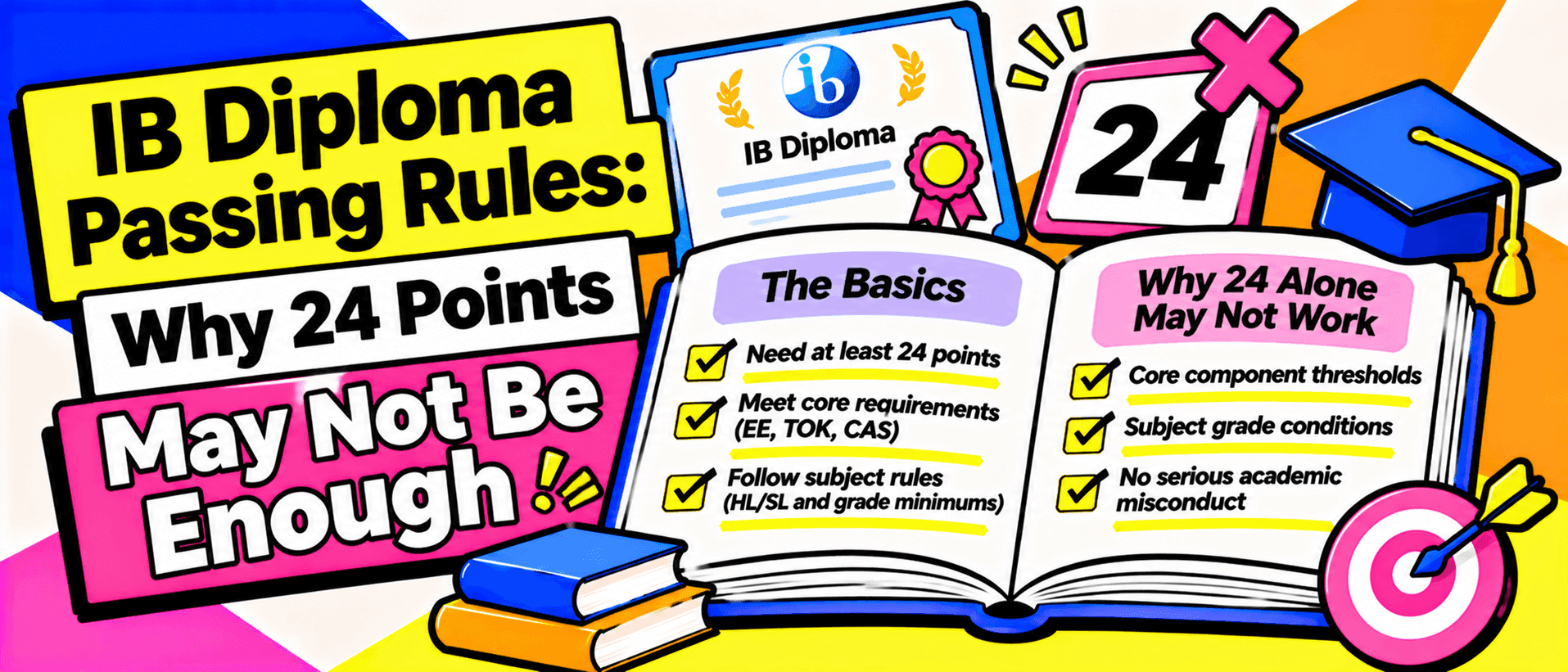
Scoring 24 points is necessary to receive the IB Diploma, but it is not sufficient.
The International Baccalaureate also requires minimum performance at Higher Level and Standard Level, restrictions on low subject grades and successful completion of the Diploma Programme core.
This guide explains every major IB diploma passing requirement, with worked score combinations showing when the diploma would and would not be awarded.
What Is the Minimum Score to Pass the IB Diploma?
The official minimum is 24 points out of 45.
The IB's Diploma Programme passing criteria, updated on 19 February 2026, confirm this threshold.
Your total score is calculated from six subjects and the Diploma Programme core.
| Component | Maximum points |
|---|---|
| Six subjects, each graded from 1 to 7 | 42 |
| Theory of Knowledge and Extended Essay | 3 |
| Creativity, Activity, Service | 0 |
| Maximum total | 45 |
Higher Level and Standard Level subjects contribute equally to the overall points total.
A grade 6 in an SL subject contributes six points, just as a grade 6 at HL does.
However, HL and SL have different minimum requirements for diploma eligibility.
This is where students can encounter problems even after earning more than 24 points.
The Official IB Diploma Passing Requirements
According to the IB's current published criteria, candidates must satisfy all the following conditions.
| Requirement | Official condition |
|---|---|
| Total diploma points | At least 24 |
| Higher Level points | At least 12 from the three HL subjects counted |
| Standard Level points | At least 9 from three SL subjects |
| Lowest permitted subject grade | No grade 1 |
| Number of grade 2 results | No more than two |
| Number of grade 3 or below results | No more than three |
| TOK and Extended Essay | Both must receive valid grades, neither can be E |
| CAS | Must be completed |
| Assessment completion | All contributing subjects and required core components must receive grades |
For students taking four HL subjects and two SL subjects, special counting rules apply.
These are explained below.
The important principle is that every condition must be satisfied simultaneously.
Meeting one condition does not compensate for failing another.
Rule 1: You Need at Least 12 HL Points
For the usual Diploma Programme combination of three Higher Level subjects, the three HL grades must add up to at least 12.
Consider these examples.
| HL grades | HL total | Meets 12-point requirement? |
|---|---|---|
| 4, 4, 4 | 12 | Yes |
| 5, 4, 3 | 12 | Yes |
| 6, 4, 2 | 12 | Yes |
| 4, 4, 3 | 11 | No |
| 5, 3, 3 | 11 | No |
A grade 3 in one HL subject does not automatically prevent a student from receiving the diploma.
The problem arises when the relevant HL grades total fewer than 12, or when another diploma condition is violated.
For example, 5, 4 and 3 meets the HL minimum.
But 4, 4 and 3 does not.
This distinction explains the situation described in the September 2026 student discussion.
The student reported receiving 4 in Physics HL, 4 in Mathematics AA HL and 3 in Chemistry HL.
Those grades total 11.
Even with 27 overall points, the HL condition was not met.
Rule 2: You Need at Least 9 SL Points
Students taking three Standard Level subjects must earn at least nine points across them.
| SL grades | SL total | Meets 9-point requirement? |
|---|---|---|
| 3, 3, 3 | 9 | Yes |
| 4, 3, 2 | 9 | Yes |
| 5, 3, 2 | 10 | Yes |
| 3, 3, 2 | 8 | No |
| 4, 2, 2 | 8 | No |
These examples check only the SL points condition. The remaining diploma rules must also be satisfied.
A student may achieve strong HL results and still miss the diploma because the SL total is too low.
Do not concentrate exclusively on your HL subjects when estimating diploma eligibility.
What If You Take Four HL Subjects?
The IB permits candidates to take four HL subjects and two SL subjects.
For the HL minimum, only the three highest HL grades count.
For students registered for two SL subjects, the minimum SL total is five points rather than nine.
Consider this original example.
| Subject level | Grades | Relevant total |
|---|---|---|
| Four HL subjects | 6, 5, 3, 2 | 14 from the highest three |
| Two SL subjects | 4, 2 | 6 |
| TOK and EE | B and C | 2 bonus points |
The six subject grades total 22.
Adding the two core points gives 24 overall.
This combination meets the HL threshold, the special two-SL minimum and the low-grade restrictions.
Assuming CAS is completed and all other conditions are met, the candidate qualifies for the diploma.
The fourth HL grade still contributes to the overall points total. It is excluded only when calculating the special three-highest-HL minimum.
Rule 3: No Subject Can Receive a Grade 1
The IB requires a grade of at least 2 in every contributing subject.
A single grade 1 prevents the diploma from being awarded.
This remains true even if the candidate performs exceptionally well in other subjects.
For example:
| Component | Grades or points |
|---|---|
| HL subjects | 6, 5, 4 |
| SL subjects | 5, 4, 1 |
| TOK and EE bonus | 2 |
| Overall total | 27 |
The student has 27 points, meets the HL minimum and has ten SL points.
However, the grade 1 violates a separate requirement.
Result: Diploma not awarded.
One strong subject cannot cancel out a grade 1 in another.
Rule 4: No More Than Two Grade 2s
Receiving a grade 2 does not automatically prevent a candidate from earning the diploma.
The official rule allows a maximum of two subject grades of 2 across HL and SL.
However, three grade 2s are not permitted.
Consider this hypothetical combination.
| Component | Grades |
|---|---|
| HL subjects | 2, 7, 7 |
| SL subjects | 2, 2, 7 |
| TOK and EE bonus | 0 |
| Overall total | 27 |
The HL total is 16 and the SL total is 11.
Both exceed their respective minimums.
The overall score is also above 24.
But the student has three subject grades of 2.
Result: Diploma not awarded.
This example demonstrates why checking only total points and HL/SL subtotals is insufficient.
Rule 5: No More Than Three Grades of 3 or Below
This rule is sometimes overlooked.
The IB allows no more than three subject grades of 3 or below.
That count includes grades of 2 and 3.
For example:
| Component | Grades |
|---|---|
| HL subjects | 3, 3, 7 |
| SL subjects | 3, 3, 7 |
| TOK and EE bonus | 0 |
| Overall total | 26 |
The student has 13 HL points and 13 SL points.
There are no grade 1 or grade 2 results.
However, four subjects have been awarded grade 3.
That exceeds the permitted number of low grades.
Result: Diploma not awarded.
This is why a student should monitor the distribution of subject grades rather than only the total score.
Rule 6: TOK and the Extended Essay Must Be Completed
Theory of Knowledge and the Extended Essay are compulsory parts of the Diploma Programme core.
Both are graded from A to E.
Their combined results can contribute up to three additional diploma points.
The official IB core points matrix determines the bonus.
| TOK and EE grades | Core points |
|---|---|
| A and A | 3 |
| A and B | 3 |
| B and B | 2 |
| B and C | 2 |
| C and C | 1 |
| C and D | 0 |
| D and D | 0 |
| Either component receives E | Failing condition |
The order of TOK and EE does not change the combined points.
An important distinction is that zero core points do not automatically mean diploma failure.
A candidate receiving C and D, or D and D, may still qualify if all other requirements are satisfied.
However, an E in either component is a failing condition.
The candidate must also receive valid grades in both TOK and EE.
An N indicating that a grade could not be awarded does not satisfy the diploma requirements.
Rule 7: CAS Must Be Completed
Creativity, Activity, Service does not contribute points to the final score.
However, successful completion is compulsory.
The IB's assessment guidance confirms that CAS participation must be authenticated and completed for the diploma to be awarded.
A candidate could therefore have 24, 35 or even more total points but remain ineligible because their CAS requirements have not been met.
CAS involves sustained engagement across creativity, activity and service, along with evidence of the seven learning outcomes and the required collaborative CAS project.
Students should confirm their completion status with the school's CAS coordinator before final results are issued.
CAS is not an optional extra that can be replaced by a strong examination performance.
Worked Examples: Diploma Awarded vs Not Awarded
The following table combines the major rules into realistic score-checking scenarios.
All examples are fictional and assume valid TOK and EE grades and completed CAS unless stated otherwise.
| Scenario | HL grades | SL grades | Core points | Total | Outcome |
|---|---|---|---|---|---|
| A: Meets all requirements | 4, 4, 4 | 4, 4, 4 | 0 | 24 | Diploma awarded |
| B: HL below 12 | 4, 4, 3 | 5, 5, 5 | 1 | 27 | Not awarded |
| C: One grade 1 | 6, 5, 4 | 5, 4, 1 | 2 | 27 | Not awarded |
| D: Three grade 2s | 2, 7, 7 | 2, 2, 7 | 0 | 27 | Not awarded |
| E: Four grades of 3 | 3, 3, 7 | 3, 3, 7 | 0 | 26 | Not awarded |
| F: SL below 9 | 5, 5, 5 | 3, 3, 2 | 1 | 24 | Not awarded |
These examples show that a candidate with exactly 24 points can qualify, while another candidate with 27 points may not.
The determining factor is whether all diploma conditions are met.
Can You Receive the Diploma With a Grade 2?
Yes, provided the other conditions are satisfied.
The IB does not establish grade 4 as a universal passing requirement for every individual subject.
The IB's university admissions FAQ explicitly explains that the IB does not assign an official pass grade to individual DP courses.
Instead, the full diploma has combined eligibility conditions.
A grade 2 may therefore be compatible with receiving the diploma, but it still contributes to the restrictions on low grades.
Universities may apply their own individual subject-grade requirements.
That is a separate issue.
What Does "Diploma Not Awarded" Mean?
A candidate who does not satisfy the full diploma requirements may still receive official Diploma Programme Course Results.
According to the IB Assessment FAQ, these results show the subject and core outcomes achieved.
They are not the same credential as the full IB Diploma.
For example, a student may have completed all six examinations but missed the HL points requirement.
Their individual subject grades remain recorded even though the diploma was not awarded.
This distinction matters when discussing results with universities.
The candidate has not necessarily received no academic results. They have received results that do not satisfy the requirements for the full diploma.
Does Not Receiving the Diploma Mean You Cannot Attend University?
Not necessarily.
IB diploma eligibility and university admission eligibility are different decisions.
The IB Assessment FAQ advises candidates to check directly with individual universities.
Some institutions or programmes require the full diploma.
Others may consider individual DP course results, alternative qualifications or different admission pathways.
Students may also encounter conditional university offers requiring particular subject grades or total scores.
For example, a university might require an overall score higher than 24, or a particular grade in Mathematics HL.
Meeting the IB's diploma minimum does not automatically satisfy those admission conditions.
Equally, not receiving the diploma does not allow anyone to assume that every university will reject the candidate.
The relevant institution must confirm its own requirements.
What Should You Do If Your Diploma Is Not Awarded?
First, identify the specific condition that was not met.
Review your subject grades, HL and SL totals, TOK and EE results, and CAS status.
Then discuss the outcome with your Diploma Programme coordinator.
Depending on the circumstances, there may be options.
Enquiry upon results: If a subject grade is close to a boundary, your coordinator can explain the IB's remarking process.
A remark is not guaranteed to increase a grade. The IB confirms that marks can also decrease, and fees and deadlines apply.
Retaking examinations: Students may register for future examination sessions at an IB World School that accepts retake candidates.
The official FAQ confirms that the IB removed its previous three-session limit in 2023.
However, retake arrangements depend on school availability and applicable examination regulations.
Core or CAS issues: Contact your coordinator promptly if the problem concerns missing grades, TOK, the Extended Essay or incomplete CAS.
Do not assume that the same remedy is available for every failing condition.
How to Check Your Diploma Eligibility Before Results Day
During DP2, students can use predicted or practice grades to identify potential risks.
Use this checklist:
- Add your six subject grades.
- Add the estimated TOK and EE bonus points.
- Check whether the total reaches 24.
- Calculate the HL subtotal using the applicable rule.
- Calculate the SL subtotal.
- Check for any grade 1.
- Count the number of grade 2 results.
- Count all grades of 3 or below.
- Check that TOK and EE have valid grades above E.
- Confirm CAS completion with your school.
Predicted grades are not final examination results, so they cannot establish actual diploma eligibility in advance.
However, the checklist can help students identify where additional preparation or administrative follow-up may be important.
Common Misconceptions About IB Passing Rules
"Anyone with 24 points passes."
Incorrect. The additional diploma conditions must also be met.
"A grade 3 in an HL subject means automatic failure."
Incorrect. The relevant HL total must reach at least 12, and all other requirements must be satisfied.
"Every subject needs at least a 4."
Incorrect. The IB's diploma rules permit certain grades of 2 and 3.
"You need at least one TOK and EE bonus point."
Incorrect. Zero core points can be compatible with receiving the diploma, provided neither TOK nor EE receives E and the remaining conditions are satisfied.
"CAS does not matter because it gives no points."
Incorrect. CAS completion is compulsory.
"If I miss the diploma, my subject grades disappear."
Incorrect. Candidates may receive official DP Course Results showing their awarded grades.
Final Checklist: IB Diploma Passing Requirements
Before interpreting your final result, confirm that:
- You have at least 24 total points.
- You meet the relevant HL minimum.
- You meet the relevant SL minimum.
- No contributing subject has a grade 1.
- You have no more than two subject grades of 2.
- You have no more than three subject grades of 3 or below.
- TOK and the Extended Essay both have valid grades above E.
- All contributing subjects have been graded.
- CAS requirements have been completed.
Final Verdict: Is 24 Points Enough to Pass the IB?
Twenty-four points is the minimum total, not a guarantee of receiving the IB Diploma.
The International Baccalaureate requires candidates to meet several conditions simultaneously.
Strong SL performance cannot compensate for an HL total below the minimum. A high overall score cannot cancel a grade 1, excessive low grades or incomplete core requirements.
A candidate with 24 points may receive the diploma, while another candidate with 27 points may not.
Understanding these rules early allows students to plan their preparation more effectively, monitor subject performance and avoid preventable administrative problems.
The key is to focus not only on your total score but also on the conditions that determine whether the diploma can actually be awarded.
For authoritative guidance, consult the official IB Diploma Programme passing criteria, the IB Assessment FAQ and your school's Diploma Programme coordinator.
Table of contents
Share
Related reading
- IB Results: Remarks, Retakes and Enquiry Upon Results IB results below expectations? Read how remarks, retakes and appeals work, what each can change, and which fees and deadlines to check with your coordinator.
- IB Chemistry IA: Is a Simple Titration Good Enough?Is a simple titration enough for your IB Chemistry IA? Learn how to refine an iron-tablet research question, process reliable data and evaluate limitations.
- IB Remark 2026: Rules, Deadlines and Retake OptionsExplore IB remark 2026 rules, EUR deadlines, possible grade changes, fees and retake options after May results. Make informed next steps with this guide.