You open your CAS tracker and see 68 hours recorded. A classmate says you need 150 hours to pass. Another says their school does not count hours at all. Suddenly, you are wondering whether your CAS programme is nearly complete or barely started.
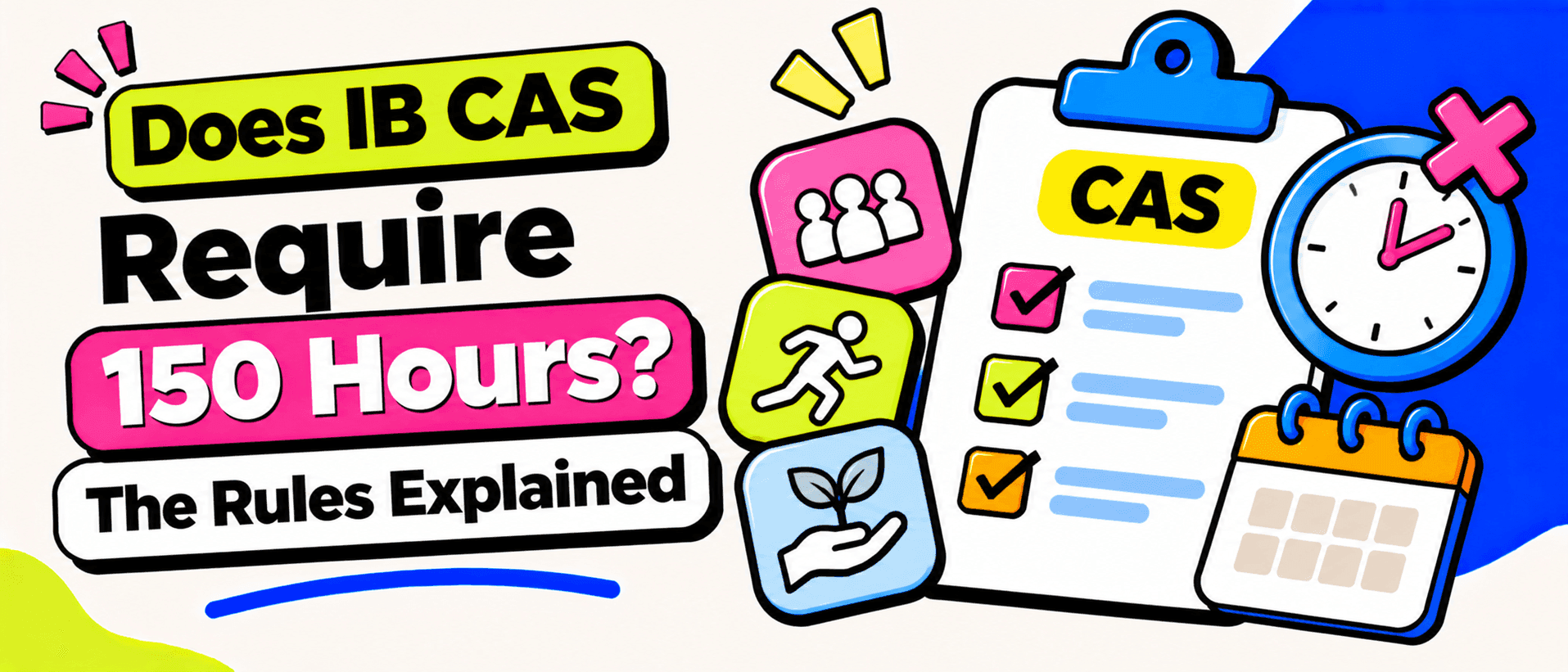
The answer is straightforward: the International Baccalaureate does not currently impose a universal 150-hour CAS requirement. Instead, CAS completion depends on sustained participation, meaningful experiences, a collaborative project and evidence of achieving the seven CAS learning outcomes.
This confusion appeared in a January 2026 r/IBO discussion, where students compared schools that counted hours with those that emphasized consistent participation.
Understanding the difference between official IB requirements and school policies can help you plan CAS without concentrating on an outdated numerical target.
Does IB CAS Still Require 150 Hours?
No. The current IB CAS framework does not require every Diploma Programme student to complete exactly 150 hours.
The 150-hour figure comes from an older approach to measuring CAS participation. The programme subsequently moved away from a universal numerical threshold toward assessing students' engagement and development over time.
The official IB CAS overview, updated on 19 February 2026, describes experiences across creativity, activity and service, reflection, and evidence of achieving seven learning outcomes. It does not specify 150 hours as a completion requirement.
The distinction matters because a student who records 160 hours has not automatically completed CAS. Equally, a student whose school does not maintain a numerical hours counter is not necessarily missing an IB requirement.
CAS is about demonstrated engagement and learning, not reaching a universal stopwatch target.
What Are the Actual IB CAS Completion Requirements?
The IB's published CAS framework identifies several expectations that students need to address throughout their Diploma Programme.
| Requirement | What the IB expects |
|---|---|
| Programme duration | Regular participation over at least 18 months |
| CAS strands | A reasonable balance of creativity, activity and service |
| CAS experiences | Purposeful experiences involving personal interests, challenges or growth |
| CAS project | At least one sustained collaborative project lasting a minimum of one month |
| Learning outcomes | Evidence of achieving all seven outcomes |
| CAS portfolio | Records that demonstrate engagement, experiences and learning |
| Reflection | Thoughtful consideration of experiences and personal development |
These expectations are described in the IB CAS subject brief.
CAS is not awarded a numerical subject grade. However, successful completion remains compulsory for the IB Diploma. The official DP passing criteria confirm that students must satisfy CAS requirements to receive the diploma.
This is why students should not treat CAS as optional simply because it does not contribute additional points.
Why Do Some IB Schools Still Count CAS Hours?
Schools need systems to monitor students' progress and decide whether their CAS programmes meet the IB's expectations. Some use digital platforms, attendance records or hour logs. Others track participation through experience records, periodic reviews and learning-outcome evidence.
A school might ask students to record 50 hours in each strand, aim for a particular total, or document activities every month. These are examples of school-level tracking rules, not universal IB hour allocations.
In the January 2026 student discussion, some participants described numerical targets, while others reported having no hour requirement at all.
The important distinction is:
IB-wide requirements establish the programme's core expectations.
School requirements explain how a particular IB World School monitors and documents student progress.
If your school sets an hours target, do not ignore it. Ask your CAS coordinator whether the target is a compulsory local completion condition, a recommended planning benchmark or simply a tracking tool.
An IB rule and a school rule can both affect what you need to do, but they should not be confused.
Why Sustained Participation Matters More Than Hours
The IB CAS subject brief explains that CAS begins with the Diploma Programme and continues regularly for at least 18 months.
This does not mean performing all three strands for an identical number of minutes every week. A reasonable balance should emerge across the programme, with ongoing involvement and opportunities to develop.
Imagine two fictional students.
Student A completes many hours during a short holiday volunteering programme but has little other engagement throughout the Diploma Programme.
Student B participates in regular physical activity, develops a creative interest, contributes to community service and collaborates on a sustained project over time.
Student A may have a higher numerical total. Student B may be better positioned to demonstrate regular engagement and several learning outcomes. However, neither example proves completion without examining the full portfolio and school requirements.
The lesson is that accumulated hours and sustained participation measure different things.
A large number of hours concentrated in one period does not replace the expectation of ongoing CAS engagement.
What Are the Seven CAS Learning Outcomes?
The seven CAS learning outcomes are central to determining completion. Students must provide evidence of achieving each outcome at least once during their CAS programme.
| Learning outcome | What you could demonstrate |
|---|---|
| 1. Strengths and growth | Recognizing your abilities and identifying areas for improvement |
| 2. Challenges and new skills | Undertaking unfamiliar challenges and developing abilities |
| 3. Initiative and planning | Planning and organizing a CAS experience |
| 4. Commitment and perseverance | Demonstrating consistent engagement despite difficulties |
| 5. Collaboration | Working with others and recognizing the benefits and challenges |
| 6. Global significance | Engaging meaningfully with an issue of global importance |
| 7. Ethics | Considering the consequences of your choices and actions |
The IB CAS subject brief identifies these outcomes and explains their role in completion.
A single experience can provide evidence for several outcomes. For example, organizing an environmental awareness campaign could involve planning, collaboration, perseverance and engagement with a global issue.
However, merely attaching four learning-outcome labels to an activity does not establish that you achieved them. Your evidence should explain what you actually did and learned.
Do You Need 50 CAS Hours in Each Strand?
There is no universal IB rule requiring 50 hours of creativity, 50 hours of activity and 50 hours of service.
The three CAS strands have different purposes.
Creativity involves exploring ideas through creative thinking, original work or interpretation. Examples might include composing music, producing artwork or developing a theatre performance.
Activity involves physical exertion that contributes to a healthy lifestyle. Examples include training, dance, hiking or participating in sports.
Service involves unpaid, voluntary engagement that responds to an authentic community need while respecting the people involved. Examples could include supporting community literacy programmes or helping organize an environmental initiative.
Students should maintain a reasonable balance across the strands. That does not mean every strand requires identical logged hours.
Your school's handbook may specify additional participation or documentation expectations. Ask your coordinator how those expectations apply to your programme.
Is a CAS Project Mandatory?
Yes. Students must complete at least one CAS project, even if they have participated in many individual experiences.
According to the IB's official CAS project guidance, projects should involve purposeful activity, personal challenge, thoughtful planning and reflection.
The IB subject brief also describes a CAS project as a collaborative series of experiences lasting at least one month.
A project can involve creativity, activity, service or a combination of strands. It does not universally have to be a charity fundraiser or service project.
For example, students could collaborate to produce a play, organize a sports initiative or develop a community garden.
What matters is the collaborative process, sustained involvement and learning demonstrated.
The project requirement is separate from any number of hours your school might record.
What CAS Evidence Do You Need if Hours Are Not Required?
A CAS portfolio provides evidence of participation and achievement of learning outcomes.
Useful documentation may include activity plans, dated records, photographs with appropriate permissions, completed creative work, feedback and reflections demonstrating specific learning.
Consider this illustrative record:
| Experience | Evidence | Possible learning demonstrated |
|---|---|---|
| Weekly dance practice | Practice schedule and progress records | Commitment, perseverance and skill development |
| Community garden project | Planning notes, photographs and team feedback | Collaboration, initiative and global significance |
| Student art exhibition | Artwork, planning documents and feedback | Creativity, personal growth and organization |
These examples illustrate possible evidence, not automatic approval.
Your portfolio should demonstrate what happened and how you developed. The IB does not prescribe one universal numerical total for logged hours.
Some schools use platforms such as ManageBac or other CAS tracking systems. Follow your school's documentation procedures even when their interface includes an hours field.
For a separate explanation of reflection frequency and school-level expectations, students should consult guidance specifically addressing CAS reflections rather than assuming every experience requires the same number of written entries.
What Should You Do if Your School Requires 150 Hours?
If your school has set a numerical CAS target, start by clarifying its purpose.
Ask your CAS coordinator whether the figure is a mandatory school policy, a recommended participation target or a progress indicator.
You should also confirm how the school evaluates sustained engagement, the seven outcomes, your collaborative project and portfolio completion.
Do not assume that the absence of a universal IB hours requirement gives you permission to disregard your school's procedures.
Equally, do not assume that reaching the school's numerical target automatically satisfies every CAS expectation.
The most useful approach is to track both participation requirements and learning evidence.
Common Misconceptions About CAS Hours
Myth: Completing 150 hours automatically means passing CAS.
Not necessarily. Students must satisfy the complete CAS framework, including learning outcomes, regular engagement and a project.
Myth: Every student must complete exactly 50 hours per strand.
The IB does not prescribe that universal distribution. Schools may establish their own tracking policies.
Myth: CAS is optional because it does not receive a grade.
CAS is compulsory for the Diploma Programme, although it does not contribute numerical points to the final score.
Myth: A large number of one-day activities can replace sustained participation.
Individual experiences can be valuable, but the programme also expects regular involvement and at least one sustained collaborative project.
Myth: The CAS project must always involve community service.
The IB allows projects within creativity, activity, service or combinations of these strands.
Final CAS Completion Checklist
Before approaching the end of your Diploma Programme, check that:
- You have participated regularly in CAS over the required period.
- Your experiences demonstrate a reasonable balance of creativity, activity and service.
- You have completed at least one sustained collaborative CAS project.
- Your portfolio provides evidence of all seven learning outcomes.
- You have followed your school's documentation and review procedures.
- Your CAS coordinator has confirmed whether any outstanding requirements remain.
Do not leave the final check until examination season. Reviewing your progress periodically makes it easier to identify gaps while there is still time to address them.
Final Thoughts: CAS Is More Than a Number
The IB CAS 150 hours requirement is an outdated interpretation of how every student's CAS completion should be measured.
The current IB framework prioritizes meaningful engagement, sustained participation, personal development, collaboration and evidence of the seven learning outcomes.
Your school may still track hours, but that does not make 150 hours a universal IB requirement.
Instead of asking only how many hours you have completed, ask what your experiences demonstrate, whether you have met the programme expectations and what your coordinator still needs to verify.
That is a more useful way to understand CAS completion.
Table of contents
Share
Related reading
- How Many CAS Reflections Does IB Actually Require?How many CAS reflections does IB require? Learn the official rules on reflection counts, word limits, portfolios, seven learning outcomes and school policies.
- IB CAS: What Counts and How to Show What You LearnedDiscover what counts for IB CAS, explore project ideas, understand the seven learning outcomes, and write honest reflections that show what you learned.
- IB Diploma Passing Rules: Why 24 Points May Not Be EnoughUnderstand IB diploma passing requirements beyond 24 points, including HL and SL minimums, grade restrictions, TOK, EE, CAS and examples of failing scores.
- IB Grade Boundaries 2026: Marks and Myths ExplainedUnderstand IB grade boundaries 2026, raw versus weighted marks, Math AA HL and Physics myths, and why unofficial grade 7 predictions mislead. Read our guide.
- IB EE 2027 Rubric: New Criteria and Marks ExplainedUnderstand the IB EE 2027 rubric, compare all five new assessment criteria with the old model, and learn how to improve your essay using practical checklists.
- IB Geography Explained: Papers, Fieldwork and MarksUnderstand IB Geography SL and HL papers, assessment weightings, and the 2,500 word fieldwork IA. Read our guide to plan smarter and prepare with confidence.