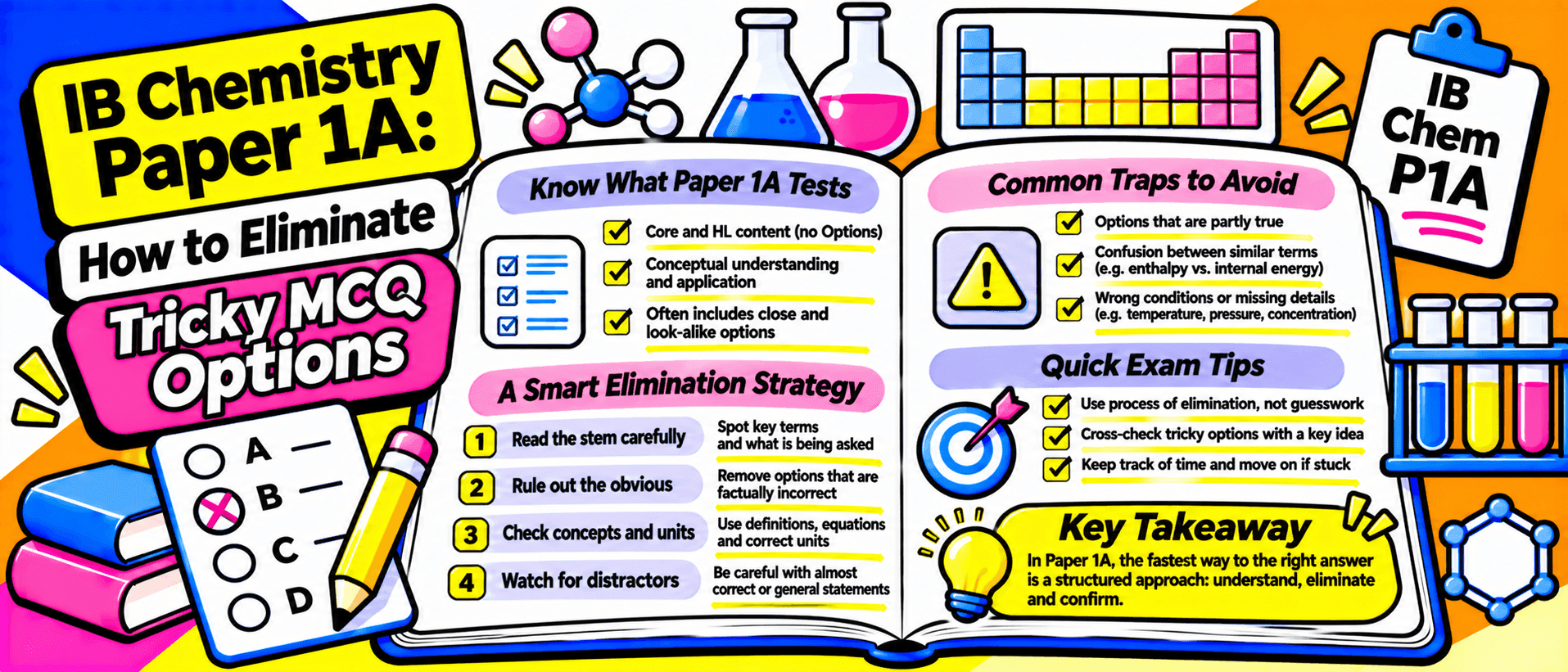
IB Chemistry Paper 1A: How to Eliminate Tricky MCQ Options
You know the chemistry, but the answer choices still look suspiciously similar. One statement is generally true, another would be true under different conditions, and a third uses exactly the numbers from the question but reaches the wrong conclusion. Which one deserves your mark?
That frustration appeared in a February 2026 r/IBO discussion, where a Chemistry HL student said several options seemed scientifically reasonable even though only one answered the question precisely. The most useful IB Chemistry Paper 1A MCQ strategy is to identify what the stem actually asks and eliminate alternatives for a specific chemical reason.
This guide demonstrates that process through five original questions. Every distractor has an explanation, so you can learn to recognize the mistake rather than simply memorize the correct letter.
What Is the Current IB Chemistry Paper 1A Format?
Under the IB Chemistry syllabus first assessed in 2025, Paper 1A contains 30 multiple-choice questions at SL and 40 at HL. HL questions cover standard level and additional higher level material. Each question has one best answer, and the guide confirms that no marks are deducted for incorrect answers.
Paper 1A and the data-based Paper 1B are completed together without a break. The combined session lasts 90 minutes at SL and 120 minutes at HL, rather than giving Paper 1A its own fixed time allowance. A calculator is permitted, and candidates have access to a clean chemistry data booklet. These arrangements are set out in the official Chemistry guide.
This means elimination is not a substitute for knowledge. It is the technique that helps you apply knowledge quickly and preserve time for Paper 1B.
Why Can Several MCQ Options Seem Correct?
A distractor often borrows a correct chemical idea but applies it to the wrong quantity, condition or conclusion. For example, higher pressure can affect a gaseous equilibrium, but pressure alone does not change its equilibrium constant at fixed temperature. Likewise, a catalyst increases reaction rates without changing the equilibrium position.
Look carefully for qualifiers such as at constant temperature, excess, initial, always, most likely and after equilibrium is re-established. An answer that ignores one of these may be plausible chemistry but incorrect for the stated situation.
Your job is not to identify the nicest-sounding fact. It is to test every option against the precise question.
A Five-Step Elimination Method
- Read the last line first. Identify the requested quantity or conclusion, then reread the full stem for conditions and exceptions.
- Predict before looking at the choices. Even a rough prediction, such as “shifts toward fewer gas molecules,” gives you an independent check.
- Eliminate with evidence. Identify the wrong assumption, unit, charge, direction or chemical principle in each distractor.
- Check the remaining option against every condition. A true statement is not necessarily the answer to this question.
- Commit and move on. If two choices remain, mark the uncertainty for review. Never leave a final answer blank merely because you are unsure: there is no negative marking.
Original MCQ 1: Equilibrium and the Meaning of Constant Temperature
Question: A sealed vessel contains the following gaseous mixture at equilibrium:
N₂O₄(g) ⇌ 2NO₂(g)
The vessel volume is reduced while temperature remains constant. After equilibrium is re-established, which statement is correct?
A. More NO₂ forms, and the equilibrium constant increases.
B. More N₂O₄ forms, and the equilibrium constant remains unchanged.
C. More N₂O₄ forms, and the equilibrium constant decreases.
D. The composition cannot change because the temperature is unchanged.
Correct answer: B. Compression favours the side containing fewer gas particles, which is N₂O₄. At constant temperature, the equilibrium constant does not change.
Why A fails: It selects the side with more gaseous particles and incorrectly changes the equilibrium constant.
Why C fails: The direction of shift is correct, but a change in pressure at constant temperature does not change K.
Why D fails: Temperature remaining constant fixes K, not the equilibrium composition after a pressure disturbance.
Exam lesson: Separate what shifts the equilibrium position from what changes the equilibrium constant. A partially correct option is still wrong.
Original MCQ 2: Stoichiometry and the Hidden Mole Ratio
Question: A sample containing 0.250 mol of calcium carbonate reacts completely with excess hydrochloric acid:
CaCO₃ + 2HCl → CaCl₂ + CO₂ + H₂O
What volume of CO₂ is produced if the molar gas volume is 24.0 dm³ mol⁻¹ at the stated conditions?
A. 3.00 dm³
B. 6.00 dm³
C. 12.0 dm³
D. 24.0 dm³
Correct answer: B. The equation shows a 1:1 mole ratio between CaCO₃ and CO₂. Therefore, 0.250 mol of CO₂ occupies 0.250 × 24.0 = 6.00 dm³.
Why A fails: It halves the required gas amount without support from the equation.
Why C fails: It doubles the volume, possibly by confusing the coefficient of HCl with the CO₂ ratio.
Why D fails: It uses the volume of an entire mole, although the question gives only 0.250 mol of carbonate.
Exam lesson: Circle excess and write the relevant mole ratio before multiplying. Check the units: 24.0 dm³ mol⁻¹ is a molar volume, not the volume automatically produced.
Original MCQ 3: Catalysts and Reversible Reactions
Question: A suitable catalyst is added to a reversible reaction at constant temperature. Which statement is correct?
A. It increases only the rate of the forward reaction.
B. It increases the equilibrium constant.
C. It can increase both forward and reverse rates without changing the equilibrium composition.
D. It makes the enthalpy change of reaction less positive.
Correct answer: C. A catalyst provides an alternative pathway with lower activation energy. It speeds up both directions and can help equilibrium be reached sooner, but does not change the equilibrium constant or composition at a fixed temperature.
Why A fails: A catalyst does not selectively accelerate only the forward direction of the reversible process.
Why B fails: The equilibrium constant is determined by temperature, not the catalyst.
Why D fails: A catalyst changes the pathway and rate, not the reaction's initial and final enthalpy states.
Exam lesson: Distinguish rate, equilibrium position and enthalpy change. These concepts are connected but not interchangeable.
Original MCQ 4: Organic Chemistry and the Exact Product
Question: Which alcohol with molecular formula C₄H₁₀O can be oxidized to a ketone under suitable conditions?
A. Butan-1-ol
B. Butan-2-ol
C. 2-Methylpropan-1-ol
D. 2-Methylpropan-2-ol
Correct answer: B. Butan-2-ol is a secondary alcohol. Oxidation of a secondary alcohol produces a ketone, in this case butan-2-one.
Why A fails: Butan-1-ol is primary and can form an aldehyde and, under further oxidation, a carboxylic acid.
Why C fails: 2-Methylpropan-1-ol is also primary, despite its branched carbon skeleton.
Why D fails: 2-Methylpropan-2-ol is tertiary and is resistant to ordinary oxidation because its hydroxyl-bearing carbon has no hydrogen.
Exam lesson: Identify the carbon bearing the O-H group before deciding whether an alcohol is primary, secondary or tertiary. Branching alone does not determine alcohol class.
Original MCQ 5: Isoelectronic Ions and Ionic Radius
Question: The ions O²⁻, F⁻, Na⁺ and Mg²⁺ each contain ten electrons. Which ion has the smallest radius?
A. O²⁻
B. F⁻
C. Na⁺
D. Mg²⁺
Correct answer: D. All four ions have the same number of electrons, but magnesium has the largest nuclear charge, with 12 protons. Its electrons are drawn closer to the nucleus, giving the smallest ionic radius of these four species.
Why A fails: Oxygen has only eight protons attracting the same ten electrons.
Why B fails: Fluorine has nine protons, still fewer than magnesium.
Why C fails: Sodium has eleven protons, one fewer than magnesium.
Exam lesson: For an isoelectronic series, first confirm the electron count. Then compare nuclear charge rather than assuming a more negative ion must be smaller.
How to Manage Time Across Paper 1A and Paper 1B
Because the two sections share an examination session, plan time for both. A possible practice allocation is about 45 minutes for SL Paper 1A or 60 minutes for HL Paper 1A, leaving a similar period for Paper 1B. This is a student practice suggestion, not an official division of time. Adjust it based on your Paper 1B performance.
Use a first pass to answer questions you understand quickly. On the second pass, return to calculations and two-option decisions. Recheck unit conversions, whether the question asks for the incorrect statement, and whether your answer-sheet choice matches the option you intended.
Do not spend several minutes proving one distractor wrong if the others can already be ruled out securely. But do not use elimination as random guessing either. Use the chemical reason that makes each option unsuitable.
Turn Wrong Answers Into a Better Revision Method
After each timed practice set, create a small error log. Record the topic, the correct answer, the tempting distractor and why you selected it. Separate missing content knowledge from reading errors, unit errors and wrong assumptions.
For example, “I changed K when pressure changed” is a more actionable note than “revise equilibrium.” Repeat the question after several days without reading the answer first, then solve a different question that tests the same distinction. The IB Questionbank offers teacher-accessible questions and markschemes aligned to the current syllabus; the IB sample examination papers page is another official starting point.
Remember that Chemistry Paper 1A markscheme reasoning is not about earning separate method marks: a multiple-choice response receives the mark for the correct selection. Writing explanations during revision trains the reasoning that leads to that selection.
Final Thoughts: Eliminate the Reason, Not Just the Option
Tricky IB Chemistry Paper 1A MCQ questions reward precise reading and connected chemical knowledge. When two answers look reasonable, return to the qualifier, the mathematical relationship and the exact quantity requested.
Practise explaining why each wrong answer fails. That habit develops the judgment to select the one answer the question actually supports, while leaving enough time for the rest of the examination.
Table of contents
Share
Related reading
- IB Chemistry HL Paper 1A: Organic Chemistry RevisionRevise IB Chemistry HL Paper 1A organic chemistry with nine original MCQs, worked answers, mechanism traps, spectroscopy clues and a focused revision plan.
- IB Chemistry HL vs SL: What Each Choice Really MeansCompare IB Chemistry HL and SL exam papers, syllabus depth, workload and university prerequisites. Read the facts before deciding which level works for you.
- IB Chemistry HL NMR: How to Interpret Complex SpectraMaster IB Chemistry HL NMR with original worked spectra, chemical shifts, integration and splitting. Learn how to identify structures. Start revising now.