An unfamiliar organic compound appears in IB Chemistry Paper 2. You can identify a peak near 1 ppm, but another signal sits around 4 ppm, two peaks have different integrations, and the splitting patterns seem to suggest several possible structures. Where should you begin?
The hardest IB Chemistry HL NMR problems rarely depend on recognizing one chemical shift. They require you to combine the number of signals, proton ratios, splitting patterns and other evidence into a structure that explains all the observations. In the May 2026 Chemistry HL exam discussion, a student specifically described struggling with a large organic compound and its proton NMR information in Paper 2.
This guide turns that uncertainty into a repeatable method, with original spectra presented as data tables and two fully worked deductions.
What Does the Current IB Chemistry HL Syllabus Expect?
Under the IB Chemistry course first assessed in 2025, proton nuclear magnetic resonance is additional higher level content in Structure 3.2: Functional groups. The official IB Chemistry guide distinguishes three connected requirements.
Structure 3.2.10: use the number of proton NMR signals, chemical shifts and integration to deduce organic structures. Structure 3.2.11: interpret singlets, doublets, triplets and quartets to obtain more structural detail. Structure 3.2.12: combine analytical evidence, including different spectra, to identify a compound.
That last requirement matters. A question may provide an infrared absorption or molecular ion alongside the NMR data. You should use those clues together, rather than treating each technique as a separate exercise.
For exact chemical-shift ranges, use section 21 of the Chemistry data booklet supplied by your school.
Start With the Number of Proton Environments
A proton NMR signal represents hydrogen atoms in a particular chemical environment. Hydrogens that are chemically equivalent normally contribute to the same signal, even when several hydrogen atoms are involved.
The three hydrogens in a methyl group commonly produce one signal; symmetry can also make separate methyl groups equivalent. Three signals do not mean three hydrogen atoms. They indicate three distinguishable environments.
Count signals first. A structure with five proton environments cannot usually explain three signals without overlap or another explanation.
Read Chemical Shifts as Clues, Not Addresses
Chemical shift, δ, is measured in parts per million relative to tetramethylsilane (TMS), assigned 0 ppm. Proton environments differ in electron shielding, so chemically different hydrogens resonate at different positions.
The following are useful approximate regions, not hard boundaries:
| Approximate shift | Typical interpretation |
|---|---|
| 0.9 to 1.7 ppm | Many alkyl methyl, methylene and methine hydrogens |
| 2.0 to 2.7 ppm | Hydrogens on carbons adjacent to a carbonyl group |
| 3.3 to 4.8 ppm | Many hydrogens on carbons attached to oxygen, including ester environments |
| 6.9 to 9.0 ppm | Aromatic ring hydrogens |
| 9.4 to 10.0 ppm | Aldehyde hydrogen |
| 9.0 to 13.0 ppm | Carboxylic acid hydrogen |
Alcohol O-H shifts vary with solvent, concentration and hydrogen bonding. Do not reject an otherwise consistent structure because a shift differs slightly from a memorized value. Consult Chemistry data booklet section 21.
Integration Tells You How Many Hydrogens Belong Together
Integration measures relative signal area, not peak height. If the integration values are 3:2:3, the three signals correspond to groups containing hydrogen atoms in that ratio. If the molecular formula contains eight hydrogens and all are represented, 3:2:3 accounts for all eight.
Step sizes of 15, 10 and 15 reduce to 3:2:3. Compare the result with the molecular formula, remembering that exchangeable O-H or N-H signals can be broad or difficult to integrate.
Do not confuse the number of lines inside a multiplet with its integration. A quartet can represent two hydrogens, one hydrogen or another count depending on the environment.
Use Splitting to Connect Neighbouring Groups
In straightforward first-order examples, n equivalent hydrogens on an adjacent carbon produce n + 1 lines in a proton's signal. The current HL guide explicitly covers singlets, doublets, triplets and quartets.
| Pattern | Typical neighbouring equivalent H atoms |
|---|---|
| Singlet | 0 |
| Doublet | 1 |
| Triplet | 2 |
| Quartet | 3 |
A common clue is an ethyl group, CH₃CH₂-. Its CH₃ signal often appears as a triplet because of two neighbouring CH₂ hydrogens. Its CH₂ signal often appears as a quartet because of three neighbouring CH₃ hydrogens. Their integrations are 3:2.
Real spectra can be more complicated, and exchangeable O-H hydrogens often do not show predictable coupling. Use the rule within its assumptions.
A Six-Step Structure-Determination Routine
First, record the molecular formula. Check the number of carbons, hydrogens and heteroatoms. If mass spectrometry provides a molecular ion, use it to check molecular mass where appropriate.
Second, count the distinct proton signals. This constrains the number of hydrogen environments, while allowing for possible overlap.
Third, convert integration into a whole-number ratio. Compare the result with the molecular formula instead of treating each signal as one hydrogen.
Fourth, identify characteristic shifts. Flag an aldehyde, aromatic region, oxygen-adjacent carbon or carbonyl-adjacent carbon when supported by the data.
Fifth, look for neighbouring groups using splitting. Pair plausible triplets and quartets, or identify a methyl singlet next to a carbonyl carbon that carries no hydrogen.
Finally, propose a structure and work backwards. Predict its signals, integrations and splitting. A structure is convincing only when it explains the complete dataset, not just its most obvious peak.
Worked Problem 1: Identify an Unknown Ester
Original practice data: A compound has molecular formula C₄H₈O₂. Its infrared spectrum shows a strong carbonyl absorption near 1740 cm⁻¹ and no broad O-H band. The proton NMR data are:
| δ / ppm | Integration | Multiplicity |
|---|---|---|
| 1.25 | 3 | Triplet |
| 2.05 | 3 | Singlet |
| 4.12 | 2 | Quartet |
Step 1: Interpret the IR evidence. A carbonyl is present. The absence of a broad O-H absorption makes a carboxylic acid less likely under these stated conditions, while an ester is consistent with both the formula and strong absorption.
Step 2: Match the triplet and quartet. The 1.25 ppm triplet integrates to three hydrogens, while the 4.12 ppm quartet integrates to two. Together they strongly suggest CH₃CH₂-. The downfield position of CH₂ suggests attachment to oxygen, giving -OCH₂CH₃.
Step 3: Interpret the singlet. The 2.05 ppm signal integrates to three hydrogens. Its location is consistent with CH₃ next to a carbonyl. Its singlet indicates no neighbouring carbon-bound hydrogens splitting that methyl signal.
Step 4: Assemble and verify. The proposed structure is ethyl ethanoate, CH₃COOCH₂CH₃. It has the required four carbons and eight hydrogens. The ethyl group generates a triplet and quartet; the acetyl methyl gives a singlet; and the ester contains the carbonyl seen in the IR data.
Verification turns a guess into a supported deduction.
Worked Problem 2: Distinguish a Ketone From an Aldehyde
Original practice data: An unknown compound has molecular formula C₄H₈O and a strong IR carbonyl absorption. Its proton NMR gives three signals:
| δ / ppm | Integration | Multiplicity |
|---|---|---|
| 1.02 | 3 | Triplet |
| 2.13 | 3 | Singlet |
| 2.45 | 2 | Quartet |
Start with the 3:2 triplet-and-quartet pair. The two signals suggest an ethyl fragment. Here the CH₂ is shifted downfield to about 2.45 ppm, consistent with a carbon adjacent to a carbonyl.
The remaining three-hydrogen singlet at 2.13 ppm suggests a methyl group directly attached to the other side of that carbonyl. Combining the fragments produces butan-2-one, CH₃COCH₂CH₃.
Why not butanal, CH₃CH₂CH₂CHO? Butanal also has formula C₄H₈O, but it contains an aldehyde proton that would ordinarily appear near 9.4 to 10.0 ppm. No such signal is present, and the proposed ketone accounts for all eight hydrogens. This is how chemical shift and integration can distinguish structural isomers even before considering every detail of splitting.
Combine NMR With IR and Mass Spectrometry
For larger compounds, begin with the strongest independent clues. An infrared carbonyl band narrows the functional-group possibilities. A molecular ion can help determine relative molecular mass, while an independently supplied molecular formula sets the total atom count. Proton NMR then reveals how hydrogen atoms are distributed among environments.
Do not assume one isolated clue proves a unique structure. A carbonyl band alone cannot reliably distinguish every aldehyde, ketone and ester. A methyl triplet alone does not identify a whole molecule. The strongest conclusion fits all the evidence. This is exactly the combined-analysis skill described in Structure 3.2.12 of the IB guide.
Common IB Chemistry HL NMR Mistakes
Reading peak height as integration: Count relative areas or integration steps, not the tallest line in each signal.
Assuming every singlet is a CH₃: Singlet describes splitting, not the number of protons. Always consult integration.
Applying n + 1 mechanically: Count the appropriate adjacent, equivalent hydrogens for simple splitting patterns. Do not automatically count hydrogens on the same carbon or exchangeable O-H protons.
Treating chemical shifts as exact: Published ranges are typical values. Consider neighbouring groups and the molecular context.
Ignoring one signal: A proposed structure must account for every supplied meaningful resonance, its integration and splitting.
Forgetting the formula: Check carbon count, hydrogen count and functional groups before committing to a name.
How to Practise NMR for Chemistry HL Paper 2
Begin with short two-signal spectra, then move to three-signal ester and ketone problems. Finally, practise questions combining a molecular formula, IR evidence and proton NMR. For each answer, explain the reasoning in this order: environments, integration, shifts, splitting, candidate structure and verification.
Keep a correction log identifying mistakes with shifts, ethyl patterns, functional groups or hydrogen counts. Practise those skills on new molecules.
In timed practice, identify the most diagnostic clue first, but do not let it determine your answer prematurely. Brief, explicit reasoning usually communicates more than a long paragraph that merely lists observed peaks.
Final Thoughts
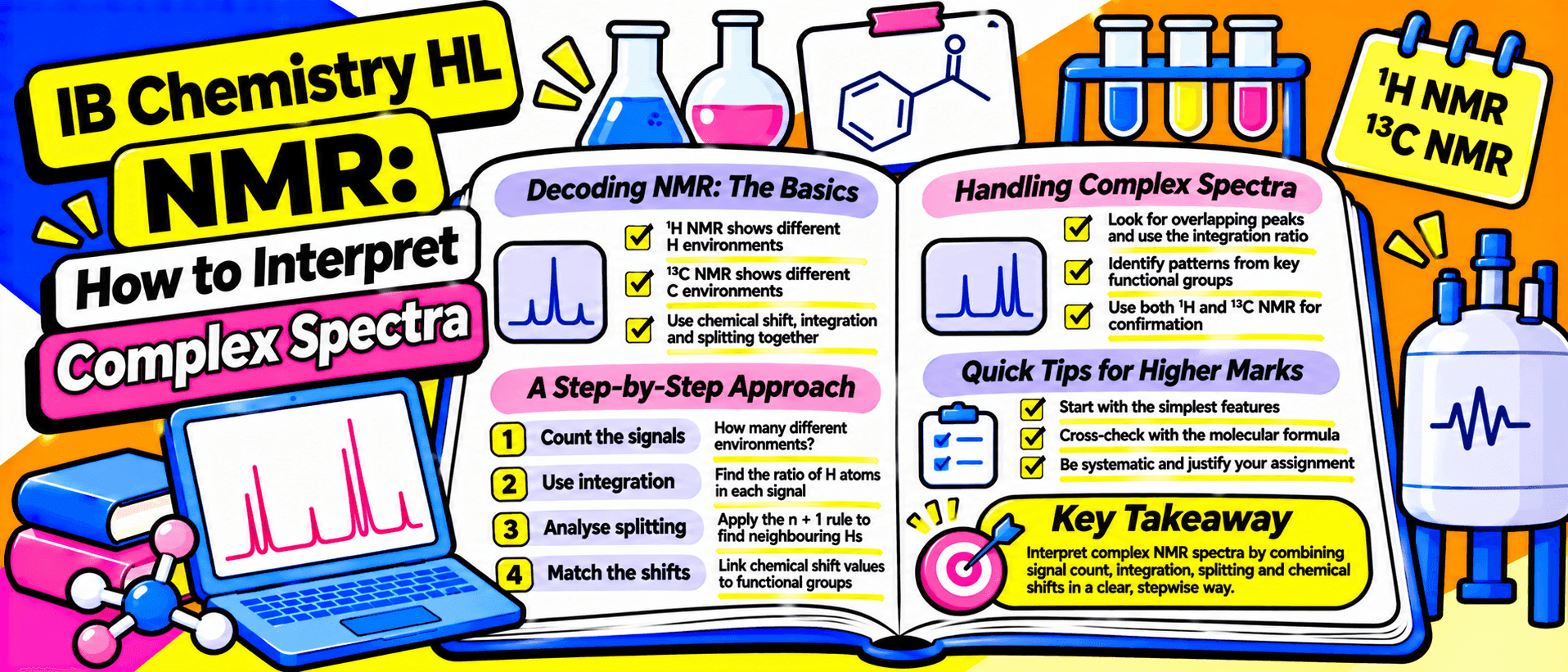
Complex IB Chemistry HL NMR questions are manageable when you treat the spectrum as a set of constraints. The number of signals identifies environments, integration counts relative hydrogens, chemical shifts suggest local structures and splitting links neighbouring groups. IR and mass spectra can then strengthen or challenge your proposal.
Practise explaining why a candidate fits every observation. That is the difference between recognizing a familiar peak and determining an unfamiliar molecular structure.
Table of contents
Share
Related reading
- IB Chemistry Paper 1A: How to Eliminate Tricky MCQ OptionsLearn IB Chemistry Paper 1A MCQ strategy with original questions, distractor analysis, unit checks and time-saving techniques. Practise smarter today.
- IB Chemistry HL Paper 1A: Organic Chemistry RevisionRevise IB Chemistry HL Paper 1A organic chemistry with nine original MCQs, worked answers, mechanism traps, spectroscopy clues and a focused revision plan.
- IB Chemistry IA: Is a Simple Titration Good Enough?Is a simple titration enough for your IB Chemistry IA? Learn how to refine an iron-tablet research question, process reliable data and evaluate limitations.