If you are planning to take IB French B, Spanish B or another Language B subject for the May 2029 examinations, you may have heard that the syllabus is changing.
Does that mean new examination papers? Different oral assessments? Additional literature requirements? Will existing revision materials become outdated?
The answer is more straightforward than many curriculum-change headlines suggest.
The IB Language B 2029 syllabus introduces enhanced teaching guidance, but the assessment model remains unchanged.
On 2 April 2026, the International Baccalaureate published details of the enhanced Language B course, confirming that the changes focus on conceptual understanding, critical thinking, language development and clearer support for teachers.
This is an important update for students entering the Diploma Programme in August 2027, but it is not a complete redesign of French B, Spanish B or other Language B examinations.
This guide explains exactly what changes, what remains the same and how students should prepare.
When Does the IB Language B 2029 Syllabus Begin?
According to the official IB Language B curriculum update, the enhanced course follows this schedule:
| Milestone | Official date |
|---|---|
| Curriculum announcement | 2 April 2026 |
| Enhanced course launch | February 2027 |
| First teaching | August 2027 |
| First assessment | May 2029 |
Students beginning the relevant two-year Diploma Programme course in August 2027 will follow the enhanced syllabus.
Students taking examinations before May 2029 should continue using the subject guide applicable to their assessment session.
This distinction matters when choosing revision resources.
A French B Paper 1 guide created for the current course may remain useful for 2029 because the assessment format is unchanged.
However, teachers and students should use the enhanced guide for the updated explanations of conceptual understanding and assessment descriptors.
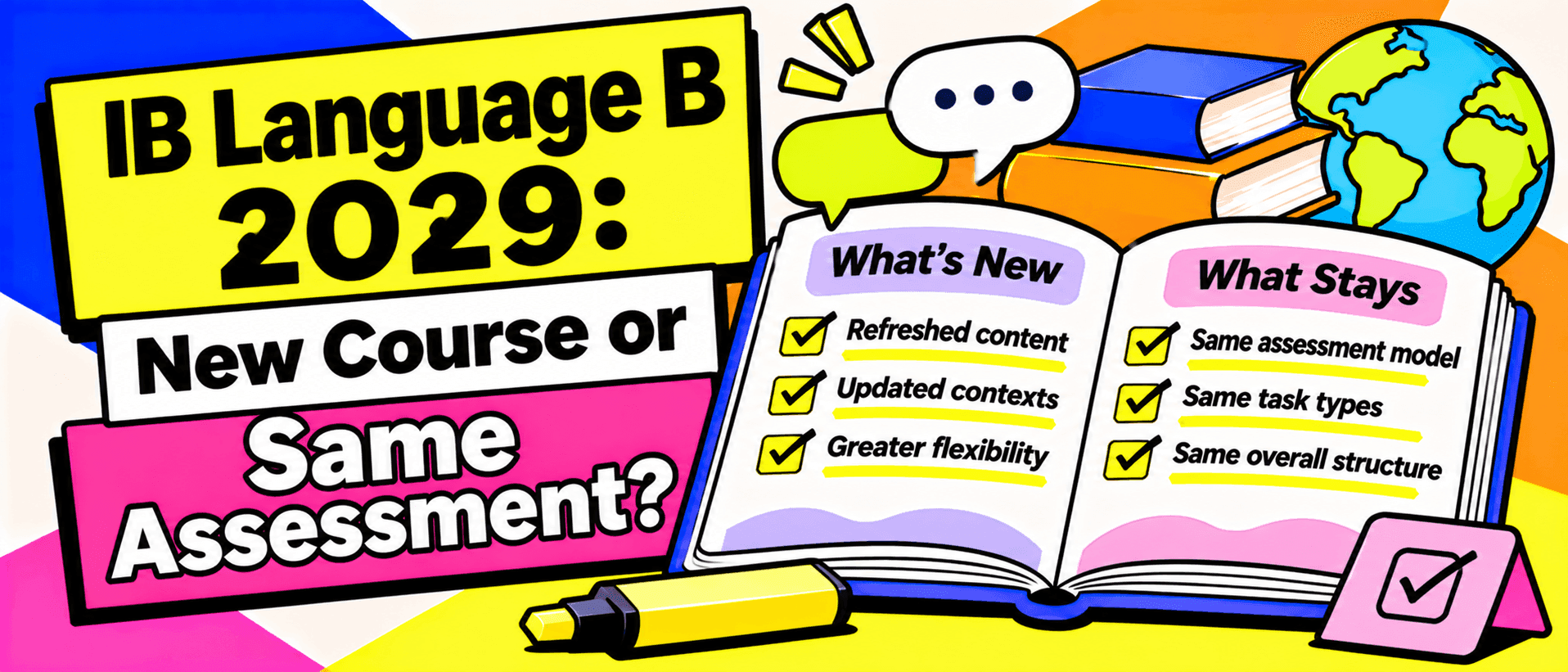
What Changes and What Stays the Same?
The official curriculum update describes the 2029 course as an enhancement of the existing curriculum.
Here is the essential comparison.
| Course element | 2029 status |
|---|---|
| Standard Level and Higher Level | Both remain available |
| Recommended teaching hours | 150 hours SL, 240 hours HL |
| Five prescribed themes | Unchanged |
| SL and HL writing assessments | Unchanged |
| Paper 2 listening assessment | Unchanged |
| Paper 2 reading assessment | Unchanged |
| Individual oral assessment | Same format |
| HL literary works | Two original target-language works still required |
| Oral assessment descriptors | Minor wording clarification in two descriptors |
| Conceptual understanding | Clearer explanation and integration |
| Critical thinking | Enhanced teaching guidance |
| Teacher support materials | Additional resources and improved navigation |
These points are confirmed by the April 2026 curriculum update and the official 2029 Language B subject brief.
The practical conclusion is that students do not need to prepare for an entirely unfamiliar examination structure.
They should continue developing the same core language skills while learning to apply them thoughtfully across different situations.
The Five Language B Themes Remain Unchanged
Language B continues to be organised around five prescribed themes.
| Theme | Main areas of exploration |
|---|---|
| Identities | Lifestyle, health, beliefs, values and personal identity |
| Experiences | Travel, traditions, life experiences and migration |
| Human ingenuity | Technology, communication, innovation and artistic expression |
| Social organization | Education, community, relationships and the world of work |
| Sharing the planet | Environment, human rights, equality and global challenges |
These themes provide contexts for language learning rather than separate examinations.
Students encounter them through written, spoken, visual and multimedia materials.
Importantly, the 2029 subject brief continues to list optional recommended topics within the themes.
This distinguishes Language B from Language ab initio, which has four prescribed topics under each theme.
Language B teachers retain flexibility to select suitable topics and texts that support communication at the relevant proficiency level.
For example, a Spanish B class might examine migration through personal narratives, news reports and interviews.
A French B class might investigate technology through articles, advertisements and discussions about digital communication.
The themes remain familiar, but the opportunities for conceptual learning receive greater emphasis.
Change 1: Clearer Conceptual Understanding
One of the most important enhancements is the clarification of how students develop conceptual understanding through language.
The 2029 Language B subject brief identifies three interconnected lenses:
Cultures: Understanding the relationship between language, cultural practices and different ways of experiencing the world.
Communication: Examining how messages are constructed and interpreted for different audiences and purposes.
Perspectives: Recognising that language communicates viewpoints, experiences and assumptions.
These lenses are not new standalone examination components.
They help students understand why language choices matter.
Consider two French-language texts discussing environmental responsibility.
One is an environmental organisation's campaign message.
The other is an interview with a local business owner concerned about the cost of new regulations.
Both address the same issue, but they may use different vocabulary, arguments and tones.
A conceptually focused lesson could investigate how the intended audience influences each message.
Students would still practise French reading, vocabulary and expression.
The difference is that communication becomes connected to context and perspective rather than treated as a purely grammatical exercise.
Change 2: Greater Integration of Critical Thinking
The IB's April 2026 announcement explicitly identifies critical thinking as an area of enhanced guidance.
This does not mean students must begin writing advanced philosophical essays in their additional language.
Critical thinking in Language B should remain appropriate to the student's linguistic proficiency.
For example, students may compare viewpoints, examine the purpose of a message, distinguish fact from opinion or explain why two people interpret an experience differently.
Consider this original Spanish B classroom question:
¿Hasta qué punto las redes sociales mejoran la comunicación entre los jóvenes?
A developing response might state:
Las redes sociales son útiles porque podemos hablar con nuestros amigos.
A more developed response could explain:
Aunque las redes sociales facilitan la comunicación, también pueden crear malentendidos porque los mensajes escritos no siempre expresan claramente las emociones.
The second response demonstrates a more considered argument.
It acknowledges a benefit while recognising a limitation.
This is the kind of language development that conceptual inquiry can support.
It is not evidence of a new mandatory essay format.
Change 3: Enhanced Teacher Support Materials
The IB has also developed additional teacher support resources.
According to the official curriculum update, these cover:
- Critical thinking.
- Formative assessment.
- Student reflection.
- Listening and reading comprehension.
- Unit planning, including guidance and sample templates.
The enhanced guide also provides clearer links between curriculum documentation and teacher support materials.
These resources are designed to help educators develop coherent learning experiences.
For example, a unit about environmental sustainability might combine a news article, an audio interview, a persuasive writing task and a classroom discussion.
Students would practise receptive, productive and interactive skills while exploring different perspectives.
However, the update does not prescribe one identical lesson structure for every IB school.
Teachers retain responsibility for choosing suitable texts, activities and examples.
Does Language B Paper 1 Change in 2029?
No. Paper 1 retains its existing assessment format.
The 2029 subject brief confirms the same writing requirements.
| Paper 1 requirement | Standard Level | Higher Level |
|---|---|---|
| Assessment focus | Productive writing | Productive writing |
| Tasks provided | Three | Three |
| Tasks completed | One | One |
| Word range | 250 to 400 words | 450 to 600 words |
| Final grade weighting | 25% | 25% |
Students select a writing task and use an appropriate text type from the options provided.
This means that understanding audience, purpose, register and text conventions remains essential.
For example, writing a formal letter to a school administrator requires a different tone from writing a personal blog for other students.
A speech may require direct address and persuasive language, while an article may need an informative headline and clearly developed arguments.
The enhanced emphasis on communication reinforces these skills.
It does not replace them with a new examination task.
Does Language B Paper 2 Change in 2029?
Paper 2 also remains unchanged.
The assessment continues to measure receptive skills through listening and reading comprehension.
| Component | Assessment | Final grade weighting |
|---|---|---|
| Listening | Questions based on three audio passages | 25% |
| Reading | Questions based on three written texts | 25% |
The passages and texts relate to the five prescribed themes.
Students must identify information, understand messages and interpret meaning.
For listening practice, this might involve following an interview, recognising changes in plans or understanding contrasting opinions.
For reading, students may work with articles, messages, advertisements or other appropriate texts.
The precise linguistic complexity varies between SL and HL.
Students should continue practising comprehension with suitable materials, including authentic language where appropriate.
The enhanced curriculum does not introduce a completely new listening examination or eliminate the reading component.
What Happens to the Individual Oral?
The individual oral remains worth 25% of the final Language B grade.
The structure also remains unchanged.
| Feature | SL individual oral | HL individual oral |
|---|---|---|
| Main stimulus | Visual image | Literary extract |
| Presentation | Discuss the image and relevant course theme | Discuss the selected literary passage |
| Follow-up | Conversation related to the stimulus | Conversation related to the extract |
| General conversation | Additional course theme or themes | Additional course theme or themes |
| Assessment weighting | 25% | 25% |
At HL, students must continue studying two literary works originally written in the target language.
The oral stimulus comes from the literature studied during the course.
Students should therefore continue practising how to discuss characters, events, ideas and messages in their chosen language.
At SL, students should continue practising visual interpretation, thematic connections and spontaneous conversation.
The official Language B curriculum page explains the distinction between the two levels.
What Exactly Changes in the Oral Criteria?
This is the only assessment-descriptor amendment specifically identified in the April 2026 Language B update.
The IB confirms that the second descriptors at the 5 to 6 mark level of Criteria B2 and C have been slightly revised.
The stated purpose is greater clarity and accessibility.
The existing assessment framework includes:
| Criterion | Main focus |
|---|---|
| A | Spoken language |
| B1 | Relevance and development of the presentation |
| B2 | Message during conversation |
| C | Interactive skills |
The revision does not create new criteria or change the overall assessment model.
Students should not interpret it as a major restructuring of the oral examination.
Teachers should consult the enhanced guide for the exact updated wording and use those descriptors when assessing the 2029 cohort.
Students can continue preparing through sustained speaking practice, clear explanations, relevant responses and confident interaction.
French B 2029: What Should Students Prepare?
For French B students, the essential language preparation remains familiar.
At SL, continue developing the ability to discuss visual material and respond naturally to thematic questions.
At HL, continue studying the two required literary works and practising discussion of extracts.
The enhanced conceptual approach can strengthen both activities.
Consider this original French B practice question:
Comment la langue que nous utilisons influence-t-elle notre identité ?
A student might discuss language choices within families, friendships or multilingual communities.
A developed response could explain:
La langue joue un rôle important dans notre identité parce qu'elle nous permet d'exprimer nos valeurs et notre culture. Cependant, certaines personnes utilisent différentes langues selon leur environnement social.
The response explores identity and communication while using relevant vocabulary and grammatical structures.
It is a classroom practice example, not a new official examination question.
Spanish B 2029: What Should Students Prepare?
Spanish B students should also continue prioritising the existing examination skills.
Paper 1 requires appropriate writing for different situations.
Paper 2 requires confident listening and reading comprehension.
The oral requires spontaneous interaction.
A useful conceptual exercise might involve comparing two perspectives on technology.
For example:
¿Cómo influye la tecnología en las relaciones entre generaciones?
A student could explain how digital communication connects family members while recognising differences in technological confidence.
This integrates the themes of human ingenuity and social organization.
The goal is not simply to memorise vocabulary about smartphones.
It is to communicate a developed response using appropriate Spanish.
Students can practise this approach without assuming the 2029 syllabus introduces new compulsory Spanish B examination tasks.
Language B vs Language Ab Initio in 2029
Both Language B and Language ab initio receive curriculum enhancements for first assessment in May 2029.
However, they are not the same course.
| Feature | Language B | Language ab initio |
|---|---|---|
| Intended students | Students with previous experience of the language | Beginners or students with very limited experience |
| Available levels | SL and HL | SL only |
| Prescribed themes | Five | Five |
| Topics | Optional recommended topics | Four prescribed topics per theme |
| HL literary works | Required at Language B HL | Not applicable |
| 2029 assessment update | Assessment structure unchanged | Assessment structure unchanged |
The Language B update and Language ab initio update confirm the continuity in their respective assessment models.
Students choosing a course should consider previous language-learning experience and school placement guidance.
Neither course should be selected solely on the assumption that it offers an easier route to a particular grade.
Can You Still Use Existing Language B Revision Materials?
Yes, provided the materials match the relevant assessment requirements and language level.
Resources covering grammar, vocabulary, writing conventions, listening comprehension and oral communication remain useful.
Likewise, appropriately selected past examination questions can help students develop relevant skills.
However, students should avoid assuming that every old revision document reflects the enhanced teaching guidance.
For the 2029 cohort, a useful resource should support:
- Communication for different audiences and purposes.
- Language accuracy alongside effective expression.
- Reading and listening comprehension.
- Cultural understanding and multiple perspectives.
- Critical reflection at an appropriate language level.
Official examination resources and the enhanced subject guide should remain the reference points for assessment preparation.
A Practical Preparation Plan for Students Starting in 2027
Students entering DP1 in August 2027 can prepare through a balanced approach.
First, strengthen the foundations. Develop vocabulary, grammatical accuracy and confidence using the target language regularly.
Second, practise all four language skills. Listening, reading, writing and speaking should develop together.
Third, explore the five prescribed themes. Build vocabulary and examples that can be adapted to different situations.
Fourth, practise explaining perspectives. Compare ideas, justify opinions and respond to unfamiliar viewpoints.
Fifth, prepare for your level. HL students should develop the additional linguistic complexity and literary understanding required by the course.
A simple weekly routine might combine two listening activities, one reading exercise, one short writing task and several speaking opportunities.
The purpose is to build consistent communication skills rather than rely on last-minute memorisation.
Common Misconceptions About the 2029 Update
Misconception 1: Language B is becoming a completely new subject.
The official announcement describes an enhanced course, not a wholesale replacement of the existing curriculum.
Misconception 2: Paper 1 and Paper 2 will use new formats.
The IB explicitly confirms continuity in both external examinations.
Misconception 3: The HL literature requirement has been removed.
Language B HL continues to require two literary works originally written in the target language.
Misconception 4: Students must learn additional prescribed themes.
The five prescribed themes remain unchanged.
Misconception 5: Critical thinking means students need to write advanced academic analysis.
The enhanced guidance integrates conceptual understanding into language learning at an appropriate proficiency level.
These distinctions prevent unnecessary changes to revision strategies.
Final Checklist: IB Language B 2029 Syllabus
Before beginning the enhanced course, remember that:
- First teaching begins in August 2027.
- First assessment takes place in May 2029.
- Language B remains available at SL and HL.
- The five prescribed themes remain unchanged.
- Paper 1 retains its current writing structure.
- Paper 2 retains its listening and reading components.
- The SL oral continues to use a visual stimulus.
- The HL oral continues to use a literary extract.
- Two oral assessment descriptors receive minor wording revisions.
- Conceptual understanding, critical thinking and teacher support receive greater emphasis.
Final Verdict: New Course or Same Assessment?
The IB Language B 2029 syllabus is an enhanced course with the same assessment model.
The International Baccalaureate has retained the core structure of Language B while clarifying how language learning can develop cultural understanding, communication and critical thinking.
For students, the main preparation priorities remain consistent.
You still need accurate vocabulary and grammar, confident comprehension, effective writing and natural spoken interaction.
For teachers, the enhanced guide and support materials offer clearer opportunities to connect these skills with conceptual inquiry and student reflection.
The most useful response to the 2029 update is therefore not to discard existing preparation methods.
It is to strengthen them through more meaningful language use.
The assessment structure remains familiar. The guidance for developing effective, thoughtful communicators becomes clearer.
For definitive information, consult the IB Language B 2029 curriculum update, the official 2029 Language B subject brief and the IB Language B curriculum page.
Table of contents
Share
Related reading
- IB Language B 2029: New Course or Same Assessment?IB Language B 2029 keeps the same exams and oral assessment. See what changes in teaching, concepts, oral descriptors and French B or Spanish B preparation.
- IB Language B Paper 1: Choosing the Right Text TypeChoose the right IB Language B Paper 1 text type with French and Spanish examples, audience and register guidance, marking criteria and a timed writing plan.
- IB Mathematics 2029 Syllabus: What Changes in AA and AI?Explore the IB Mathematics syllabus 2029: AA and AI topic removals, exam marks, Paper 3 timing and new IA criteria. Compare both courses and prepare early.
- From IGCSE Spanish to IB Spanish B: A Study RoadmapMoving from IGCSE to IB Spanish B? Compare assessments, learn writing formats, strengthen listening and speaking, and follow a practical four-week study plan.