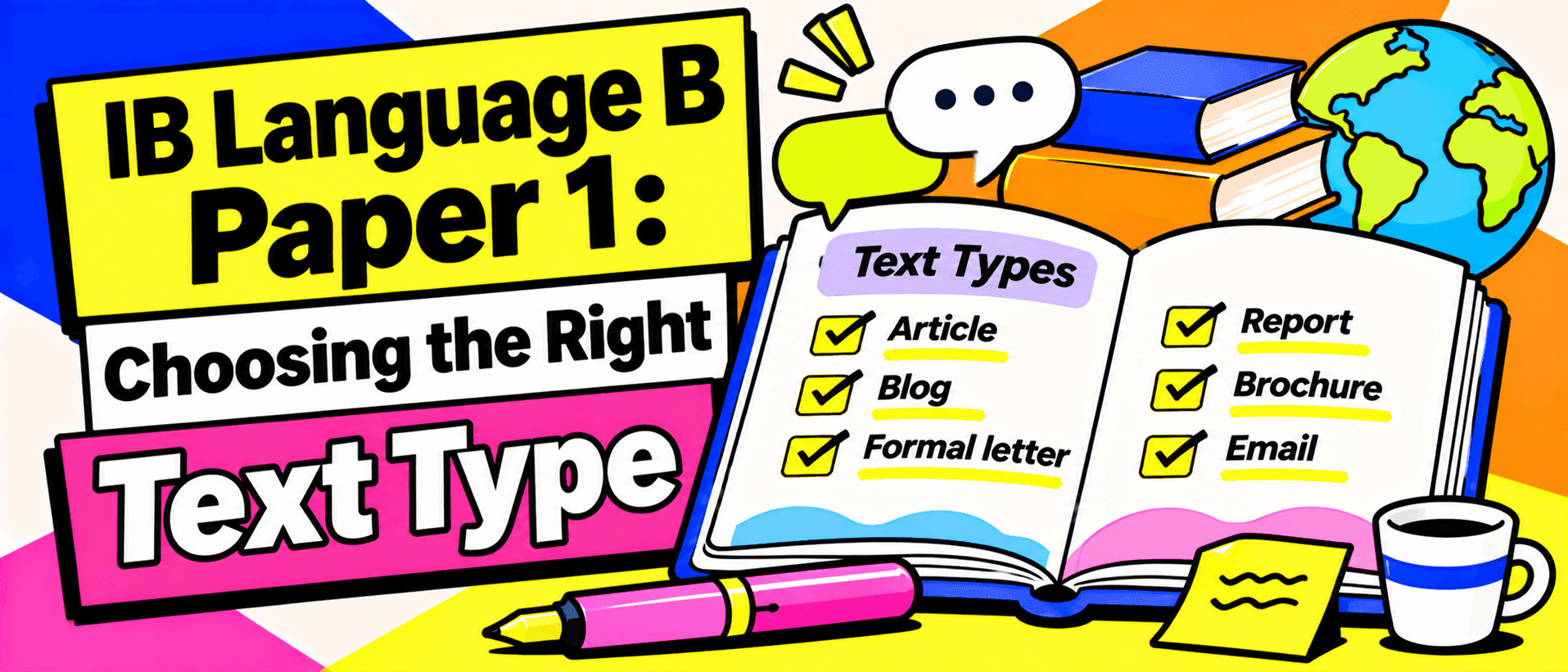
You open your IB French B or Spanish B Paper 1 examination and find three writing tasks. One asks you to persuade students, another involves informing a wider audience, and a third requires communicating with an organisation.
You understand the vocabulary, but should you write a blog, speech, article or formal letter?
Choosing the right text type matters because Paper 1 assesses more than grammar. It also examines whether you can communicate appropriately for a particular audience and purpose.
In a July 2026 r/IBO discussion, a student described Language B revision as difficult and requested practical resources. The May 2026 French B SL examination discussion also reflected varied experiences with the language assessments.
This guide explains how to select IB Language B Paper 1 text types, apply their conventions and adapt your French or Spanish to different communication situations.
What Is the IB Language B Paper 1 Format?
According to the official IB Language B guide, Paper 1 assesses productive writing skills at Standard Level and Higher Level.
| Assessment detail | SL | HL |
|---|---|---|
| Examination duration | 1 hour 15 minutes | 1 hour 30 minutes |
| Tasks provided | Three | Three |
| Tasks completed | One | One |
| Required length | 250 to 400 words | 450 to 600 words |
| Maximum marks | 30 | 30 |
| Final grade weighting | 25% | 25% |
Each task relates to a different theme from the syllabus.
Students choose one task and select a text type from the options provided for that task.
The current examination follows the Language B guide first assessed in 2020. A revised course is scheduled for first assessment in 2029, so students should use the requirements applicable to their examination session.
The IB Language B curriculum page provides the current course information.
You Must Choose From the Offered Text Types
This is one of the most important examination rules.
You cannot automatically choose whichever format you have memorised best.
The examination presents three writing tasks, with each task offering text-type options.
Your responsibility is to identify which option best suits the audience, purpose and context.
The IB's 2027 examiner instructions clarify that using a text type that is not among the options for the selected task limits the maximum available under Criterion C to two marks.
Therefore, even an otherwise well-written response can weaken its conceptual understanding score through an unsuitable choice.
Always read the task and its permitted formats before planning.
Understand the Three Paper 1 Assessment Criteria
Paper 1 is assessed out of 30 marks using three criteria.
| Criterion | Marks | What examiners assess |
|---|---|---|
| A: Language | 12 | Vocabulary, grammatical range and accuracy |
| B: Message | 12 | Relevance, development and organisation of ideas |
| C: Conceptual understanding | 6 | Text type, register, tone and conventions |
| Total | 30 |
The official examiner guidance explains that Criterion C considers how appropriate your chosen format is for the task.
However, choosing the correct format alone does not guarantee six marks.
You must also use suitable language and demonstrate recognisable conventions.
An article written as a private diary, for example, may fail to communicate effectively with the intended public audience.
The best format is the one that helps your message reach the intended readers or listeners.
Use the Audience, Purpose and Register Test
Before choosing a text type, identify three things.
Audience: Who will receive the message? Friends, students, parents, readers of a magazine or school administrators?
Purpose: What must the message achieve? Inform, persuade, describe, recommend, explain or request?
Register: How formal or informal should the language be?
Consider these examples.
| Communication situation | Likely suitable format | Appropriate register |
|---|---|---|
| Sharing a personal experience with fellow students | Blog | Personal and conversational |
| Informing readers about an environmental issue | Article | Clear and informative |
| Persuading classmates during an assembly | Speech | Engaging and audience-focused |
| Requesting action from a school principal | Formal letter | Respectful and professional |
| Reflecting privately on an important event | Diary | Personal and reflective |
| Presenting findings to a committee | Report | Organised and factual |
These are typical matches, not universal rules.
A blog can be professional, and an article can be highly persuasive.
The wording of the task determines the appropriate choice.
Blog vs Article vs Speech: What's the Difference?
These three formats are easily confused because all can address public issues.
Imagine the topic is reducing food waste at school.
A blog could share personal observations, experiences and suggestions with a student readership. The writer may use a conversational style and direct questions to encourage engagement.
An article could explain the causes and consequences of food waste, present relevant examples and organise recommendations for a broader readership.
A speech would address a listening audience, using a greeting, direct address and persuasive progression towards a clear call to action.
The subject remains the same.
What changes is the relationship between writer and audience.
A successful Paper 1 response demonstrates that difference through both language and structure.
Original French Example: Choosing a Blog
Consider this original French B practice task:
You recently participated in a school initiative to reduce food waste. Share your experience with other students and encourage them to adopt similar habits.
Suppose the offered formats are a blog, a formal report and a formal letter.
A student blog is a strong choice because the task emphasises personal experience and communication with peers.
A possible opening is:
Salut à tous ! La semaine dernière, j'ai participé à une initiative contre le gaspillage alimentaire dans mon lycée. Cette expérience m'a fait réfléchir à nos habitudes quotidiennes.
In English, the student greets readers, introduces a recent experience and establishes a reflective, accessible tone.
The writing could then describe what happened, explain what the student learned and offer practical suggestions.
A suitable closing might invite readers to share their own experiences.
This is an original introductory example, not a complete examination answer.
What Are the Main Blog Conventions?
A blog commonly includes a relevant title, an engaging introduction, a personal or accessible voice and clearly organised paragraphs.
Depending on the task, it may include direct questions, examples or an invitation for readers to respond.
However, students should not assume that blogs must contain excessive slang, emojis or invented comments.
The register depends on the audience.
A professional blog written for teachers may require more formal language than a personal blog written for classmates.
The IB Language B guide explicitly includes blogs in personal, professional and mass-media contexts.
Therefore, blog does not automatically mean informal.
Original Spanish Example: Writing an Article
Consider this original Spanish B practice task:
Your school magazine is publishing a special issue about sustainability. Write a text explaining why food waste is a problem and suggest practical solutions.
Suppose the options are an article, a diary entry and a personal letter.
An article is suitable because the purpose is to inform a wider readership.
A possible title and opening are:
Reducir el desperdicio de comida: un reto para nuestro colegio
Cada día se desperdician alimentos en muchos centros educativos. Aunque parece un problema pequeño, nuestras decisiones cotidianas pueden contribuir a un cambio positivo.
The headline introduces the issue clearly.
The opening establishes the topic without assuming a personal relationship with readers.
The article could continue by explaining causes, consequences and possible responses.
Unlike a personal letter, it would not normally begin with an individual greeting or end with an intimate farewell.
How to Structure an Effective Article
A straightforward article structure includes an informative headline, an engaging introduction, developed body paragraphs and a relevant conclusion.
For a persuasive article, the final paragraph may recommend action.
For an informative article, the conclusion might summarise the main implications.
Avoid turning the article into a list of disconnected facts.
Criterion B rewards relevant, developed and coherently organised ideas.
A strong article should therefore establish relationships between its points.
For example, explain how limited awareness of food waste may influence student habits before recommending educational initiatives.
The reader should understand both the problem and the reasoning behind the proposed solution.
Original French Example: Writing a Speech
Now imagine the task changes:
You have been invited to speak at a school assembly about reducing single-use plastic.
Suppose the permitted formats include a speech, an article and a diary.
The speech is appropriate because students are being addressed directly during an event.
A possible French opening is:
Chers élèves, chers enseignants,
Aujourd'hui, je voudrais vous parler d'un problème qui nous concerne tous : l'utilisation excessive du plastique à usage unique.
The greeting acknowledges the listeners.
The phrase nous concerne tous builds a sense of shared responsibility.
The speech might use rhetorical questions, clear transitions and a final appeal.
For example:
Alors, pourquoi ne pas commencer dès aujourd'hui en apportant une gourde réutilisable ?
The direct question invites the audience to consider a practical action.
A speech needs to sound natural when spoken, even though Paper 1 assesses it as written production.
When Is a Formal Letter More Appropriate?
Consider a situation where a student wants school administrators to introduce a recycling programme.
The intended audience is a person or group with the authority to approve a proposal.
A formal letter would provide a clearer communicative relationship than a personal diary.
An original Spanish opening might be:
Estimada directora:
Le escribo para proponer la creación de un programa de reciclaje en nuestro colegio. Considero que esta iniciativa podría mejorar nuestros hábitos y reducir los residuos.
The salutation and use of Le escribo establish a respectful register.
The body could explain the problem, present practical suggestions and request consideration of the proposal.
A suitable closing is:
Atentamente,
Nombre del estudiante
Formal French correspondence similarly requires respectful forms of address and consistent use of vous where appropriate.
Avoid mixing informal greetings with highly formal requests unless there is a clear communicative reason.
Compare the Same Message Across Text Types
A useful revision technique is to rewrite one idea in different formats.
Consider the message: The school should reduce food waste.
| Text type | Original Spanish example | Communicative effect |
|---|---|---|
| Blog | ¿Alguna vez has pensado en cuánta comida tiramos cada día? | Opens a conversation with readers |
| Article | El desperdicio alimentario representa un desafío para nuestra comunidad escolar. | Introduces an issue for a wider audience |
| Speech | Compañeros, hoy tenemos la oportunidad de cambiar nuestros hábitos. | Addresses listeners directly |
| Formal letter | Le solicito que considere nuevas medidas para reducir el desperdicio alimentario. | Makes a respectful request to an authority |
None of these sentences is universally superior.
Their effectiveness depends on the situation described in the examination task.
Practising this transformation helps you develop flexibility instead of memorising one generic introduction.
How Do You Avoid Losing Criterion C Marks?
The 2027 examiner guidance assesses three interconnected elements: choice of text type, appropriateness of register and tone, and use of conventions.
Common weaknesses include:
- Choosing a format because it is familiar rather than suitable.
- Writing a speech without addressing the audience.
- Presenting a formal letter using casual or inconsistent language.
- Writing a diary as though it were a public newspaper article.
- Adding decorative conventions without developing the message.
- Ignoring an important part of the question.
The examiner instructions also clarify that students do not need to explicitly label their chosen text type.
Examiners assess the format actually produced.
The priority is making the intended format recognisable through the response itself.
Don't Forget Criterion B: Complete the Task
Imagine a task requiring you to describe a school problem and propose solutions.
A response that only describes the problem is incomplete, even if its language is fluent.
Under the examiner instructions, failing to address a required aspect can limit achievement in Criterion B.
Before drafting, underline each instruction in the prompt.
For example:
Describe the experience. Explain its impact. Suggest two improvements.
Your plan should contain material addressing all three requirements.
Do not spend most of the word allowance introducing the topic and leave the final requested action undeveloped.
A clearly completed message is more valuable than an elaborate introduction unrelated to the task.
A Practical Paper 1 Timing Strategy
Use the examination time deliberately.
| Activity | SL: 75 minutes | HL: 90 minutes |
|---|---|---|
| Select task and text type | 5 minutes | 5 minutes |
| Plan ideas and register | 8 minutes | 10 minutes |
| Write the response | 52 minutes | 65 minutes |
| Review and correct | 10 minutes | 10 minutes |
These are suggested practice timings, not official IB allocations.
During the final review, check the task requirements, paragraph organisation and consistency of register.
Correct obvious verb, gender, agreement and sentence-structure errors without unnecessarily rewriting entire passages.
The current examiner instructions do not impose an automatic numerical penalty solely for writing outside the recommended word range, but writing too little can leave ideas underdeveloped.
Aim to stay within the specified range and meet the complete task.
A Seven-Day Language B Text-Type Practice Plan
| Day | Focus | Practice activity |
|---|---|---|
| 1 | Audience and purpose | Classify ten sample writing situations |
| 2 | Blogs and diaries | Practise personal voice and reflection |
| 3 | Articles and reports | Write clear introductions and organised explanations |
| 4 | Speeches | Practise direct address and persuasive language |
| 5 | Letters and emails | Compare formal and informal register |
| 6 | Mixed text-type selection | Choose formats for unfamiliar prompts |
| 7 | Timed Paper 1 practice | Write one complete response and assess it using Criteria A, B and C |
Use official specimen examinations and teacher feedback wherever possible.
For every practice response, ask whether the chosen format, language and message work together.
Final IB Language B Paper 1 Checklist
Before submitting your response, check that you have:
- Selected one of the three examination tasks.
- Chosen a text type from the options offered.
- Identified the intended audience and purpose.
- Used a consistent and suitable register.
- Included recognisable conventions of the selected format.
- Addressed every requirement in the task.
- Organised and developed ideas logically.
- Used accurate and varied language appropriate to your level.
- Reviewed grammar, vocabulary and coherence.
The strongest IB Language B Paper 1 response is not the one with the most complicated vocabulary or the most memorised formatting rules.
It is the response that communicates the required message appropriately and effectively.
Whether you write a French blog, a Spanish article, a speech or a formal letter, begin with the same question:
Who am I communicating with, what do I need to achieve, and which text type will help me do that?
Once those decisions are clear, vocabulary, tone and structure become easier to manage.
For authoritative preparation, consult the IB Language B curriculum, the official Language B guide and the 2027 examiner instructions.
Table of contents
Share
Related reading
- IB Language B 2029: New Course or Same Assessment?IB Language B 2029 keeps the same exams and oral assessment. See what changes in teaching, concepts, oral descriptors and French B or Spanish B preparation.
- IB Language B 2029: New Course or Same Assessment? IB Language B 2029 keeps the same exams and oral assessment. See what changes in teaching, concepts, oral descriptors and French B or Spanish B preparation.
- From IGCSE Spanish to IB Spanish B: A Study RoadmapMoving from IGCSE to IB Spanish B? Compare assessments, learn writing formats, strengthen listening and speaking, and follow a practical four-week study plan.