Memorizing French vocabulary does not guarantee you will understand a recording. Speaking Spanish confidently does not automatically prepare you for a formal writing task. Different skills need different practice.
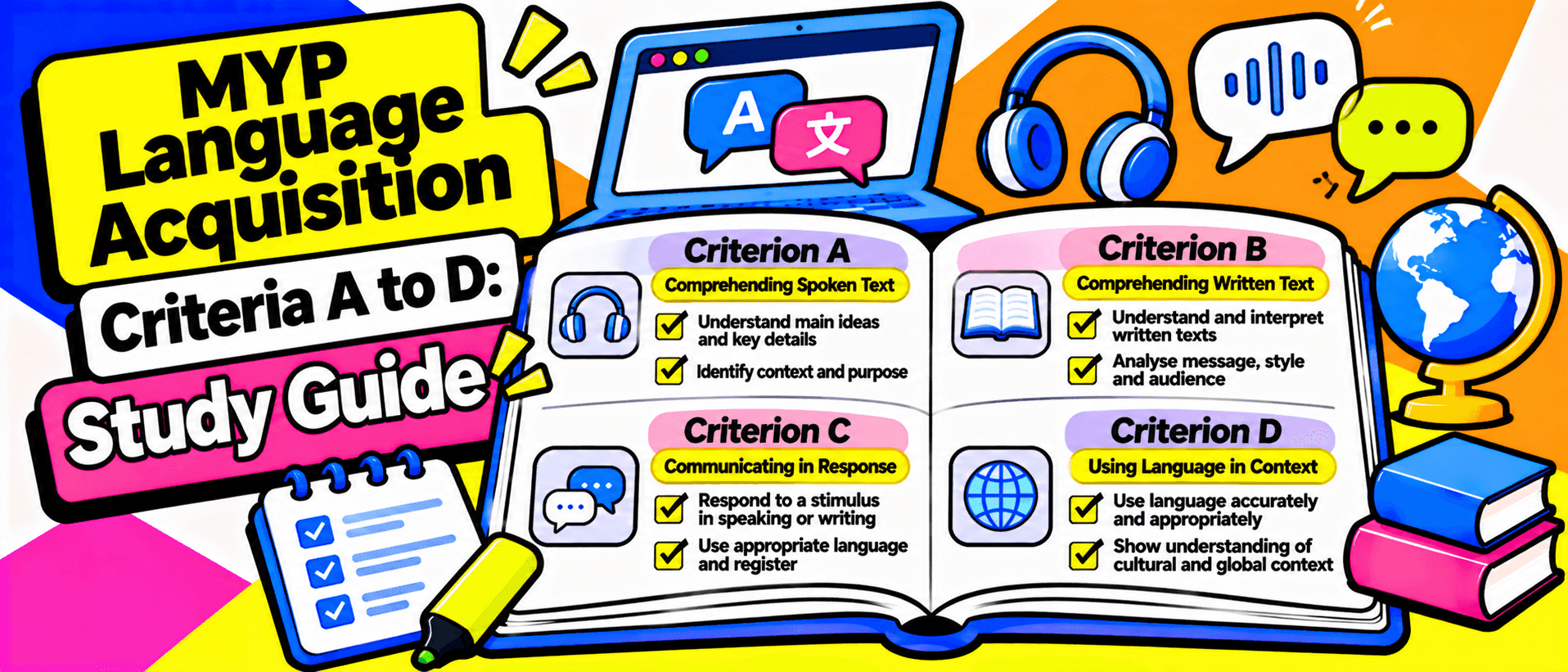
The MYP Language Acquisition criteria make those expectations clearer. Criteria A, B, C and D assess listening, reading, speaking and writing respectively. Understanding each criterion helps you practise and review feedback more effectively.
Students in an April 2026 r/IBMYP examination discussion asked how to prepare for French and Spanish, including writing under Criterion D. Here are original exercises, proficiency-level examples and a revision checklist.
What Do MYP Language Acquisition Criteria A to D Assess?
The IB Language Acquisition subject brief identifies four equally weighted criteria. In school-based assessment, each is assessed using achievement descriptors across levels 1 to 8.
| Criterion | Skill | Central question |
|---|---|---|
| A | Listening | Can you interpret spoken language and accompanying visual information? |
| B | Reading | Can you understand written texts and the meaning created by their visual features? |
| C | Speaking | Can you communicate and interact effectively in the target language? |
| D | Writing | Can you express ideas using language suited to your audience and purpose? |
The MYP organizes language learning into six phases, rather than assigning every student in a school year the same starting point. Formal MYP language acquisition eAssessment is offered at emergent, capable and proficient levels. These describe proficiency pathways, not grades.
Ask your teacher for descriptors matching your proficiency level, then use appropriately challenging materials.
How Does the MYP Language Acquisition eAssessment Work?
The IB's current assessment overview distinguishes classroom assessment from optional external eAssessment in MYP year 5. For language acquisition, external assessment combines an on-screen examination with an individual speaking assessment marked at school and moderated by the IB.
The IB subject brief describes three on-screen tasks covering Criterion A listening, Criterion B reading and Criterion D writing. Criterion C speaking is assessed separately. The published blueprint allocates 24 marks to each of the four components, although the precise distribution within examinations is governed by current assessment guidance.
Plan revision for each assessed skill, rather than relying entirely on conversation or written exercises.
Schools can access specimen examinations through the IB Programme Resource Centre. Ask your coordinator for current materials for your language, level and session. Do not assume that online claims about word counts or formats are official requirements.
Criterion A: Listening Without Translating Every Word
Criterion A focuses on constructing meaning from spoken multimodal texts. A video, for example, may communicate information through a speaker's words, images and setting. Good listening means connecting those clues rather than recognizing isolated vocabulary.
During revision, listen first for the overall message, again for details, and once more to check uncertain answers. This is a practice method, not a statement about permitted examination replays.
Original French listening exercise
Have someone record the following script. Do not look at it until you have answered the questions.
"Samedi, notre collège organise une journée pour protéger la rivière. Le matin, nous allons ramasser des déchets. L'après-midi, des élèves présenteront des idées pour réduire le plastique. J'y participe parce que je veux aider ma ville."
Questions: What is happening on Saturday? What are the two planned activities? Why is the speaker participating?
Answer guide: A river-protection event; collecting rubbish and presenting ideas for reducing plastic; the speaker wants to help their town.
Emergent practice: identify the event and activities. Capable: explain the timetable. Proficient: interpret the speaker's motivation and the contribution of visual clues. These are illustrative extensions, not official questions.
Avoid translating every word as you listen. Track keywords, negatives, time phrases and opinions.
Criterion B: Reading for Meaning and Evidence
Criterion B assesses interpretation of written texts, including the way layout and images contribute to meaning. A notice, article or message may contain familiar words but still demand attention to purpose, audience and implied meaning.
Read for the overall message, locate evidence for each question and check that your answer addresses what was asked.
Original Spanish reading exercise
"El viernes, nuestro instituto celebrará una feria de intercambio de libros. Los estudiantes podrán traer libros que ya han leído y elegir otros. La biblioteca organizará también una conversación sobre historias de diferentes culturas. La actividad busca fomentar la lectura y reducir el desperdicio."
Questions: What must students bring? What additional activity will the library organize? Identify two purposes of the event.
Answer guide: Books they have already read; a discussion about stories from different cultures; encouraging reading and reducing waste.
Annotated response: For the question about purpose, "students bring books" identifies an activity, not a purpose. "The event promotes reading and reduces waste" responds directly to the question and reflects the text's concluding sentence.
Emergent learners identify facts. Capable learners connect ideas across sentences. Proficient learners interpret the school's values and the notice's wording.
Do not substitute outside knowledge for evidence in the text or its visual features.
Criterion C: Speaking as an Interaction, Not a Speech
The MYP speaking assessment emphasizes meaningful interaction on topics of personal, local and global significance. Practising only memorized paragraphs leaves you vulnerable when someone asks a follow-up question.
Record unfamiliar prompts, review clarity and relevance, then answer follow-up questions without notes.
Try these original Spanish prompts: "¿Qué cambiarías en tu colegio?" and "¿Por qué sería importante ese cambio?"
An emergent response might be: "Quiero más árboles en el colegio. Son bonitos y dan sombra." It communicates a simple proposal and reason.
A capable response might be: "Me gustaría plantar más árboles porque los estudiantes necesitan espacios frescos para descansar." It connects a proposal with a fuller explanation.
A proficient response might add a limitation and a solution: "Aunque plantar árboles requiere tiempo y recursos, podríamos empezar con un proyecto dirigido por los estudiantes." It demonstrates more nuanced development of the idea.
These are illustrative examples, not official samples or guaranteed achievement levels.
If you forget a word, paraphrase. If confused, ask for clarification in the target language.
Criterion D: Writing for Audience, Purpose and Format
Criterion D tests whether you can communicate meaningfully in writing, using language suitable for the task. Students searching for MYP French Criterion D advice often focus on verb endings, but accuracy is only one part of effective communication.
Before drafting, identify your audience, purpose, required content and format. A note to a friend needs a different register from an email to a coordinator.
Original French writing task: Your school wants to reduce waste. Write a message inviting a friend to help organize a reusable-bottle campaign. Explain the idea and why participation matters.
A simple opening could be: "Salut Léa, notre école veut utiliser moins de plastique. Tu veux m'aider à organiser une campagne pour les gourdes réutilisables ?"
To develop this across levels, an emergent learner can add a clear time and meeting place. A capable learner can explain the campaign's activities and give a reason. A proficient learner can introduce a potential obstacle, suggest a practical response and use language that connects the ideas naturally.
Original Spanish writing task: Write to a school coordinator proposing a student reading club. Explain how it would work and why it would benefit the school.
A purposeful opening is: "Estimado coordinador: Le escribo para proponer un club de lectura semanal. Esta actividad permitiría a los estudiantes compartir opiniones y descubrir autores de diferentes culturas."
The formal greeting suits the audience. The opening states a proposal and supports it with benefits. Contrast that with "Hola, quiero un club porque me gusta leer," which communicates a wish but offers little development and uses a less suitable register for this recipient.
Review missing details, register, cohesion and errors that change meaning. Confirm task formats and lengths using current IB specimens and teacher guidance.
MYP Language Acquisition Revision Checklist
Alternate listening, reading, speaking and writing practice throughout the week. Use this checklist before your assessment:
- I can identify the main message and supporting details in a recording.
- I can support reading answers with evidence from a text.
- I can respond to follow-up questions without a memorized script.
- I can choose an appropriate audience, purpose and register for writing.
- I know which errors repeatedly affect my understanding or communication.
- I have checked the official tasks for my language and proficiency level.
Common Mistakes That Limit Progress
Memorizing vocabulary without using it: Learn expressions inside sentences, then reuse them in a spoken answer and a written response. Recognition and production require different practice.
Treating all three proficiency levels as interchangeable: Choose materials suited to your registered level. A harder task is not automatically a better revision task if you cannot understand its instructions.
Confusing more words with a stronger answer: In reading, answer the question precisely. In speaking and writing, develop relevant ideas instead of adding unrelated detail.
Ignoring multimodal clues: Notice the images, text layout, speakers and context. The IB criteria explicitly include interpretation of visual elements alongside spoken or written language.
Skipping feedback: After every task, record one error and one specific adjustment. For example, replace "revise grammar" with "check past-tense forms when explaining what happened yesterday."
Final Advice for MYP French, Spanish and Other Languages
Prepare for MYP Language Acquisition criteria through realistic practice, feedback and repeated use of language in unfamiliar situations.
Build listening skills by following meaning rather than translating every word. Read with attention to evidence. Speak responsively instead of reciting. Write for a clear audience and purpose. Above all, confirm the requirements of your current assessment with your teacher and use official IB specimens when available.
With that approach, each practice session teaches you not just more language, but how to communicate with it.
Table of contents
Share
Related reading
- MYP Language and Literature: What Earns a Level 7 or 8? Learn how MYP Language and Literature criteria A to D are assessed, what separates levels 5 to 6 from 7 to 8, and how to improve your writing. Read more.
- MYP Mathematics eAssessment: Command Terms and CriteriaMaster MYP Mathematics eAssessment with all four criteria, clear command terms, original worked examples and practical revision strategies for MYP 5 exams.
- MYP Sciences Criterion B: Designing a Valid InvestigationMaster MYP Sciences Criterion B with testable hypotheses, independent and controlled variables, reliable methods, and Biology, Chemistry and Physics examples.
- MYP Sciences Criterion D: What a 7 to 8 Really TakesLearn what MYP Sciences Criterion D really rewards, see how levels 1 to 8 differ, and use a practical structure to write stronger impact reflections today.
- Inside the MYP eAssessment: Tasks, Timing and MarksDiscover what an MYP eAssessment exam looks like, how tasks and timings work, and why exam marks differ from classroom levels. Read our clear student guide.
- Free MYP Revision Resources That Are Actually UsefulFind free MYP revision resources for Maths, Sciences, English and Individuals and Societies. See what each does well and build a more focused study plan.
- MYP Sciences Criterion B: What Makes a 7 or 8 Design?Learn how to improve your MYP Sciences Criterion B investigation. Explore Year 5 descriptors, hypotheses, variables and methods for achievement levels 7 to 8.
- MYP Math Criterion B: Are Tasks Capping Level 4?Learn how to design MYP Math Criterion B tasks that give students access to Level 7–8 through method choice, verification, justification and proof.