Imagine opening your MYP 5 Chemistry examination and encountering a question asking you to design an experiment.
You understand the scientific concept. You know which variable should change and what needs to be measured.
But is identifying the variables enough? How many measurements should you collect? What makes your procedure valid, and how much detail is necessary?
These are common challenges in MYP Sciences.
During an April 2026 r/IBMYP examination discussion, students exchanged advice about experimental procedures, measurable controlled variables and investigation design.
The discussion highlights an important distinction.
MYP Sciences Criterion B does not simply assess whether you know how an experiment works. It assesses whether you can design a scientifically justified, measurable and safe investigation.
This guide explains the four Criterion B strands, demonstrates complete investigation planning and provides original Biology, Chemistry and Physics examples.
What Is MYP Sciences Criterion B?
According to the official IB MYP Sciences curriculum, scientific inquiry is central to the programme.
Students develop skills through research, observation, experimentation and the evaluation of evidence.
MYP Sciences uses four assessment criteria.
| Criterion | Official title | Maximum achievement level |
|---|---|---|
| A | Knowing and understanding | 8 |
| B | Inquiring and designing | 8 |
| C | Processing and evaluating | 8 |
| D | Reflecting on the impacts of science | 8 |
Criterion B focuses on planning an investigation that can meaningfully answer a scientific question.
At MYP Year 5, its four strands require students to:
- Explain a problem or question suitable for scientific investigation.
- Formulate a testable hypothesis and justify it scientifically.
- Explain how variables will be manipulated or controlled and how relevant data will be collected.
- Design a logical, complete and safe investigation.
These objectives are established in the MYP Sciences assessment framework.
The IB MYP Sciences subject brief provides the official assessment overview.
What Does a Strong Criterion B Response Look Like?
The highest achievement band, 7 to 8, requires more than identifying scientific terms.
Students must explain their investigation using appropriate scientific reasoning and design a method capable of generating sufficient, relevant data.
| Element | Incomplete response | More developed response |
|---|---|---|
| Research question | Names a general topic | Defines a measurable relationship |
| Hypothesis | Makes a prediction | Explains the prediction scientifically |
| Independent variable | Names what changes | Specifies how it changes and across which values |
| Dependent variable | Names what is measured | Explains the instrument, units and measurement method |
| Controlled variables | Lists variables | Explains how each relevant variable is kept constant |
| Procedure | Gives general instructions | Provides a reproducible, logical and safe method |
A longer answer is not automatically better.
Every detail should contribute to answering the research question.
Step 1: Write a Testable Research Question
A strong research question identifies what is being changed and what will be measured.
Consider a Biology investigation.
Weak question:
How does sugar affect potatoes?
This is too broad.
It does not specify the type of sugar solution, the measured response or the experimental conditions.
Improved question:
How does sucrose concentration, from 0.0 to 0.4 mol/L, affect the percentage change in mass of potato cylinders after 45 minutes?
This question establishes:
- The independent variable: sucrose concentration.
- The dependent variable: percentage change in potato mass.
- The experimental range: 0.0 to 0.4 mol/L.
- The exposure period: 45 minutes.
It also identifies a scientifically meaningful relationship involving osmosis.
The exact concentrations and duration are proposed values for an original classroom investigation, not compulsory IB requirements.
Step 2: Formulate a Scientifically Justified Hypothesis
A hypothesis predicts an outcome that can be tested.
However, a strong MYP Sciences Criterion B response must also explain why the outcome is expected.
For the potato investigation:
Weak hypothesis:
The potato will lose mass when more sugar is added.
Stronger hypothesis:
As sucrose concentration increases, the percentage change in potato mass is expected to become more negative because the surrounding solution has a lower water potential. Water will therefore tend to move out of the potato cells through their partially permeable membranes by osmosis.
The stronger response establishes a predicted relationship and connects it to a relevant scientific mechanism.
A successful hypothesis does not have to turn out to be correct.
Scientific investigation involves testing explanations, not guaranteeing predetermined results.
Step 3: Identify the Three Types of Variables
Every controlled investigation requires a clear understanding of variables.
| Variable type | Meaning | Potato example |
|---|---|---|
| Independent | The factor deliberately changed | Sucrose concentration |
| Dependent | The response measured | Percentage change in mass |
| Controlled | Relevant factors kept constant | Potato dimensions, exposure time and temperature |
The most common weakness is naming variables without describing how they will be managed.
For example, writing "temperature is controlled" does not explain the control method.
A stronger response states:
All samples will remain in the same temperature-controlled environment, monitored using a thermometer, throughout the 45-minute exposure period.
This makes the procedure more reproducible.
Step 4: Explain How You Will Control Variables
Controlled variables help prevent alternative factors from affecting the outcome.
For the potato experiment:
| Controlled variable | Method of control | Why it matters |
|---|---|---|
| Potato source | Cut cylinders from the same potato where practical | Reduces biological variation |
| Cylinder dimensions | Use the same cork borer and cut each cylinder to 3 cm | Keeps approximate geometry consistent |
| Solution volume | Use 20 mL for each sample | Maintains consistent exposure conditions |
| Exposure time | Leave all samples for 45 minutes | Prevents differences caused by duration |
| Temperature | Keep samples together in a monitored environment | Reduces temperature-related effects |
| Surface drying | Apply the same brief blotting procedure before weighing | Reduces differences caused by surface liquid |
Not every imaginable factor needs to be included.
Prioritise variables that could plausibly affect the dependent variable.
Explain how they are controlled and why that matters.
Step 5: Plan How to Collect Sufficient Data
A scientifically useful method needs more than one observation.
For the potato experiment, students could investigate five sucrose concentrations:
0.0, 0.1, 0.2, 0.3 and 0.4 mol/L.
They could use three independently prepared potato cylinders at each concentration.
That produces 15 sample measurements.
Each cylinder would be weighed before and after exposure.
The percentage change in mass would then be calculated.
A planned data table could look like this:
| Sucrose concentration (mol/L) | Trial | Initial mass (g) | Final mass (g) | Percentage change (%) |
|---|---|---|---|---|
| 0.0 | 1, 2, 3 | To measure | To measure | To calculate |
| 0.1 | 1, 2, 3 | To measure | To measure | To calculate |
| 0.2 | 1, 2, 3 | To measure | To measure | To calculate |
| 0.3 | 1, 2, 3 | To measure | To measure | To calculate |
| 0.4 | 1, 2, 3 | To measure | To measure | To calculate |
The values in the table describe a proposed investigation. No experimental results have been invented.
Multiple independent trials help reveal variation.
However, repeating measurements does not automatically eliminate systematic error, so accurate equipment and consistent procedures remain essential.
Step 6: Write a Reproducible Experimental Procedure
A weak procedure might say:
Put potatoes in sugar solutions and measure their masses.
Another student would not know how to reproduce the investigation consistently.
A stronger illustrative method would be:
- Prepare five labelled containers containing 20 mL of sucrose solution at the selected concentrations.
- Using appropriate supervision for cutting equipment, prepare 15 potato cylinders with identical nominal dimensions.
- Measure and record the initial mass of each cylinder using the same balance.
- Place three separate cylinders into each concentration, keeping samples identifiable.
- Leave the cylinders immersed for 45 minutes under consistent temperature conditions.
- Remove each cylinder and apply the same brief blotting procedure.
- Measure and record the final mass.
- Calculate the percentage change in mass for each sample.
- Compare the results across the five concentrations.
The plan should also specify suitable personal protective equipment, safe use of cutting tools and hygienic disposal of biological samples.
A strong procedure allows another person to carry out the investigation without repeatedly asking for clarification.
Original Chemistry Example: Reaction Rate and Temperature
Consider an original MYP Chemistry Criterion B practice investigation using commercially available effervescent tablets.
Research question:
How does water temperature, from 15°C to 35°C, affect the time required for a standard effervescent tablet to stop producing visible bubbles?
Hypothesis:
Increasing water temperature is expected to reduce the time until visible effervescence stops because particles generally have greater kinetic energy at higher temperatures, increasing the frequency of effective collisions.
The measured time is an operational indicator of the reaction's progress. It is not a direct measurement of the intrinsic reaction-rate constant.
Variables and Method
| Variable | Proposed approach |
|---|---|
| Independent | Water temperatures of 15°C, 20°C, 25°C, 30°C and 35°C |
| Dependent | Time until visible bubbling stops, measured in seconds |
| Controlled | Tablet brand and mass, water volume, vessel type and mixing procedure |
| Equipment | Thermometer, stopwatch, measuring cylinder, containers and suitable temperature-controlled water baths |
Students could use 200 mL of water per trial and conduct three independent trials at each temperature.
The procedure must explain when the stopwatch starts, how the endpoint is identified and how temperature is maintained or monitored.
Because bubble visibility can be subjective, students should define the endpoint consistently.
Use teacher-approved materials and procedures, avoid sealed reaction vessels and follow school laboratory safety instructions.
This is an original practice design, not an officially endorsed IB experimental protocol.
Original Physics Example: Pendulum Length and Period
Physics investigations often require precise definitions of measurement techniques.
Consider:
Research question:
How does pendulum length, from 0.30 m to 0.90 m, affect the period of a simple pendulum released from an initial angle of approximately 10 degrees?
Hypothesis:
Increasing pendulum length will increase the oscillation period because, for small-angle oscillations, the period is proportional to the square root of the pendulum length.
A well-designed investigation could use five lengths and three independent timing trials at each length.
Students should measure length from the pivot to the centre of the bob, maintain a consistent initial angle and release the bob without pushing it.
To reduce the relative effect of human reaction time, measure ten complete oscillations and divide the total time by ten.
The method should also specify a stable support, a clear swing path and suitable precautions against falling equipment.
Notice that the three scientific examples use different measurement techniques, but the underlying Criterion B principles remain consistent.
Criterion B vs Criterion C: What Is the Difference?
Students sometimes confuse designing an investigation with evaluating its results.
The distinction is important.
| Criterion B: Inquiring and designing | Criterion C: Processing and evaluating |
|---|---|
| Formulates the research question | Presents collected data |
| Develops a justified hypothesis | Processes and interprets results |
| Defines variable manipulation and controls | Uses evidence to evaluate the hypothesis |
| Plans measurements and repeated trials | Evaluates the validity of the method |
| Develops a safe experimental procedure | Discusses improvements or extensions |
Criterion B addresses how an investigation should be conducted.
Criterion C addresses what the resulting evidence shows and how trustworthy the investigation was.
For example, planning three trials belongs to Criterion B.
Analysing the variation between those trials belongs to Criterion C.
The official MYP Sciences subject brief confirms that the two criteria assess related but distinct scientific skills.
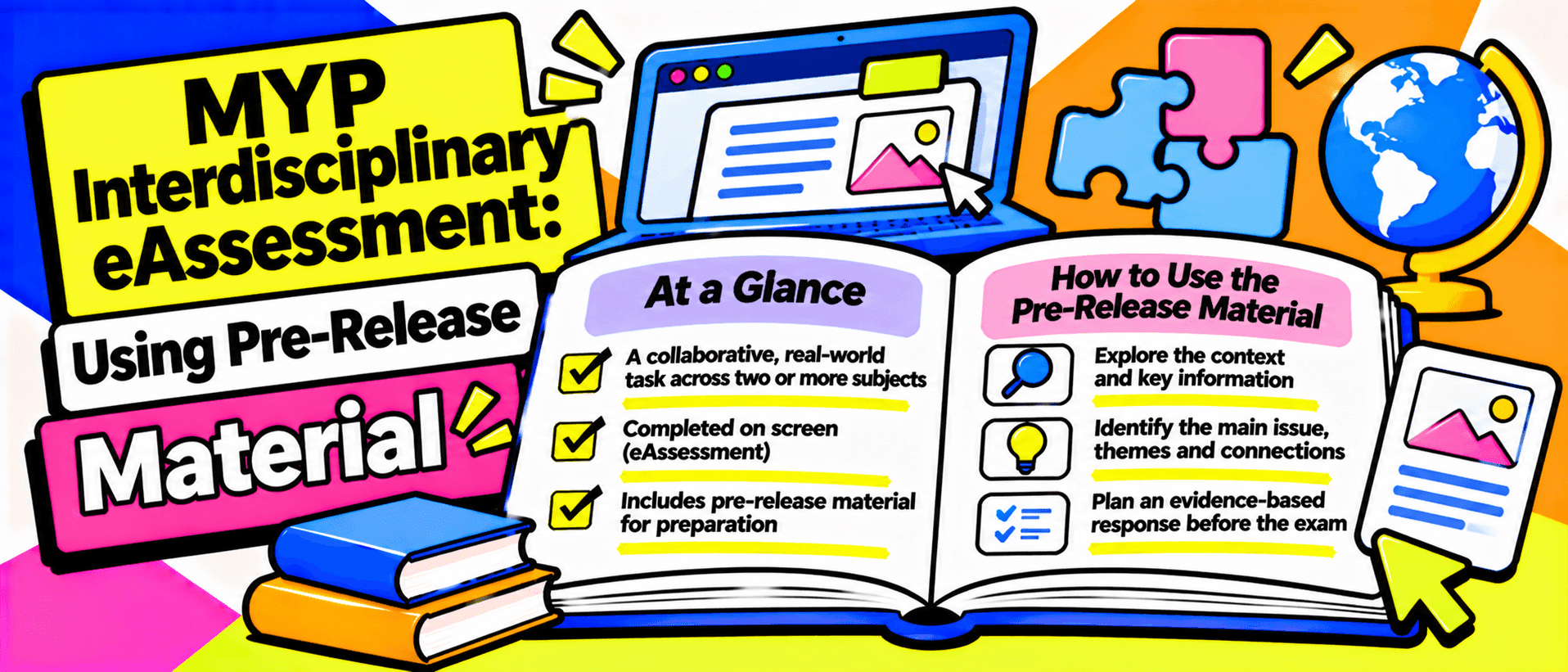
How Does Criterion B Appear in MYP eAssessment?
In MYP 5, students registered for external eAssessment complete an on-screen Sciences examination.
The official subject brief identifies an investigation-skills task assessing Criteria B and C together.
This portion is worth 50 marks within the 100-mark Sciences examination.
It may include a single investigation or several scientific scenarios.
Students might be asked to propose variables, construct a hypothesis, plan a method, interpret data or evaluate an investigation.
The exact context is not known in advance.
Therefore, memorising one laboratory procedure is less useful than practising how to design different investigations.
Common Criterion B Mistakes
Students should avoid these recurring errors.
1. Writing a broad research question. Specify the changed factor, measured response and relevant conditions.
2. Giving a hypothesis without scientific reasoning. Explain the mechanism behind your prediction.
3. Listing controlled variables without methods. State how each relevant factor will remain constant.
4. Using vague measurement instructions. Specify instruments, units and operational definitions.
5. Collecting insufficient data. Plan suitable ranges and independent repeats.
6. Ignoring safety. Identify realistic risks and appropriate precautions.
7. Writing an incomplete procedure. Another person should be able to understand how to perform the investigation.
8. Confusing prediction with results. Do not invent outcomes to support a hypothesis.
The most effective revision involves correcting these weaknesses in original practice designs.
A Simple Criterion B Answer Structure
When responding to an investigation-design question, organise your answer around the four strands.
Research question: What relationship are you investigating, and why is it scientifically relevant?
Hypothesis: What do you predict, and which scientific explanation supports that prediction?
Variables and data: What will you change, measure and control? How will you collect sufficient evidence?
Method: What equipment, sequence, repetitions and safety precautions are needed?
This structure is a revision framework, not an official IB answer template.
Use the precise wording and mark allocation of the question to determine how much detail to provide.
Final MYP Sciences Criterion B Checklist
Before submitting your investigation design, check that:
- Your research question is specific and testable.
- The independent and dependent variables are clearly identified.
- Your hypothesis predicts a measurable relationship.
- Scientific reasoning supports the hypothesis.
- You explain how the independent variable changes.
- You specify how the dependent variable is measured, including units.
- Relevant controlled variables have clear control methods.
- Your data collection plan includes suitable values and repetitions.
- Equipment and quantities are sufficiently specified.
- The method is logical, reproducible and safe.
Final Verdict: How to Improve in MYP Sciences Criterion B
A strong MYP Sciences Criterion B response is a complete plan for a valid scientific investigation.
It begins with a focused question, develops a scientifically justified hypothesis and explains exactly how relevant variables will be changed, measured or controlled.
It also provides a safe and reproducible method capable of generating enough useful evidence to answer the question.
Whether you are planning a Biology osmosis experiment, a Chemistry reaction investigation or a Physics pendulum study, the same principles apply.
The objective is not to memorise the longest experimental procedure.
It is to demonstrate that you understand why each part of the method is necessary.
The best test of your Criterion B answer is simple: Could another student follow your plan, collect meaningful data and investigate the same question fairly?
For official guidance, consult the IB MYP Sciences curriculum, the MYP Sciences subject brief and the IB MYP assessment and examinations overview.
Table of contents
Share
Related reading
- MYP Sciences Criterion D: What a 7 to 8 Really TakesLearn what MYP Sciences Criterion D really rewards, see how levels 1 to 8 differ, and use a practical structure to write stronger impact reflections today.
- MYP Sciences Criterion B: What Makes a 7 or 8 Design?Learn how to improve your MYP Sciences Criterion B investigation. Explore Year 5 descriptors, hypotheses, variables and methods for achievement levels 7 to 8.
- MYP Math Criterion B: Are Tasks Capping Level 4?Learn how to design MYP Math Criterion B tasks that give students access to Level 7–8 through method choice, verification, justification and proof.
- MYP Language Acquisition Criteria A to D: Study GuideLearn MYP Language Acquisition criteria A to D with French and Spanish practice for listening, reading, speaking and writing. Use our revision guide today.
- MYP Mathematics eAssessment: Command Terms and CriteriaMaster MYP Mathematics eAssessment with all four criteria, clear command terms, original worked examples and practical revision strategies for MYP 5 exams.
- Inside the MYP eAssessment: Tasks, Timing and MarksDiscover what an MYP eAssessment exam looks like, how tasks and timings work, and why exam marks differ from classroom levels. Read our clear student guide.