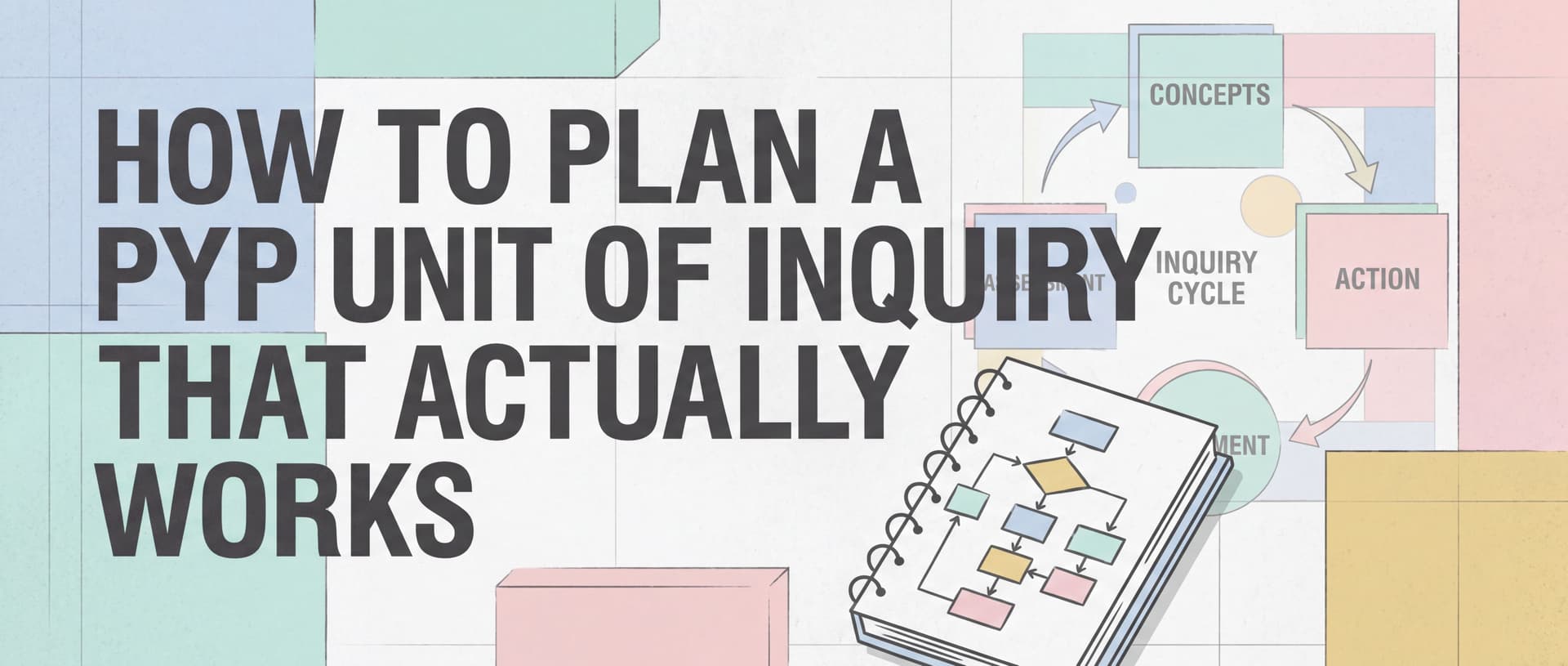
A PYP Unit of Inquiry can look complete on paper and still feel disconnected in the classroom.
The theme is there. The central idea sounds polished. The planner contains lines of inquiry, concepts, learning goals, assessment, ATL skills and reflections. Yet the learning experiences can still become a collection of activities that never quite build toward the same understanding.
Strong PYP unit planning solves that problem by creating alignment. The theme gives the inquiry its wider context. The central idea names the understanding. Lines of inquiry create focus. Concepts deepen thinking. Assessment makes understanding visible. Learning experiences provide the knowledge and skills needed to build it.
This guide takes you through that process and includes a practical PYP Unit of Inquiry planner template you can adapt for your school.
What a PYP Unit of Inquiry Planner Is Really For
A PYP planner is not simply a document completed before teaching begins. It is a working record of the thinking behind the unit.
Current digital PYP planning structures reflect this breadth. ManageBac, for example, includes fields for the transdisciplinary theme, central idea, lines of inquiry, learning goals, success criteria, concepts, learner profile connections, ATL skills, action, ongoing assessment, learning experiences and reflection.
The important point is not the number of fields. It is the relationship between them.
A useful planner should help a teaching team answer four questions:
- What significant understanding should learners develop?
- What evidence would show that this understanding is growing?
- What learning experiences will help learners build it?
- How will learner questions, choices and reflection influence what happens next?
Step 1: Start With the Transdisciplinary Theme
Every Unit of Inquiry sits within one of the six PYP transdisciplinary themes. The theme gives the unit a broad human context and helps connect learning across subject boundaries.
Do not choose a theme only because a topic appears to fit it. Consider a unit on migration. It could explore movement through history and geography, systems that influence migration, identity and belonging, or the effects of migration on communities and resources.
The better question is: what larger understanding are learners exploring through this context?
That decision also benefits from collaboration. A genuinely transdisciplinary unit may need contributions from class teachers and specialists rather than subject activities attached after the main plan is finished. Both practitioner accounts and digital planning structures emphasise collaborative planning as a significant part of building a coherent unit.
Step 2: Write a Central Idea That Can Travel
The central idea is the conceptual heart of the unit.
A weak central idea often names a topic or states a fact. A stronger one expresses a relationship that learners can investigate, challenge, apply and transfer.
Compare these statements:
Topic statement: Communities have different systems.
Conceptual statement: Systems change in response to the needs and values of communities.
The second gives learners more to think about. They can investigate different systems, examine causes of change, consider perspectives and test whether the idea still holds in unfamiliar situations.
Before finalising a central idea, ask:
- Does it express an understanding rather than a topic?
- Can learners investigate relationships within it?
- Can the idea transfer beyond one example?
- Does it fit the selected theme?
- Can we gather evidence that learners understand it?
Step 3: Build Lines of Inquiry That Divide the Thinking
Lines of inquiry define the main pathways through the central idea. They should not become a disguised list of weekly topics.
For the central idea, “Systems change in response to the needs and values of communities,” possible lines of inquiry could be:
- The structures and purposes of community systems
- Factors that cause systems to change
- How different perspectives influence decisions within systems
Together, the lines move from understanding what systems are, to investigating change, to examining perspective. They create focus without forcing the inquiry into a rigid sequence.
This reflects the broader purpose of lines of inquiry as focused threads through which learners can investigate the relationships contained within the central idea.
Step 4: Choose Concepts, Goals and Skills With Purpose
Concepts should deepen the inquiry, not simply fill a planner field.
In a unit about systems and communities, function could help learners investigate how systems operate. Change could focus attention on why systems evolve. Perspective could help learners examine how different groups experience the same system.
Apply the same discipline to learning goals and ATL skills. Choose the skills learners genuinely need for the inquiry, then plan opportunities to teach and practise them.
Current planning structures also make space for learner profile connections, action and success criteria. These are most useful when tied to observable learning rather than added simply because the planner provides a field for them.
Step 5: Plan Questions and Provocations
A central idea becomes an inquiry when learners have something worth wondering about.
Teacher questions can establish essential knowledge, explore relationships between concepts and invite judgement based on evidence. For example:
- What systems exist in our community?
- How does the structure of a system influence what it can do?
- When should a community change a system that no longer works for everyone?
Provocations can help these questions emerge. A photograph, object, scenario, local problem, contradictory claim, short text or unfamiliar data set can reveal prior thinking and create curiosity.
Chad Hyatt, writing about upper primary PYP planning, describes building questions from concepts and context and revisiting debatable questions later to see how learners' thinking has changed. The implication is useful: questions can become evidence of developing understanding.
Do not try to predict every student question before the unit begins. Plan enough structure to launch meaningful inquiry while leaving room for learner thinking to influence what happens next.
Step 6: Design Assessment Before Planning Every Activity
One of the easiest planning mistakes is to fill several weeks with engaging experiences and decide on assessment afterward.
Instead, ask first: what would learners need to explain, create, apply, compare, justify or demonstrate for us to know that they understand the central idea?
Plan evidence across the inquiry.
Before learning: identify prior knowledge, misconceptions, questions and readiness.
During learning: gather evidence through observation, discussion, journals, drafts, demonstrations, conferences and reflection.
Toward the end: give learners an opportunity to demonstrate conceptual understanding in a task connected directly to the central idea and lines of inquiry.
Assessment should inform the next teaching decision, not only produce a final record. The provided planning sources similarly place formative evidence, culminating assessment and reflection inside the planning process rather than treating assessment as a separate final stage.
For a deeper explanation, see the Koncepts School guide PYP Assessment Without Exams: A Practical Guide.
What the Official IB Worked Example Shows
The IB provides a useful worked planner titled Signs and Symbols for learners aged 5 to 6.
Its central idea states that “Signs and symbols can be used to communicate a message.” The lines of inquiry examine signs and symbols, reasons they are used, and the features that help them communicate locally and globally.
The assessment follows the same logic. Learners create a sign or symbol, consider the message it communicates and explain aspects of their thinking.
The value of the example is the alignment:
- Theme
- Central idea
- Lines of inquiry
- Questions and learning experiences
- Evidence of understanding
- Reflection
There is one important caution. The official PDF carries a 2007 copyright and uses terminology from an earlier version of PYP planning. It is valuable as an example of coherent inquiry design, but it should not be treated as a current planner template to copy field for field.
Free PYP Unit of Inquiry Planner Template
Use this as an ungated planning template and adapt the fields to your school's process. The structure brings together the major planning areas visible across the provided PYP planning references.
Unit basics
Transdisciplinary theme:
Age or year level:
Unit title:
Duration:
Subject connections:
Inquiry
Central idea:
Lines of inquiry:
Specified concepts:
Related concepts:
Learner profile connections:
Questions and provocations
Opening provocation:
Teacher questions:
Emerging student questions:
Learning
Learning goals:
Success criteria:
ATL skills:
Connections to prior and future learning:
Potential learning experiences:
Resources, people, places and materials:
Support and differentiation:
Assessment
Evidence of prior understanding:
Ongoing assessment evidence:
Culminating evidence of understanding:
Student self assessment:
Peer feedback opportunities:
Agency and action
Where can learners make meaningful choices?
How can learner questions influence the inquiry?
What opportunities exist for student initiated action?
Reflection
What are learners understanding now?
Which misconceptions are becoming visible?
What evidence should influence the next learning experience?
What changed during the unit?
What should the teaching team retain, revise or remove next time?
Your Planner Should Be Allowed to Change
Strong planning does not mean predicting every lesson before learners enter the room.
A provocation may reveal stronger prior understanding than expected. A student question may open a worthwhile direction. Assessment may expose a misconception that needs direct teaching. A specialist teacher may see a connection the original team missed.
Qridi's planning guidance similarly stresses that initial unit ideas can change as students become active participants in their learning and as teachers continue to collaborate and reflect.
Toddle contributor Chad Hyatt captures the principle well: “no one can create a unit that can be relevant in all contexts.” He argues for collaboration with teachers and students so the unit can be adapted to the learners and school in front of you.
Digital planners also support ongoing reflection and collaborative editing, which matches the reality of inquiry. Teachers plan, teach, notice, reconsider and refine.
Related Blogs
- PYP Assessment Without Exams: A Practical Guide
- PYP Concept Based Learning: From Topics to Transfer
- How to Build Meaningful PYP Reflection in the Classroom
Build Your Next Unit Around the Understanding
The strongest PYP planners are not necessarily the longest. They are the ones where every major decision points toward the same understanding.
The theme gives context. The central idea names the understanding. Lines of inquiry create focus. Concepts deepen thinking. Questions and provocations open investigation. Assessment makes learning visible. Agency gives learners meaningful influence. Reflection helps the plan evolve.
If you already have a theme, central idea or early unit concept, the Koncepts UOI Content Builder can help turn it into a connected planning structure while keeping teacher judgement at the centre.
A planner should reduce friction, not replace professional thinking. The goal is to spend less time completing disconnected fields and more time designing an inquiry that makes sense from the first provocation to the final evidence of understanding.
Table of contents
Share
Related reading
- IB PYP for Parents: What Your Child Is Really LearningUnderstand how the IB PYP works, what your child learns, how inquiry and assessment work, and what parents should expect. Read the complete parent guide.
- IB English IO: How to Choose a Global Issue That WorksLearn how to choose an IB English IO global issue, select strong extracts, structure the ten minutes and understand all four assessment criteria clearly.
- May 2027 IB Exam Timetable: Plan Revision BackwardsSee the confirmed May 2027 IB exam dates, identify tight subject clusters, and build a smarter revision plan backwards from your papers with less stress.
