Timetable verified on 9 October 2026 against the May 2027 IB Diploma Programme and Career related Programme final examination schedule. Always use your school coordinator and personal candidate timetable to confirm your local start times and arrangements.
Most revision plans begin with today.
They ask how many hours you can study this week, which subject feels weakest and how much of the syllabus remains.
For the May 2027 IB examinations, start somewhere else:
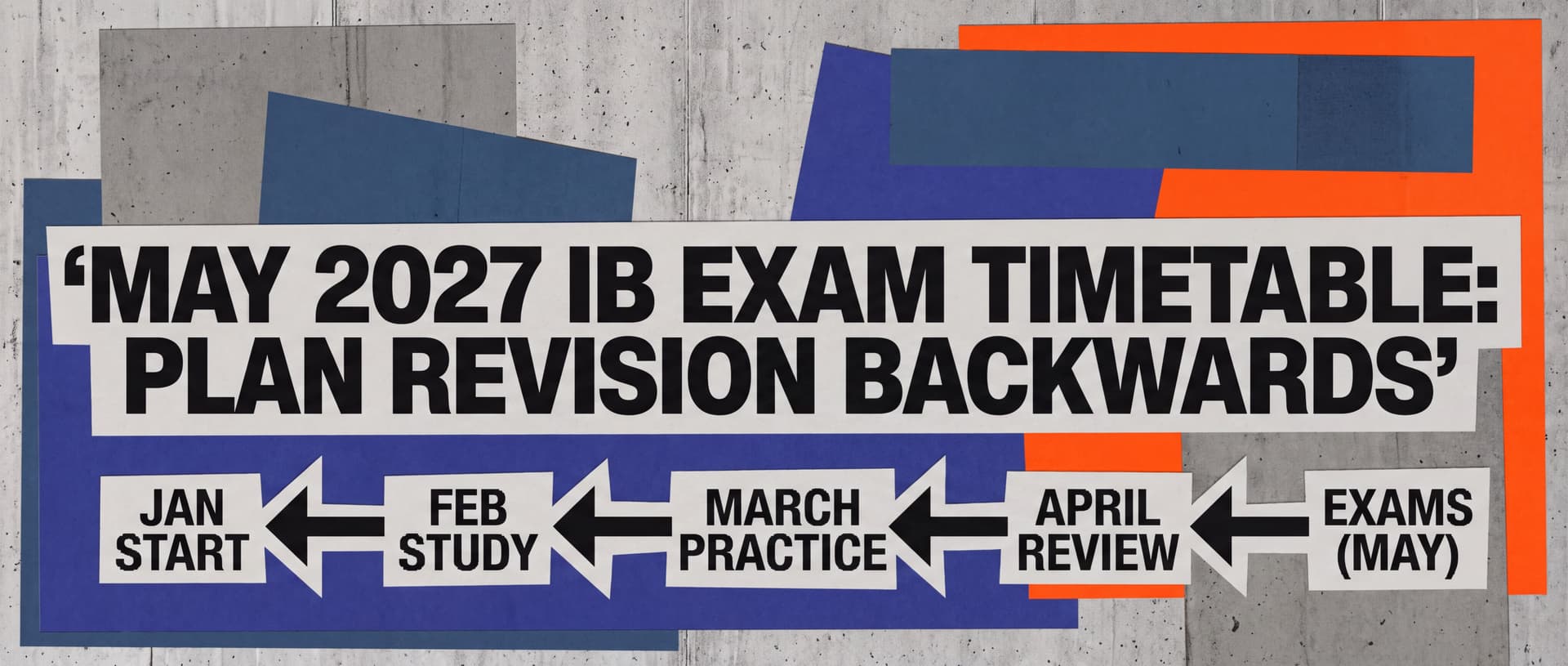
Start with your last paper and work backwards.
The final May 2027 timetable is now available. It is marked FINAL VERSION and covers all examination zones. Written examinations begin on Friday 23 April 2027 and finish on Tuesday 18 May 2027. There are no examinations on 1 May.
Source: May 2027 IB Final Examination Schedule
Those dates should change how you revise.
A student taking Biology and Economics faces a very different final month from someone taking Business Management and Mathematics. Your six subjects may be spread reasonably evenly, or four important papers may arrive within two days.
The timetable is therefore more than an administrative document.
It is the structure your revision plan should be built around.
The May 2027 IB Exam Dates That Matter Most
All dates and morning or afternoon sessions below come directly from the May 2027 final IB examination schedule.
| Subject | May 2027 examination dates |
|---|---|
| Business Management | Paper 1 and HL Paper 3: 27 April afternoon. Paper 2: 28 April morning |
| Physics | Paper 1: 28 April afternoon. Paper 2: 29 April morning |
| Psychology | Papers 1 and 2: 29 April afternoon. HL Paper 3: 30 April morning |
| Computer Science | Paper 1: 30 April afternoon. Paper 2: 3 May morning |
| Environmental Systems and Societies | Paper 1: 30 April afternoon. Paper 2: 3 May morning |
| History | Papers 1 and 2: 3 May afternoon. HL Paper 3: 4 May morning |
| Chemistry | Paper 1: 5 May afternoon. Paper 2: 6 May morning |
| English A | Paper 1: 6 May afternoon. Paper 2: 7 May morning |
| English B | Paper 1 and reading: 6 May afternoon. Listening: 7 May morning |
| Geography | Paper 1: 7 May afternoon. Paper 2 and HL Paper 3: 10 May morning |
| Biology | Paper 1: 10 May afternoon. Paper 2: 11 May morning |
| Economics | Paper 2: 11 May afternoon. Paper 1 and HL Paper 3: 12 May morning |
| Mathematics AA and AI | Paper 1: 13 May afternoon. Paper 2: 14 May morning. HL Paper 3: 18 May afternoon |
| Digital Society | Paper 1: 14 May afternoon. Paper 2 and HL Paper 3: 17 May morning |
| Global Politics | Papers 1 and 2: 14 May afternoon. HL Paper 3: 17 May morning |
Language schedules require additional attention. English, French and Spanish are scheduled separately from the other languages, so students should check the exact language and course listed on their own timetable.
Do not copy local clock times from another student online. The final schedule assigns different morning and afternoon start times according to examination zone, and schools are responsible for knowing their allocated zone.
Source: May 2027 IB Final Examination Schedule
Why You Should Ignore Older Provisional 2027 Dates
This timetable is also a useful reminder not to plan an IB examination season from memory.
The final May 2026 schedule included an advance note saying the 2027 session was expected to finish on Wednesday 19 May 2027, subject to confirmation.
The final 2027 timetable instead finishes on Tuesday 18 May.
Source: IB May 2026 Examination Schedule
One day sounds small until it changes a flight, revision plan, university event or family booking.
Use the final schedule for planning.
Then use the timetable issued by your school for the details that apply specifically to you.
The Difficult Part Is Not the First Exam
The dates become useful when you stop reading them one subject at a time.
Look at them as clusters.
Consider a student taking Physics and Psychology:
28 April afternoon: Physics Paper 1
29 April morning: Physics Paper 2
29 April afternoon: Psychology Papers 1 and 2
30 April morning: Psychology HL Paper 3, if taking HL
That can mean four demanding examination sessions in a very short period.
Now consider Chemistry and English:
5 May afternoon: Chemistry Paper 1
6 May morning: Chemistry Paper 2
6 May afternoon: English Paper 1
7 May morning: English Paper 2 or listening component
Again, revision time almost disappears once the sequence begins.
Biology and Economics create another demanding run:
10 May afternoon: Biology Paper 1
11 May morning: Biology Paper 2
11 May afternoon: Economics Paper 2
12 May morning: Economics Paper 1, plus Paper 3 for HL
A student with this combination cannot reasonably plan to learn major Economics content after finishing Biology. The preparation for Economics has to be substantially complete before the Biology papers begin.
That is what working backwards from the timetable reveals.
Actual Clashes Need Your Coordinator
A pressure cluster and an examination clash are not the same thing.
A pressure cluster means several examinations arrive close together.
A genuine clash occurs when examinations you are registered for occupy the same session.
The IB says registration data is used when building the timetable to minimise the number of students affected by clashes. It also states that an examination cannot simply be rescheduled by a student or school without IB authorization.
If your personal combination produces an overlap, speak to your Diploma Programme coordinator.
Do not decide for yourself that you will sit one paper later.
Your school's arrangements and the applicable IB assessment procedures control what happens.
Build Your Revision Plan From the Papers Backwards
The schedule itself does not tell you when to revise each topic.
The following is a practical Koncepts planning model, not an official IB requirement.
Eight to Six Weeks Before Your First Paper
Diagnose before you intensify.
Complete representative questions from every major area of each subject and identify three categories:
Secure: You can answer reliably without notes.
Unstable: You understand the content but lose marks through application, recall or technique.
Missing: You cannot yet produce an acceptable response independently.
Spend most of this stage repairing the last two categories.
Do not make the mistake of repeatedly revising the material that already feels comfortable.
Nail IB also recommends building revision backwards from the examination date. The useful principle is the direction of planning, rather than treating any one fixed number of revision days as an IB rule.
Five to Three Weeks Before Your First Paper
Move from topics to examination performance.
Start mixing content.
Instead of completing ten questions from one chapter immediately after revising it, combine questions from different areas so that you must decide which knowledge or method applies.
Add timed sections.
Then review every response against the markscheme.
Separate errors into:
- content gaps
- command term mistakes
- weak explanations
- calculation errors
- timing problems
- missing evaluation or justification
This is also the stage where Koncepts DP can become useful for moving between syllabus lessons, questions, past papers and markschemes without treating each as a separate revision activity.
Two Weeks Before the First Paper
Your revision should increasingly resemble the conditions under which you will be assessed.
Complete full papers where appropriate.
Use the real time limit.
Use only the materials permitted for that paper.
Practise the transition between papers that sit close together.
If you take Mathematics, do not make exam mode on your calculator an exam morning discovery. RevisionDojo similarly recommends rehearsing the required calculator setup before the examination. Confirm your permitted calculator and the current restrictions with your school.
The same principle applies beyond Mathematics.
Know what you need to bring.
Know how long each paper lasts.
Know whether your next examination is that afternoon, the next morning or several days later.
Remove avoidable surprises.
The Final Week Should Follow Your Personal Timetable
Once examinations begin, a balanced six subject timetable stops making sense.
Your next paper deserves more attention than a paper sitting ten days later.
Lanterna's final exam guidance recommends prioritising the next examination while still preserving rest and some attention for subjects that remain. It also offers a useful four word rule after a difficult paper:
“What’s done is done.”
Source: Lanterna Education: Getting Through the Final Exams
That mindset matters.
Do not spend three hours after Biology Paper 1 comparing answers in a group chat when Biology Paper 2 is the next morning.
Do not perform a postmortem on Economics when Mathematics begins the following afternoon.
Review what remains.
Then move forward.
Protect Subjects That Appear Late
The opposite mistake is forgetting late examinations because early papers feel more urgent.
Mathematics HL Paper 3 is on the afternoon of 18 May, the final day of the May 2027 schedule.
That does not mean HL Mathematics revision should disappear while you prepare for earlier subjects.
Use maintenance sessions.
Once a subject reaches a strong level, a short timed set every few days can preserve fluency while your main revision attention moves elsewhere.
This is especially important for subjects that depend on procedural speed, essay planning or regular retrieval.
Your plan should therefore contain two types of work:
Priority work for the next examinations.
Maintenance work for later subjects you cannot afford to forget.
Mark Your High Pressure Windows Now
Take the final timetable and create your own six subject version.
For every paper, record:
- date
- morning or afternoon session
- paper number
- level
- duration
- permitted equipment
- days since the previous examination
- time until the next examination
Then highlight every period where you have three or more sessions close together.
Those are your high pressure windows.
The final IB schedule explains that subjects with high candidature are distributed across the four weeks and that most papers within a subject are scheduled on consecutive days. That helps the global timetable, but your personal combination can still create intense sequences.
Your revision should compensate for those sequences before they arrive.
What to Do This Week
Do not respond to the May 2027 timetable by suddenly trying to study six subjects every day.
Build the map first.
Put every paper from your own combination onto one page.
Circle your tightest clusters.
Identify the subject that must be examination ready earliest.
Then identify any later subject that will need maintenance while those early examinations dominate your attention.
After that, work backwards.
Content first.
Then mixed questions.
Then timed sections.
Then full paper conditions.
Then final review.
The timetable tells you when the assessment happens.
Your job is to decide when the learning needs to be finished.
That is the difference between revising until an exam arrives and preparing deliberately for the sequence you already know is coming.
Related Resources
Koncepts DP, for syllabus lessons, practice questions, past papers and markschemes.
How to Get Through Your Final IB Exams, from Lanterna Education.
IB Math: Put Your Calculator in Exam Mode, from RevisionDojo.
How to Revise for IB, from Nail IB.
Table of contents
Share
Related reading
- IB in India: What Universities and CUET Really RequireApplying to Indian universities with the IB Diploma? Read our guide to CUET, recognition, percentage conversion and subject choices to plan your next steps.
- Best AI Tools for IB Students: What Actually Helps?Compare AI tools for IB explanations, practice, coursework and notes. Use a real IB question to check their limits and choose the right support for study.
- The Most Valuable IB Season That Students Almost Always WasteMake the most of your DP1 to DP2 summer with a practical plan to finish your Extended Essay, prepare HL subjects, and start DP2 ahead.
