
What is DNA Replication and Why Does It Matter?
Every time a cell divides, it must pass on a complete set of genetic instructions to each daughter cell. This is achieved through DNA replication — one of the most fundamental processes in biology.
The biological process by which a cell copies its entire DNA molecule, ensuring that each daughter cell receives an identical set of genetic instructions during cell division.
DNA replication is essential for three key reasons:
- Reproduction: Offspring inherit DNA from their parents — this inheritance depends on accurate copying of DNA.
- Growth: Multicellular organisms grow by producing more cells through division, each needing a full copy of the genome.
- Tissue Replacement: Worn-out or damaged cells (e.g., skin cells, red blood cells) are continuously replaced, which requires cell division and therefore DNA replication.
Think of DNA replication like photocopying a blueprint before construction begins. Every builder (daughter cell) needs their own complete set of plans — an incomplete or inaccurate copy could lead to serious problems.
Semi-Conservative Replication
DNA replication is described as semi-conservative. This term describes what happens to the original (parental) strands during copying.
A mode of DNA replication in which each new DNA double helix consists of one original (parental) strand and one newly synthesised strand.
Here is what happens step by step:
- The two strands of the parental DNA double helix separate.
- Each original strand acts as a template for building a new complementary strand.
- The result is two identical DNA molecules, each containing one old strand and one new strand.
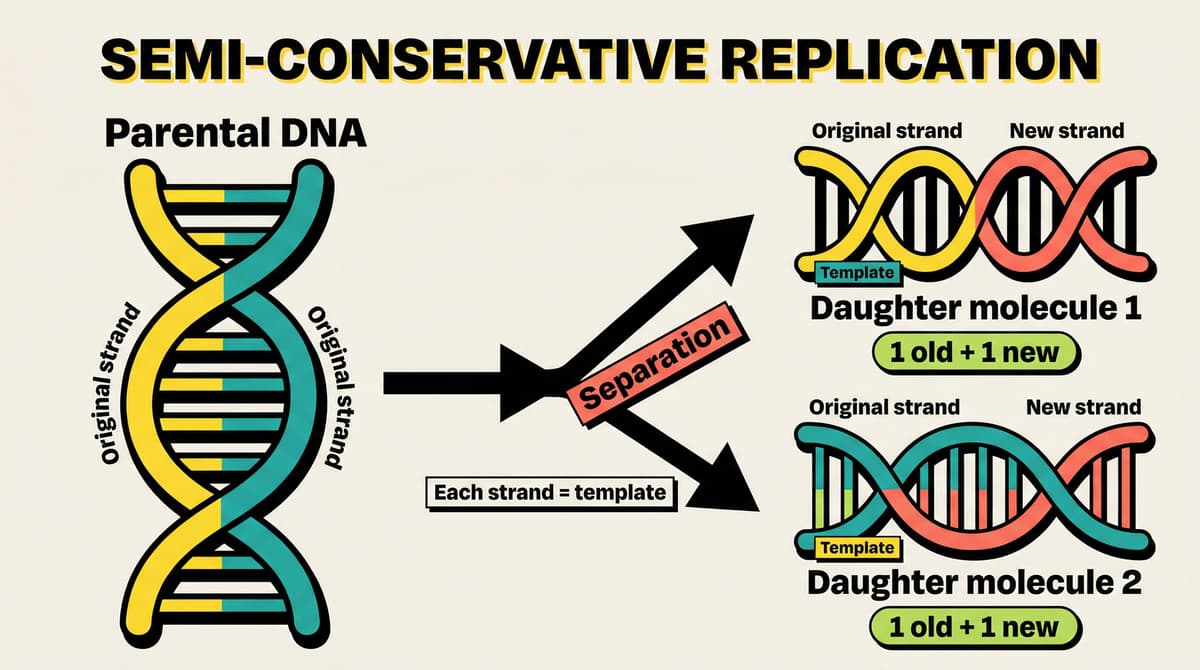
Memory aid: "Parents share, kids pair." Each parent strand is shared with a new complementary strand in each daughter molecule — nothing is lost, nothing is entirely new.
The Meselson-Stahl experiment (1958) provided definitive evidence for semi-conservative replication. They grew bacteria in a medium containing heavy nitrogen (N), then transferred them to normal (N) medium. After one round of replication, all DNA had intermediate density — consistent with each molecule containing one heavy and one light strand. This ruled out conservative and dispersive models of replication.