Introduction: The Nuclear Atom
Every element in the universe is defined by something astonishingly small — the nucleus at the centre of its atoms. Understanding atomic structure is the foundation of all chemistry: it explains why elements have unique identities, why isotopes exist, and how atomic mass is calculated.
In this subtopic, we explore:
- The three subatomic particles and their properties
- How nuclear symbols encode an atom's structure
- What isotopes are and how to calculate relative atomic mass
- How to interpret mass spectra (a key analytical tool)
Think of the atom like a vast, mostly empty stadium. The nucleus is a marble sitting at the centre — tiny, but containing almost all the mass. The electrons are like scattered specks of dust somewhere in the stands.
Subatomic Particles: Protons, Neutrons, and Electrons
Atoms are composed of three types of subatomic particles, each with distinct properties:
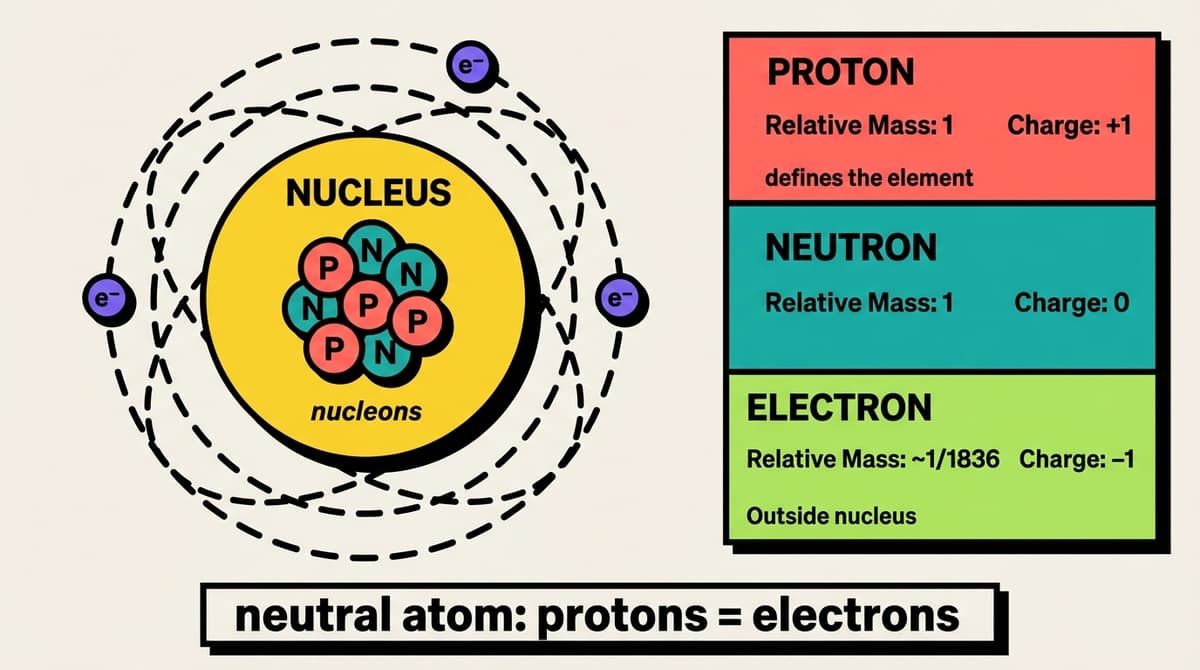
The nucleus is the dense, positively charged core of an atom containing protons and neutrons, collectively called nucleons.
| Particle | Relative Mass | Relative Charge | Location |
|---|---|---|---|
| Proton | 1 | +1 | Nucleus |
| Neutron | 1 | 0 | Nucleus |
| Electron | Negligible (~1/1836) | −1 | Outside nucleus |
Key points:
- Protons define the element. An atom with 6 protons is always carbon — no exceptions.
- Neutrons stabilise the nucleus by offsetting proton-proton repulsion. Their number can vary, giving rise to isotopes.
- Electrons determine chemical behaviour. Their arrangement around the nucleus controls how atoms bond and react.
- In a neutral atom, the number of electrons equals the number of protons.
Actual particle masses are on the order of kg — far too small for everyday use. Relative masses expressed in atomic mass units (amu) make calculations manageable. Protons and neutrons each have a relative mass of 1; the electron's mass is so small it is treated as negligible.