
Introduction: What Is Entropy?
Why does ice melt in your hand? Why does perfume spread across a room? Why does a hot coffee cool down? These everyday phenomena share a common thermodynamic thread: entropy.
Entropy (symbol ) is a thermodynamic property that quantifies the dispersal or distribution of energy and matter in a system. The greater the dispersal, the higher the entropy.
Entropy is often described informally as a measure of disorder or randomness, but this is a simplification. More precisely, entropy is related to the number of microstates — the number of different ways the energy and particles of a system can be arranged.
A microstate is one specific arrangement of the particles and energy of a system. The more microstates available, the higher the entropy.
Think of a freshly opened deck of cards — perfectly sorted, with only one possible arrangement (low entropy). After shuffling, there are an astronomically large number of possible arrangements (high entropy). Chemical systems behave analogously: more possible arrangements of particles and energy means higher entropy.
While "disorder" is a handy analogy, it can mislead. Entropy is rigorously defined through statistical mechanics as , where is the number of microstates and is Boltzmann's constant. For IB purposes, focus on energy/matter dispersal and the qualitative trends this produces.
Entropy and States of Matter
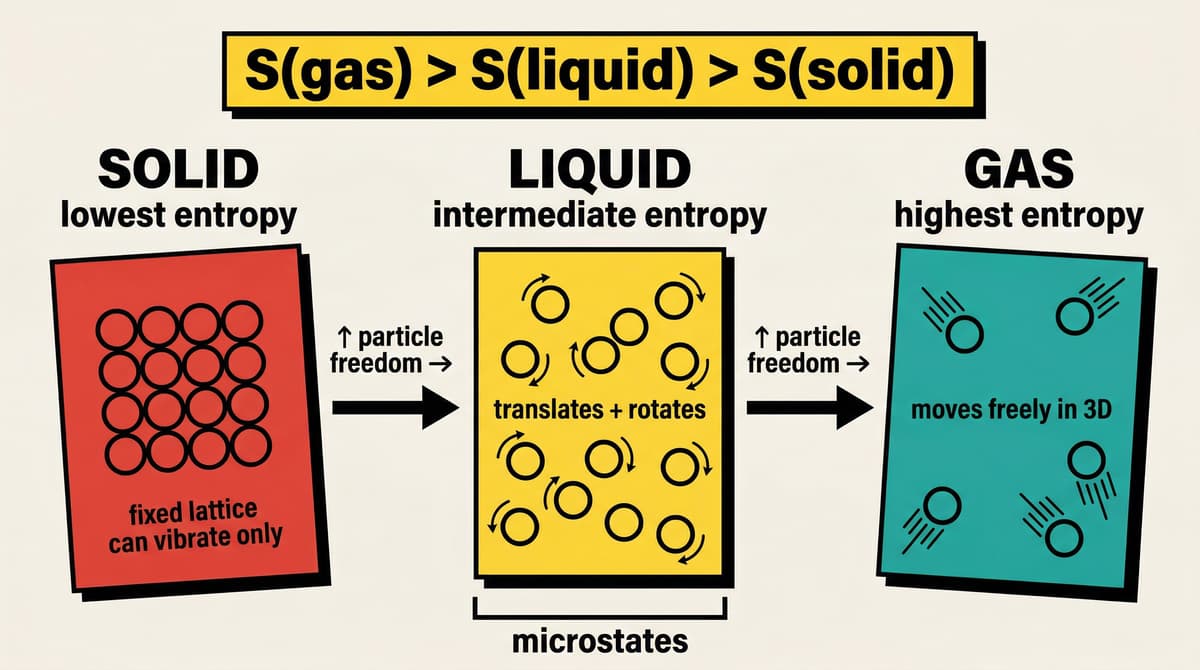
The state of matter is the single most important factor in comparing the entropy of substances under identical conditions. The general trend is:
- Solids: Particles are locked in fixed lattice positions and can only vibrate. Very few microstates are available → lowest entropy.
- Liquids: Particles can translate and rotate, giving greater freedom of movement → intermediate entropy.
- Gases: Particles move rapidly and randomly in three dimensions, occupying a large volume → highest entropy.
Entropy Changes During Phase Transitions
| Phase Transition | Reason | |
|---|---|---|
| Solid → Liquid (melting) | Particles gain translational freedom | |
| Liquid → Gas (vaporisation) | (large) | Massive increase in particle dispersal |
| Gas → Liquid (condensation) | Particles become more constrained | |
| Liquid → Solid (freezing) | Particles return to ordered lattice |
When ice melts, the rigid hydrogen-bonded crystal lattice breaks down and water molecules gain freedom to move and rotate. This increases the number of available microstates, so . When liquid water vaporises at 100°C, the entropy increase is far larger still, as gaseous water molecules become highly dispersed.
Do not assume that all exothermic processes decrease entropy. Entropy depends on the dispersal of energy and matter — not directly on heat flow. For example, the combustion of propane is exothermic and increases entropy (due to an increase in moles of gas).