
What is a Function?
A function is a mathematical rule that takes each input value and produces exactly one output value. Think of it like a machine: you feed in a number , and the machine returns a single result .
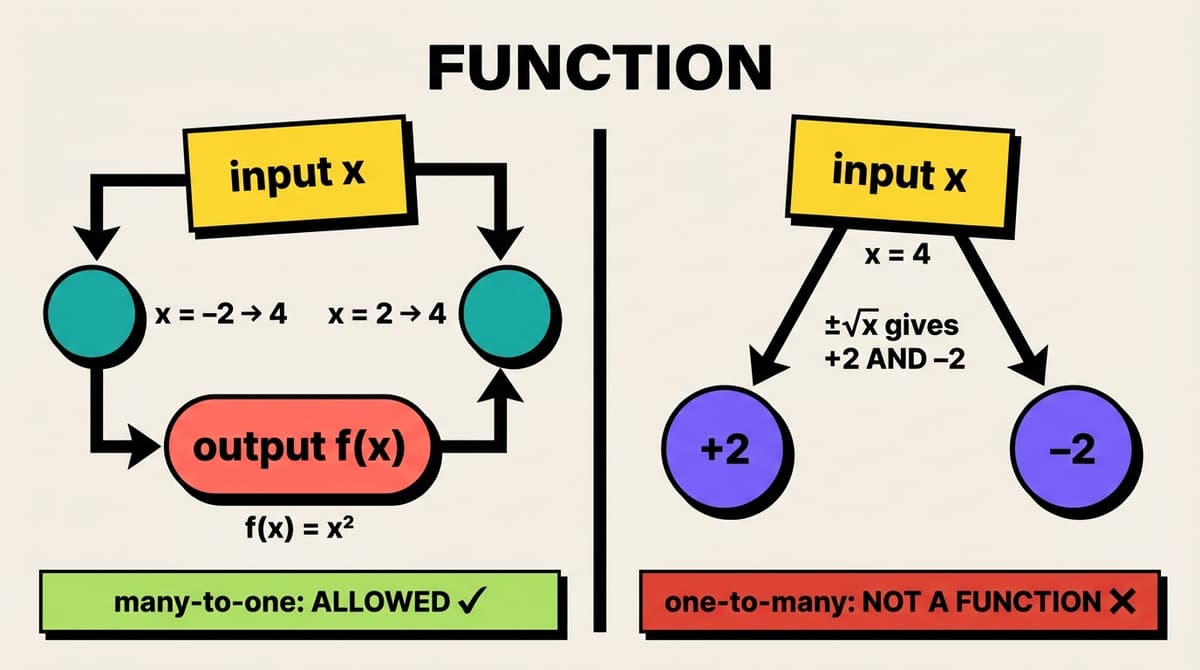
A function is a rule that assigns to each element in the domain exactly one element in the range.
The critical requirement is the one output per input rule. If a single input could produce two different outputs — for example, gives both and when — then the relation is not a function.
A function can map different inputs to the same output. For example, maps both and to . This is perfectly fine — what's forbidden is one input giving two different outputs.
Think of a vending machine: each button (input) gives you exactly one snack (output). Two buttons can give the same snack — but one button can't give you two different snacks at once.
Function Notation
The standard way to write a function is , where:
- is the name of the function
- is the input variable
- is the output
Other letters are used when the context calls for it:
- — velocity as a function of time
- — cost as a function of number of items
- — height as a function of time
You may also see the mapping notation:
This is completely equivalent to writing . It simply says "the function maps input to output ."
When an exam uses multiple functions, they'll often label them , , , etc. Keep track of which letter refers to which rule — mixing them up is a common source of errors.
Evaluating a function at a specific value means substituting that value in place of :
Let . Find .
Simply replace every with and simplify.