
What is a Quadratic Function?
A polynomial function of degree 2, written in the form , where , , and . The condition is essential — if , the function becomes linear, not quadratic.
The graph of any quadratic function is called a parabola — a smooth, symmetric, U-shaped (or ∩-shaped) curve.
The sign of tells you the overall shape:
- If : the parabola opens upward (concave up, like a cup ∪)
- If : the parabola opens downward (concave down, like a cap ∩)
The magnitude of controls the steepness: a larger gives a narrower parabola, while a smaller gives a wider one.
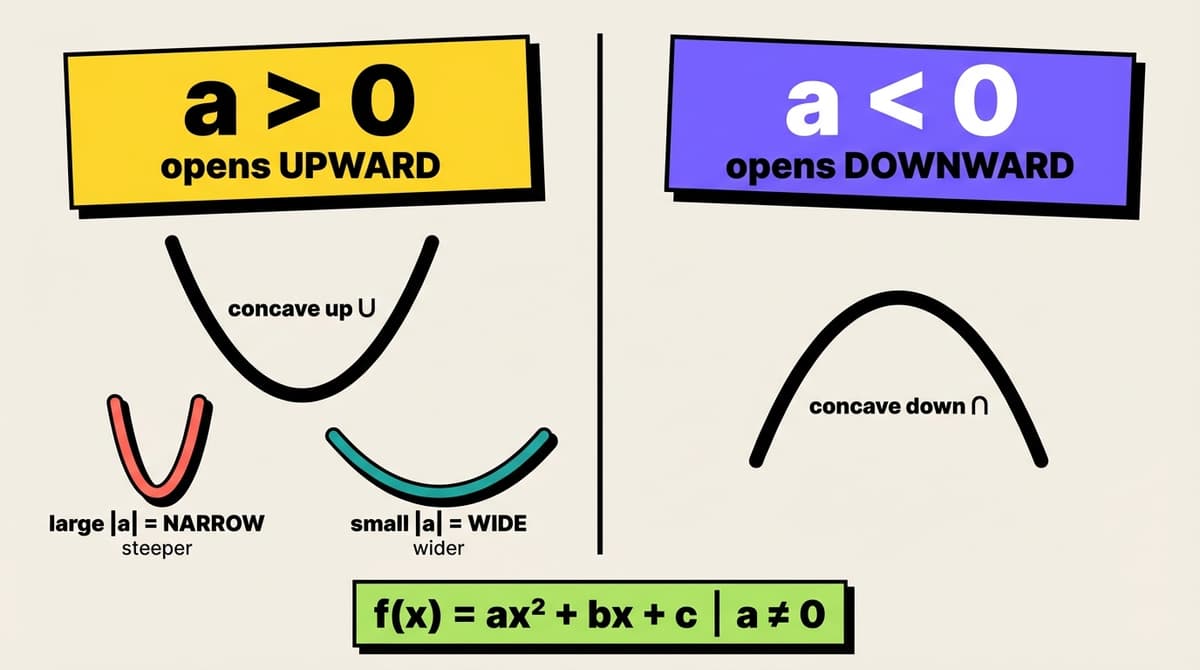
Think of as a bowl that can hold water, and as an upside-down bowl that can't. The bigger the value of , the steeper the sides of the bowl.
Standard Form: $f(x) = ax^2 + bx + c$
The standard form of a quadratic is . Each coefficient plays a distinct role:
| Coefficient | Role |
|---|---|
| Direction (up/down) and steepness of the parabola | |
| Influences the position of the axis of symmetry | |
| The y-intercept — the value of when |
The y-intercept is always at the point , since substituting gives .
For :
- , so the parabola opens upward
- , so the y-intercept is
Don't confuse with the y-intercept coordinate. The y-intercept is the point , not just the number . In exam questions, always write the full coordinate pair when asked for an intercept.