
Introduction to Exponential Functions
An <strong>exponential function</strong> has a variable in the exponent — this is what makes it fundamentally different from polynomial functions like or .
A function of the form , where the base is a positive constant with and .
The base controls the function's behaviour:
- If , the function grows exponentially (e.g. )
- If , the function decays exponentially (e.g. )
Note that is excluded because for all — that's just a constant function, not interesting!
Think of exponential growth like a rumour spreading at school. Each person tells two friends, who each tell two more — the number of people who know doubles every round. That's after rounds. No polynomial function grows this explosively.
Properties of the Parent Exponential Function
The parent exponential function has several key properties you must know cold for the exam.
| Property | Value |
|---|---|
| Domain | All real numbers, |
| Range | All positive reals, |
| -intercept | — always, since |
| Horizontal asymptote | (the -axis) |
| Type | One-to-one function |
The function is always positive — no matter what you substitute for , can never be zero or negative.
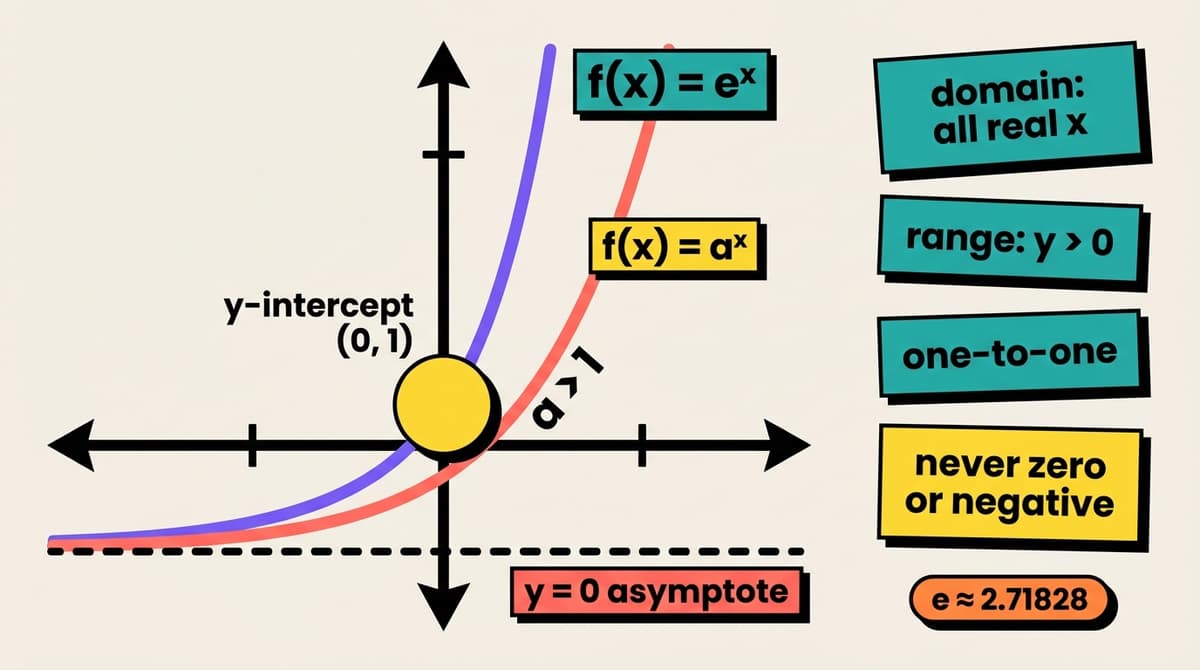
The natural exponential function is a special and extremely important case, where the base is Euler's number . It appears throughout calculus, statistics, and real-world modelling. Its defining property is that its rate of change equals itself:
A common error is confusing (exponential) with (power function). In the exponential, the variable is in the exponent. In a power function, the variable is the base. They behave very differently!