
Introduction to Trigonometric Equations
A trigonometric equation is an equation that contains one or more trigonometric functions of an unknown angle. Unlike trigonometric identities (which are true for all values), trigonometric equations are only satisfied by specific angles within a given domain.
An equation involving trigonometric functions (sin, cos, tan, etc.) that is true only for particular values of the variable, usually restricted to a given interval.
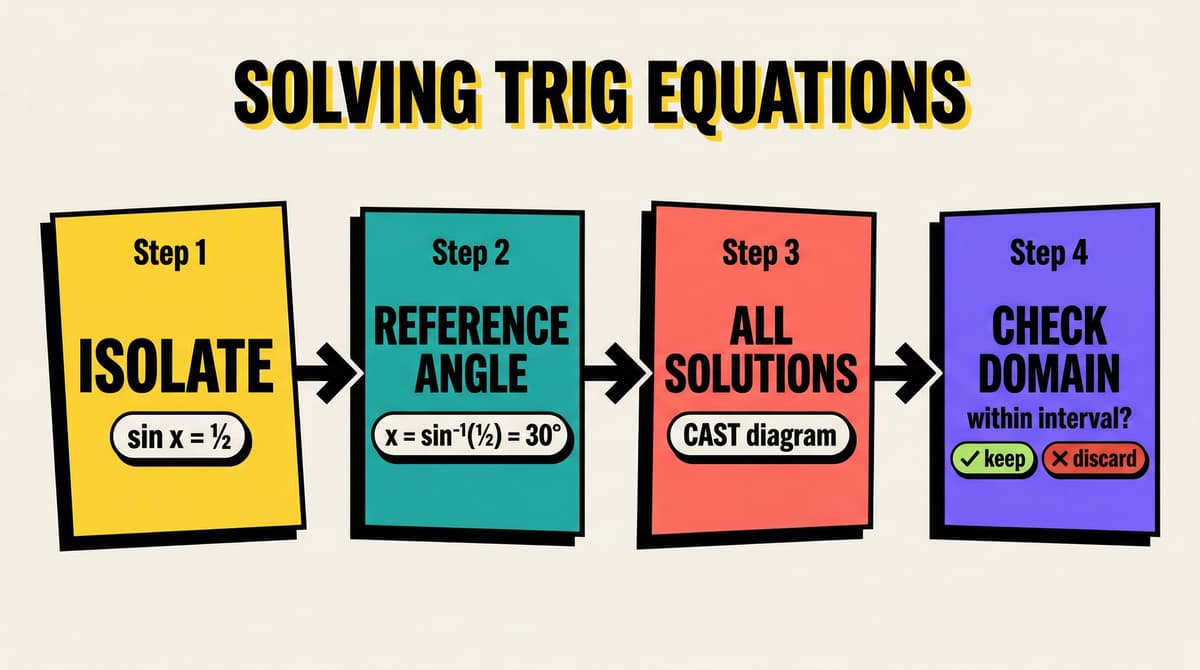
The general strategy for solving any trig equation follows these steps:
- Isolate the trigonometric function
- Find the reference angle using the inverse function
- Identify all solutions in the given interval using knowledge of the CAST diagram
- Check that all solutions lie within the stated domain
Always read the domain carefully before you start. Solutions outside the given interval score no marks, and missing solutions within it will cost you marks.
Exact Values — Essential for Paper 1
IB SL Paper 1 is a non-calculator paper. When solving trigonometric equations on Paper 1, you must recognise exact values immediately. The table below lists all required exact values.
| Angle | |||
|---|---|---|---|
| (30°) | |||
| (45°) | |||
| (60°) | |||
| (90°) | undefined |
When you isolate a trig function and get a value from the table above, the reference angle is exact. For example, immediately gives reference angle . Always give exact answers on Paper 1 unless told otherwise.
is sometimes written as — these are equivalent. Similarly, .