
Introduction to the Vector Equation of a Line
In coordinate geometry, we typically describe lines using equations like . But in three-dimensional space, this approach breaks down — a single scalar equation can't fully describe a line in 3D. The vector equation of a line solves this elegantly by using vectors to pin down both a point on the line and the direction it travels.
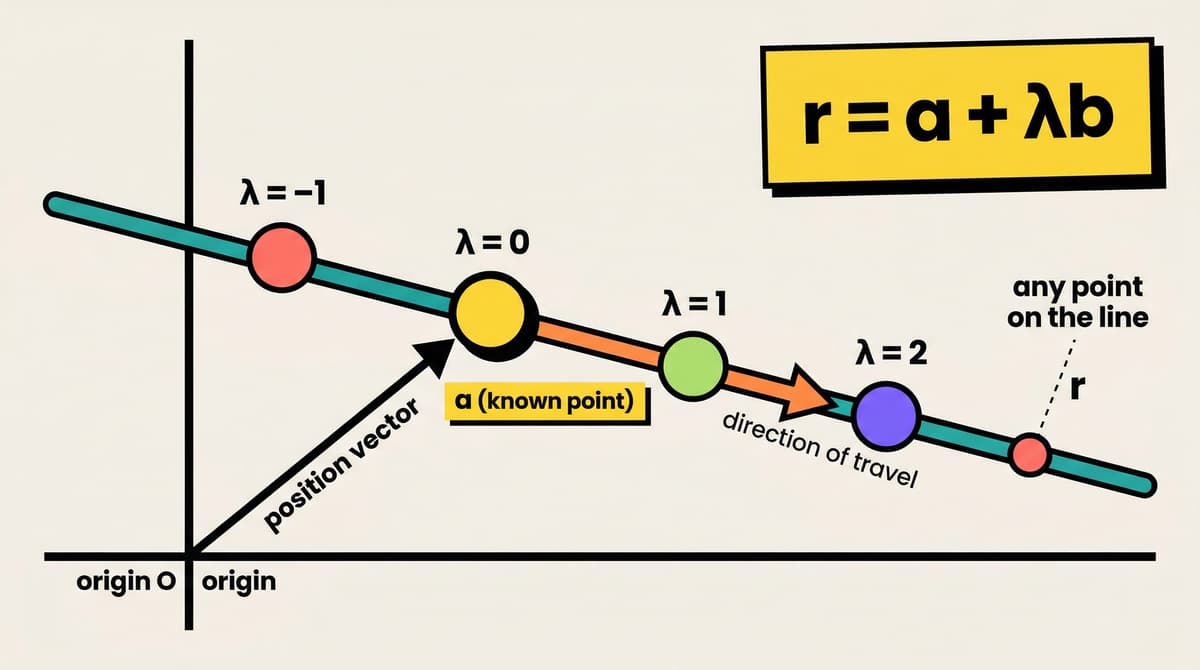
The vector equation of a line is:
Where:
- is the position vector of any point on the line
- is the position vector of a known point on the line
- is the direction vector (parallel to the line)
- is a scalar parameter
Analogy
Think of it like giving directions: "Start at the town hall (), then walk in the direction of north-east () for any distance you like ()." Every possible distance gives a different point on the same road (line).
Note
This equation works in both 2D and 3D space. In 2D, all vectors have two components; in 3D, three components. The structure of the equation is identical in either case.
9 more sections in this topic
Checking your topic access