
Introduction: Integrating with Respect to y
In standard integration, we sum thin vertical strips of area between a curve and the -axis, integrating with respect to . But what if the region is bounded by the y-axis instead?
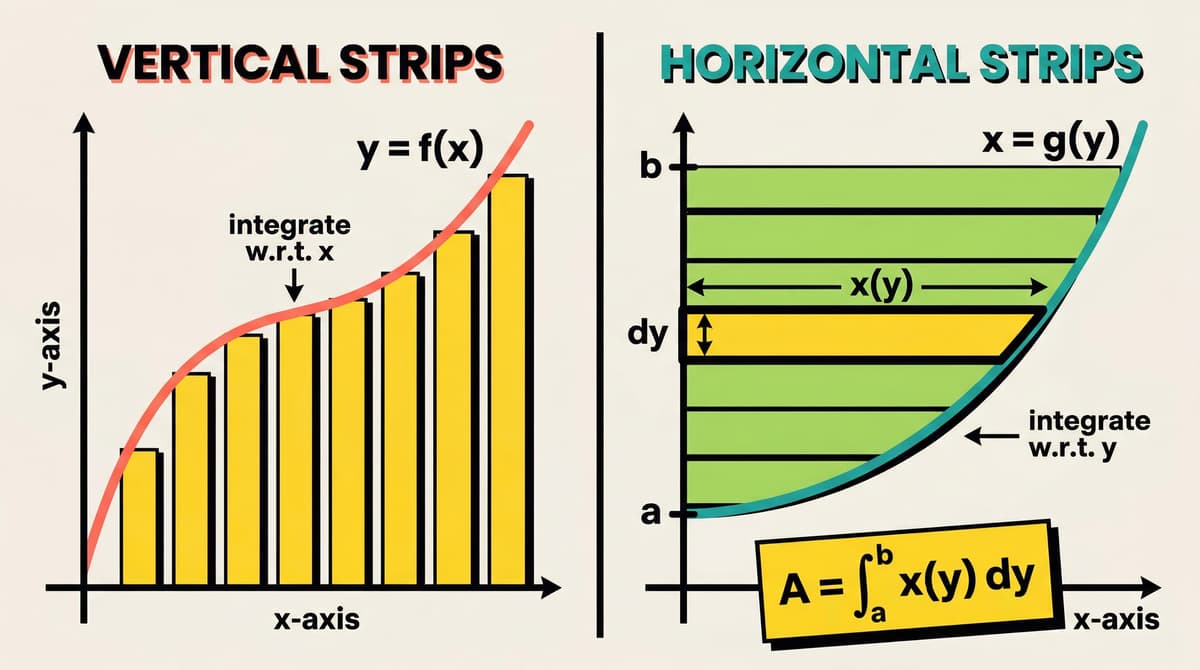
The key idea is simple: swap the roles of and . Instead of thin vertical strips, we use thin horizontal strips of width . Each strip has length — the horizontal distance from the y-axis to the curve — so the area of each strip is .
Summing infinitely many such strips gives:
where and are y-values (not x-values), and is the curve expressed as a function of .
To use this formula, you must express explicitly in terms of . If your curve is given as , rearrange it to get before setting up the integral.
Setting Up Area Integrals onto the y-axis
For a curve expressed as , the area of the region bounded by the curve, the y-axis, and the horizontal lines and is:
provided on .
The process for setting up such an integral:
- Rearrange the equation of the curve to express in terms of .
- Identify the y-limits of integration from the problem (the horizontal boundaries).
- Write and evaluate the integral .
A very common error is to keep the limits in terms of after switching to integrating with respect to . The limits must correspond to the variable of integration. If you are integrating , the limits are -values.
Find the area bounded by the curve and the y-axis from to .
Step 1: The curve is already in the form . ✓
Step 2: Limits are to . ✓
Step 3: Set up and evaluate:
The area is square units.
It can help to sketch the region first. Draw the horizontal strip at a general height , note where it starts (the y-axis, ) and where it ends (the curve, ). Its length is .