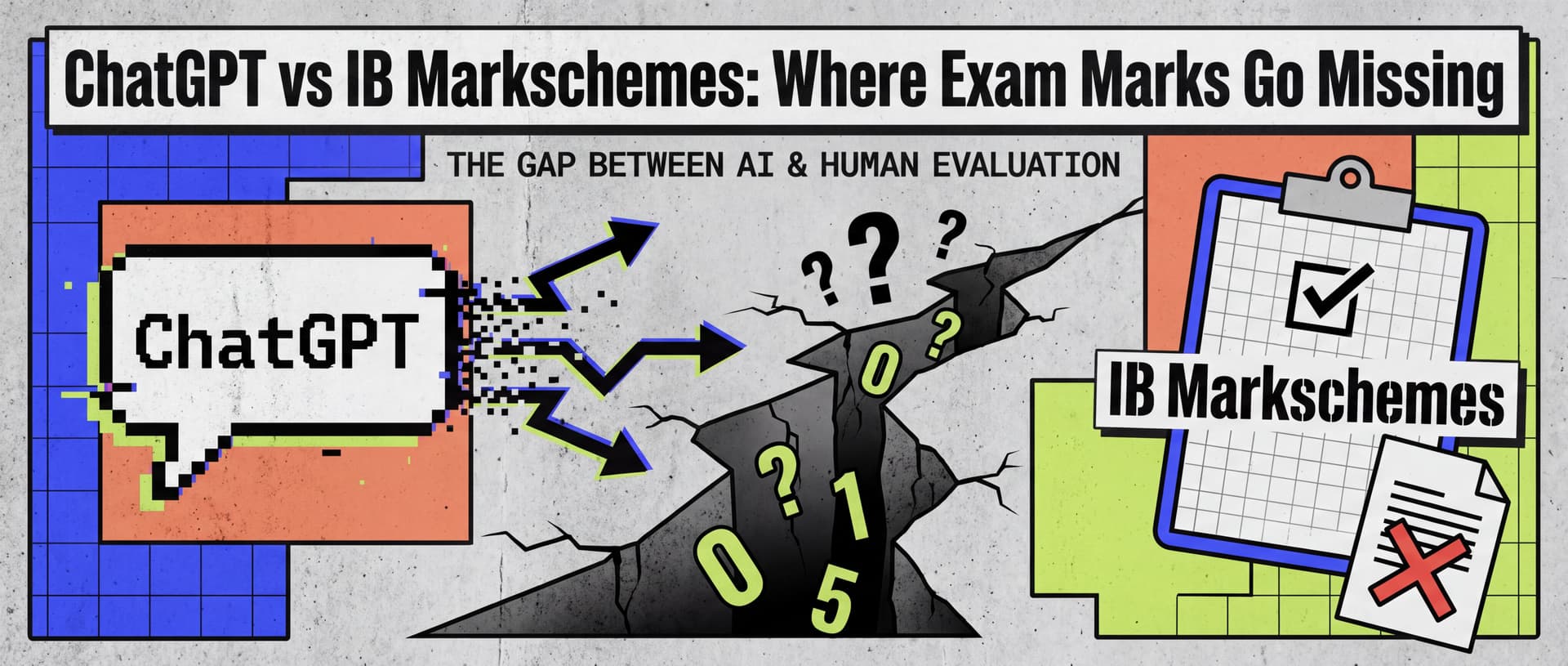
ChatGPT can calculate the right answer to an IB Mathematics question.
That does not automatically mean the response would receive full marks.
The distinction becomes obvious when you stop asking whether an AI answer is mathematically correct and start asking a more useful question:
What evidence does the markscheme actually reward?
IB examinations do not always award marks only for the number written at the end. In Mathematics, marks can be attached to the method, correct substitutions, intermediate results, reasoning and the final answer. In other subjects, command terms can require evaluation, justification, comparison or a supported judgement.
This creates an important limitation for any general AI tool. A fluent solution can look complete while failing to make every mark earning step visible.
Here is a real IB example.
The Real IB Question We Used
The example comes from the IB's official Mathematics: Analysis and Approaches Higher Level Paper 1 specimen paper. Paper 1 does not permit a calculator, and the examination instructions explicitly tell students to show their working.
Source: IB Mathematics: Analysis and Approaches specimen papers
The five mark question is:
“Let A and B be events such that P(A) = 0.5, P(B) = 0.4 and P(A ∪ B) = 0.6. Find P(A | B).”
The final answer is:
P(A | B) = 0.75
But that number represents only the end of the solution.
The official markscheme allocates the five marks across several pieces of mathematical evidence.
| Mark | What the student needs to demonstrate |
|---|---|
| M1 | Attempt to use the probability rule connecting the union and intersection |
| A1 | Correctly substitute the given probabilities |
| A1 | Obtain P(A ∩ B) = 0.3 |
| M1 | Use the conditional probability relationship |
| A1 | Reach P(A | B) = 0.75 |
That is the important part.
Five marks are available, but only one final number appears at the end.
What a Correct AI Answer Can Still Miss
Consider this short chatbot style response:
P(A | B) = P(A ∩ B) / P(B) = 0.3 / 0.4 = 0.75.
It is mathematically correct.
It is also incomplete as evidence for the full five mark solution.
The response shows the conditional probability step and the correct answer. It also uses the value 0.3 for the intersection.
What it does not show is how that intersection was obtained.
The missing reasoning is:
P(A ∪ B) = P(A) + P(B) − P(A ∩ B)

0.6 = 0.5 + 0.4 − P(A ∩ B)

P(A ∩ B) = 0.3
Only then should the student continue:
P(A | B) = P(A ∩ B) / P(B)

P(A | B) = 0.3 / 0.4 = 0.75
The second version is barely longer.
But it gives the examiner evidence for the full route through the problem.
That difference is exactly why the IB paper warns:
“Full marks are not necessarily awarded for a correct answer with no working.”
Source: IB Mathematics: Analysis and Approaches specimen papers
Why We Are Not Calling This a ChatGPT Accuracy Benchmark
There is an important limitation to this demonstration.
The short answer above is an intentionally minimal chatbot style response designed to isolate the marking problem. It is not evidence that every ChatGPT session will produce that exact answer.
A well prompted general AI tool can produce the complete method. Students can also provide course documents, markschemes or other relevant material as context.
OpenAI itself states that ChatGPT can be useful while still producing incorrect or misleading responses, and recommends checking important information against reliable sources.
Source: OpenAI Help Center
Our earlier comparison of AI tools for IB students uses this same probability question as a repeatable test and explicitly notes that one question cannot establish which platform is universally more accurate.
Related reading: Best AI Tools for IB Students
So the conclusion is not:
ChatGPT cannot solve IB questions.
The more useful conclusion is:
A correct AI solution is not automatically a markscheme complete solution.
That is a much more important distinction for an IB student.
Method Marks Change What “Correct” Means
The Mathematics AA markscheme explains several types of marks.
M marks reward an attempt to use a correct method.
A marks reward an answer or accuracy and often depend on earlier method marks.
R marks reward reasoning.
Source: IB Mathematics: Analysis and Approaches specimen papers
The examiner guidance goes further. It states that examiners should not automatically award full marks because the final answer is correct. Working must be checked against the markscheme.
It also explains that an accuracy mark generally cannot simply replace a missing preceding method mark.
This matters whenever AI compresses reasoning.
A chatbot may recognise a familiar problem and jump rapidly from the information in the question to the result.
That can be efficient for checking an answer.
It can be poor preparation if the student learns that compressed response as the form they should reproduce in an exam.
The issue is not excessive brevity by itself. A concise solution can earn full marks.
The issue is whether the necessary evidence is visible.
Why Math AA Paper 1 Makes the Difference Obvious
Paper 1 is particularly useful for showing this problem because students must work without a calculator.
The official specimen instructions require working or explanations and explicitly advise candidates to show all working.
Source: IB Mathematics: Analysis and Approaches specimen papers
That makes the route to the answer part of the assessment.
Imagine two students both write 0.75.
One has demonstrated the union formula, found the intersection correctly and then applied conditional probability.
The other has written only the final value.
Those responses are not necessarily equivalent under the markscheme even though the number at the bottom of the page is identical.
That principle extends beyond this probability question.
In calculus, an examiner may need evidence of the method used.
In a proof, reasoning must establish the conclusion.
In a multi part question, earlier working may determine whether later marks are available.
The safest habit is therefore not to memorise how short an answer can be.
Learn which mathematical decisions the examiner needs to see.
The Same Problem Appears Outside Mathematics
Markscheme alignment is not only about M1 and A1.
In Economics, a response can explain a concept correctly but fail to evaluate.
In Biology, accurate knowledge may not answer the command term precisely enough.
In History, relevant facts do not replace a developed argument.
In English, identifying a technique is different from analysing how the writer's choices create meaning.
A general AI model is optimising for a useful response to your prompt. It is not automatically operating as the examiner for your exact subject, level, paper, session and markscheme.
That is why adding “Make this an IB answer” to a prompt is not enough.
The assessment context needs to be visible.
A Better Way to Use ChatGPT for IB Questions
The answer is not to stop using AI.
It is to change what you ask it to do.
Instead of:
Solve this question.
Try a study workflow that keeps the markscheme in the loop.
- Attempt the question yourself first. Write enough working that another person can see your reasoning.
- Ask AI for one hint instead of the solution. This protects the part of revision that actually builds problem solving ability.
- Compare your answer with the official markscheme. Identify which lines in your work provide evidence for each mark.
- Ask AI what is missing from your written reasoning. Give it the markscheme where your school or resource permits you to do so.
- Rewrite the solution yourself. Remove unnecessary explanation while keeping every mark earning step visible.
The useful prompt is not simply:
Is my answer correct?
A stronger question is:
Which marks in this markscheme are visibly supported by my working, and which are not yet evidenced?
You still need to verify the response yourself.
AI should help you inspect your thinking, not make the final assessment decision for you.
What an IB Specific Study Tool Should Add
This is where the difference between a general chatbot and an IB specific study environment becomes useful.
The current Koncepts DP platform places exam style questions alongside marks, command terms and markschemes, with HL and SL kept distinct. It currently lists more than 80,000 DP questions and provides guided Homework Help alongside its practice system.
Explore: Koncepts for DP students
The important advantage is context.
The student does not have to begin every conversation by explaining that the question is Mathematics AA HL, which paper it resembles, what the command term means, or that the mark allocation matters.
That does not mean Koncepts is an IB examiner.
This article is not claiming that Koncepts produces official IB grades, bands or scores for a student's work. Any AI generated feedback remains study support, and official assessment remains governed by the IB and the student's school.
The useful goal is simpler: make the connection between question, working and markscheme easier to see.
Explore Koncepts DP Homework Help
Do Not Confuse Exam Practice With Coursework Authorship
There is another boundary IB students need to keep clear.
Using AI to understand why a calculation earns a method mark is a study activity.
Submitting AI generated analysis as your own coursework raises a different academic integrity question.
The IB does not impose a blanket ban on AI tools, but it states that AI generated material included in assessed work must be acknowledged appropriately. Its guidance also makes clear that work produced by such tools is not automatically considered the student's own work.
Source: IB statement on ChatGPT and artificial intelligence
RevisionDojo's guidance makes a similar practical distinction by recommending AI for understanding, practice and planning while keeping authorship with the student.
Source: RevisionDojo guidance on AI tools for IB work
If AI contributes to an IA, Extended Essay or TOK task, follow your school's current rules and document the assistance accurately.
For the referencing side of that question, see our dedicated guide below.
Run This Test on Any AI Tutor
Before trusting an AI tool for IB revision, give it one real question with an official markscheme and check six things:
- Does it respect the exact course and level?
- Does it recognise the paper conditions?
- Does it answer the actual command term?
- Does it show the steps that correspond to available marks?
- Can it explain why those steps matter?
- Can you close the tool and solve a similar problem yourself?
The sixth test matters most.
An AI system can produce a beautiful solution while leaving the student unable to reproduce the reasoning.
That is not strong exam preparation.
Professor Curious also identifies past papers and markschemes as important resources for understanding how IB examination responses are assessed.
Source: Professor Curious
The most useful technology is therefore not the one that gets to the answer fastest.
It is the one that helps you understand why the answer earns the marks.
The Question to Ask Before Your Next IB Exam
When an AI response looks convincing, do not stop at:
“Is this correct?”
Ask:
“Where, exactly, are the marks?”
For the probability question in this article, the difference between a final answer and a markscheme complete solution is only a few lines of working.
Those few lines are the point.
IB exams assess what you demonstrate on the page, not what a chatbot might have understood silently before giving you the answer.
Use AI to clarify.
Use it to question your reasoning.
Use it to find gaps.
But learn to read the markscheme yourself.
That is the skill you will still have when the chat window is gone and the examination starts.
Related Blogs
Table of contents
Share
Related reading
- How to Study IB Past Papers and Markschemes ProperlyLearn how to study IB markschemes effectively with past-paper strategies, self-marking, error logs, topic-wise practice and a repeatable revision workflow.
- Citing ChatGPT in IB Coursework: Where to Draw the LineLearn how to cite ChatGPT in IB coursework, compare MLA, APA, Harvard and Chicago formats, and understand where useful AI support becomes outsourced work.
- IB Business Management Paper 2: Beat Exam Time PressureBeat IB Business Management Paper 2 time pressure with SL and HL timing plans, worked break-even calculations, case-study techniques and evaluation tips.