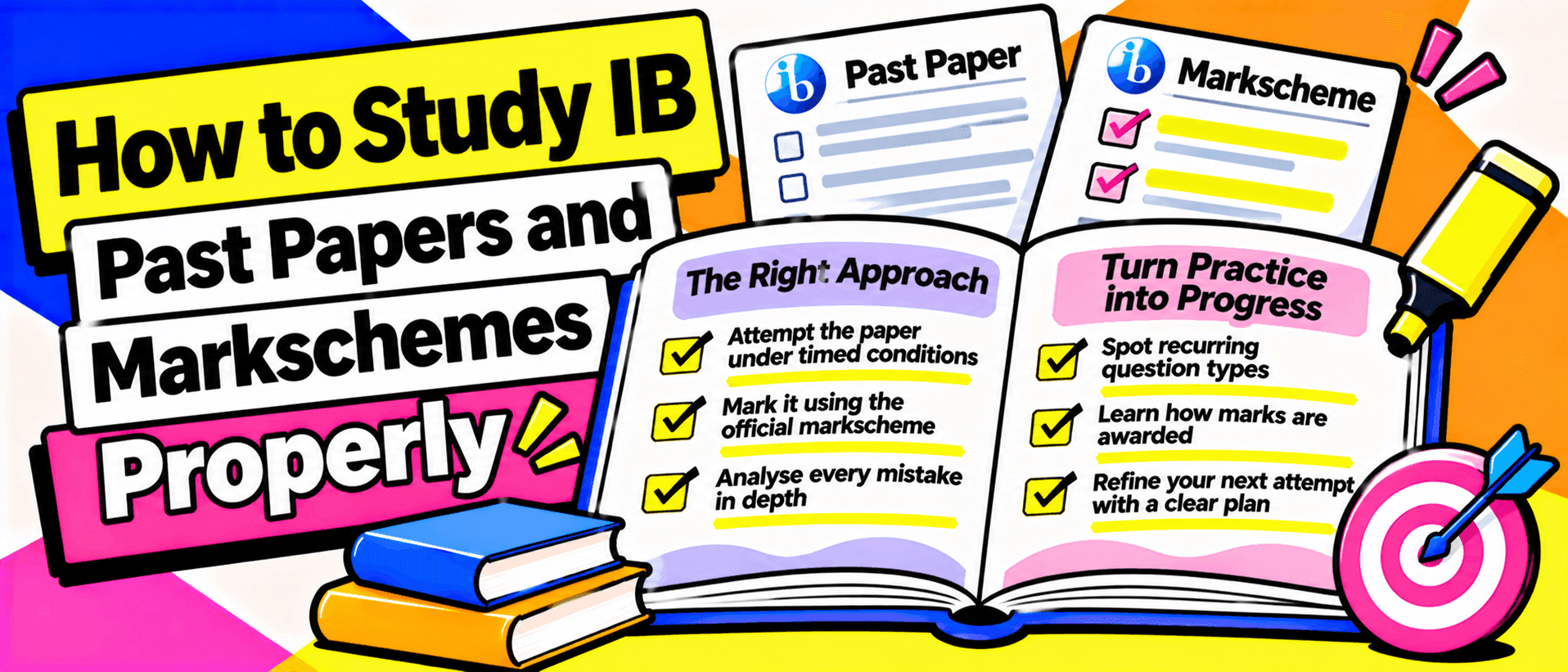
You've completed three IB past papers this week. You checked the answers, highlighted a few mistakes and moved on to the next paper.
But when you encounter a slightly different question, you make the same errors again.
The problem might not be how many past papers you're completing. It might be what you do after finishing them.
In a March 2026 r/IBO discussion, a DP1 student asked how to actually study markschemes rather than simply find them.
A June 2026 discussion raised a related question: what should students do before, during and after attempting practice papers?
Both highlight a gap in common revision advice.
Completing past papers tests what you know. Analysing your answers against the markscheme helps identify what you still need to learn.
This guide explains a repeatable revision process that turns examination practice into targeted improvement.
Why IB Past Papers Are More Than Practice Tests
The International Baccalaureate's assessment guidance explains that Diploma Programme assessments evaluate knowledge alongside skills such as applying methods, constructing arguments, analysing information and solving problems.
Consequently, knowing a topic does not automatically mean you can answer an examination question effectively.
A student might understand market failure but struggle to evaluate a government intervention.
Another might remember a biological process but omit the explanation connecting its stages.
Past papers reveal these differences.
They help students identify the demands of questions, practise working under time constraints and recognise weaknesses in their application of knowledge.
Markschemes add another layer by explaining what constitutes a creditworthy response.
However, their usefulness depends on how they are interpreted.
What Is an IB Markscheme?
An IB markscheme provides guidance for awarding marks on a particular examination paper.
Depending on the subject and question type, it may include accepted answers, relevant scientific points, calculation methods, alternative responses or assessment markbands.
Different questions are assessed differently.
| Question type | What to examine in the markscheme |
|---|---|
| Multiple choice | Correct answer and underlying reasoning |
| Short explanation | Required knowledge and conceptual relationships |
| Mathematical calculation | Valid method, working, units and final result |
| Data response | Accurate interpretation and application of evidence |
| Extended essay response | Argument quality, analysis, evaluation and organisation |
| Language comprehension | Meaning, acceptable alternatives and response instructions |
The IB's examiner instructions confirm that acceptable responses may include appropriate paraphrases rather than exact wording.
Similarly, extended responses in some subjects use markbands and a best-fit approach rather than a checklist of compulsory phrases.
A markscheme is a guide to the assessment standard, not a script that students must reproduce word for word.
Step 1: Select Questions That Match Your Syllabus
Before attempting a paper, check whether it matches your examination syllabus.
The IB regularly reviews its courses.
For example, Psychology and Computer Science introduce revised assessments in May 2027, while other subjects have changes scheduled for later sessions.
The IB curriculum update directory identifies current and upcoming syllabus transitions.
An older question may still be useful for practising a particular concept.
However, its topic, structure or mark allocation may no longer reflect your examination.
Start by identifying:
- Your subject and level.
- Your first-assessment syllabus.
- The paper and question type being practised.
- Whether the question remains relevant to your course.
Ask your teacher for the applicable subject guide or specimen materials if you are unsure.
Do not assume that every past paper labelled with your subject is equally suitable.
Step 2: Begin With Topic-Wise Practice
Students often attempt complete papers before they have sufficiently reviewed individual topics.
A more manageable approach is to begin with focused question sets.
For example, an Economics student revising elasticity could complete several questions involving calculations, diagrams and explanations before attempting a full examination.
A Biology student revising inheritance could practise structured questions that require interpreting genetic information.
Topic-wise practice helps isolate specific weaknesses.
| Revision stage | Recommended practice |
|---|---|
| Learning a topic | Short questions with access to notes when needed |
| Consolidating knowledge | Independent topic-wise questions |
| Developing examination skills | Mixed questions from several completed topics |
| Preparing for the final examination | Complete papers under official timing conditions |
This is a suggested progression, not an IB-prescribed method.
Once you become comfortable with individual topics, include mixed practice so that you must identify the relevant concepts independently.
Step 3: Attempt the Question Before Opening the Markscheme
One of the least effective revision habits is reading the markscheme immediately after encountering a difficult question.
The answer may appear obvious once you have seen it.
But recognising an explanation is different from generating one independently.
During your first attempt:
- Read the command term and question carefully.
- Identify the relevant topic or skill.
- Write a complete response without looking at the answer.
- Record any uncertainty.
- Finish within a reasonable time limit.
If you are still developing your knowledge, begin without strict timing.
As your understanding improves, introduce the official examination conditions.
Mark uncertain responses with a small question mark so you can review them later.
This distinguishes answers you knew confidently from correct answers that involved guessing.
Step 4: Analyse the Markscheme, Not Just the Final Answer
After completing a question, compare your response with the official marking guidance.
Do not simply check whether the final answer looks similar.
Ask four questions:
What knowledge was required? Identify the underlying concept, process or theory.
What relationships needed explaining? Look for causal links, mechanisms or interpretations.
What did I include? Identify the parts of your response that demonstrate the required understanding.
What was missing? Determine whether the problem was conceptual, procedural or related to examination technique.
For calculations, examine the working as well as the result.
For essays, compare the quality of your argument with the relevant markband descriptors.
The purpose is to understand why marks may be earned or missed.
Worked Example: Learning From a Biology Markscheme
Consider this original practice question:
"Explain why enzyme activity generally decreases when temperature rises substantially above the optimum." [3]
This is an illustrative question with a hypothetical three-mark allocation, not an official IB past-paper item.
A developing response might state:
The enzyme gets too hot and stops working.
This identifies a general outcome but does not explain the mechanism.
A stronger response would explain:
At temperatures substantially above the optimum, increased thermal motion can disrupt interactions maintaining the enzyme's tertiary structure. This changes the shape of the active site, reducing successful substrate binding and causing the reaction rate to decrease.
The important learning is not memorising the phrase tertiary structure.
It is understanding the connection between temperature, protein structure, substrate binding and reaction rate.
A student who understands that sequence is better prepared for questions using unfamiliar wording.
Step 5: Stop Memorising "Examiner Keywords"
Students frequently search for IB examiner keywords, assuming that including particular words automatically earns marks.
Accurate terminology matters, especially in scientific and technical subjects.
However, isolated words do not replace correct explanations.
Consider the difference:
Weak: Enzyme, denaturation, active site, substrate.
Stronger: Denaturation changes the enzyme's active-site shape, reducing the likelihood of successful substrate binding.
The second response explains a relationship.
In an extended Economics answer, writing elasticity, stakeholders, short run, long run does not automatically demonstrate evaluation.
You must explain why those ideas affect the policy's likely effectiveness.
The IB's 2026 examiner guidance also recognises that appropriate responses may take different analytical approaches.
Learn the meaning and application of terminology, not a collection of words detached from reasoning.
Step 6: Learn to Interpret Markbands
Some examination responses are assessed using markbands rather than individual marking points.
These commonly consider qualities such as understanding, application, analysis, evaluation and communication.
For example, a History or Economics essay may contain accurate knowledge but receive a limited mark because it does not develop a convincing argument.
When reviewing a markband, ask:
- Did I answer the precise question?
- Did I use relevant and accurate evidence?
- Did I explain my argument rather than describe information?
- Did I evaluate important limitations or perspectives?
- Did I reach a supported judgement where required?
The IB's assessment principles establish that candidate performance is judged against standards rather than relative class ranking.
Self-marking extended responses is inherently less precise than checking a straightforward calculation.
Use markband descriptors for provisional feedback and ask a teacher to review uncertain judgements.
Step 7: Maintain an IB Error Log
An error log turns individual mistakes into revision priorities.
You do not need a complicated spreadsheet.
Record the question reference, topic, error type and corrective action.
| Question | Mistake | Cause | Next action |
|---|---|---|---|
| Biology, enzyme question | Omitted active-site explanation | Conceptual gap | Review protein structure and reattempt |
| Mathematics, differentiation | Incorrect chain rule | Method error | Complete five focused examples |
| Economics, evaluation | No case-specific evidence | Application weakness | Practise linking arguments to stimulus data |
| Geography, extended response | Final paragraph unfinished | Timing issue | Practise shorter plans under timed conditions |
Use a consistent set of error categories.
For example: knowledge, application, calculation, interpretation, evaluation and timing.
Avoid vague notes such as "revise Chemistry."
Instead, record the precise weakness and the action needed to address it.
Step 8: Correct the Underlying Misconception
An error log is only useful when followed by targeted revision.
Suppose a Mathematics student repeatedly makes mistakes when applying the chain rule.
Completing another entire paper may not be the most efficient next step.
A better response is to revisit the rule, practise several focused examples and explain the method without referring to notes.
Similarly, a student struggling with Biology data-response questions may need additional graph interpretation practice rather than more content memorisation.
Choose the corrective activity based on the cause.
| Error category | Useful corrective action |
|---|---|
| Knowledge gap | Review the relevant concept and explain it from memory |
| Calculation error | Practise the specific mathematical method |
| Misread command term | Compare questions requiring different types of responses |
| Weak application | Practise using evidence from unfamiliar case studies |
| Weak evaluation | Develop arguments with justified limitations |
| Timing problem | Practise answers with defined time limits |
The aim is to prevent the same error from appearing repeatedly.
Step 9: Reattempt Questions Without Looking at the Answer
Reading a corrected answer can create a false sense of mastery.
A more reliable test is whether you can reproduce the reasoning independently.
After reviewing a question:
First attempt: Complete the question without help.
Correction: Identify errors and study the relevant explanation.
Delayed reattempt: Return to the question after several days.
Transfer test: Answer a different question assessing the same concept.
The final step is particularly important.
Repeating the exact question may become easier simply because you remember the answer.
A new question shows whether the underlying skill has improved.
For example, after correcting a break-even calculation, practise another problem with different costs and selling prices.
If you can explain and apply the method correctly, that is stronger evidence of learning than recalling the previous numerical result.
Step 10: Move From Topics to Full Timed Papers
Once you have reviewed the relevant syllabus content, begin completing full papers under realistic examination conditions.
Use the official time allowance for your subject and level.
Practise without notes unless the examination explicitly permits reference materials.
Use the calculator, formula booklet or other materials allowed for your actual examination.
After finishing, record:
| Performance indicator | What to track |
|---|---|
| Raw marks | Provisional marks earned against the applicable guidance |
| Time used | Whether you completed the paper within the limit |
| Unanswered questions | Questions skipped or left incomplete |
| Repeated errors | Problems appearing across several sessions |
| Confidence | Questions answered correctly but with uncertainty |
Do not treat one practice score as a guaranteed final IB grade.
Grade boundaries vary by examination session, and self-marked extended responses may not exactly match an examiner's judgement.
Look for improvements across several comparable practice attempts.
A Repeatable 60-Minute Revision Cycle
You can apply the following workflow to a focused practice session.
| Stage | Time | Activity |
|---|---|---|
| Prepare | 5 minutes | Select relevant questions and review the instructions |
| Attempt | 25 minutes | Answer independently |
| Mark | 10 minutes | Compare responses with the markscheme |
| Diagnose | 10 minutes | Identify errors and correct misunderstandings |
| Record and plan | 10 minutes | Update the error log and schedule a reattempt |
| Total | 60 minutes |
These timings are illustrative and should be adjusted for the type of questions.
An extended essay response may require a longer session.
The central principle is to reserve meaningful time for feedback rather than spending the entire session answering questions.
Where Can You Find Legitimate IB Past Papers?
The IB provides several official sources.
IB Sample Examination Papers offers selected past and specimen papers, including some markschemes and audio materials.
IB Programme Resource Centre provides resources for authorised school staff, including specimen papers, subject guidance and subject reports.
IB Questionbank is a licensed teacher resource for creating assessments from available examination questions and associated material.
IB Store provides official examination resources for purchase, subject to availability.
Ask your teacher or Diploma Programme coordinator which resources your school can provide.
Avoid relying on unauthorised file-sharing repositories or assuming that leaked materials are accurate, current or appropriate.
For a revised syllabus, official specimen papers and current subject guidance are especially important.
How Can Subject Reports Improve Your Revision?
Subject reports provide broader feedback on candidate performance during particular examination sessions.
They may identify recurring problems, effective approaches and areas where students struggled.
The IB's assessment documentation explains the role of assessment standards, while subject reports are made available to schools through official IB resources.
For example, a report might identify weak evaluation, misunderstanding of a command term or difficulty interpreting a particular type of evidence.
Use these observations as revision guidance.
However, do not assume that a weakness described in one examination session will necessarily appear in the same form in your own examination.
Your priority remains mastery of the applicable syllabus and assessment skills.
A Seven-Day IB Past-Paper Revision Plan
| Day | Activity | Goal |
|---|---|---|
| 1 | Identify syllabus-relevant questions | Build a focused practice set |
| 2 | Complete topic-wise questions | Establish current strengths and weaknesses |
| 3 | Analyse markschemes | Understand missing reasoning and methods |
| 4 | Review recurring misconceptions | Correct the causes of errors |
| 5 | Reattempt questions independently | Test retention |
| 6 | Complete a mixed timed practice | Improve transfer and time management |
| 7 | Review the error log and plan the next week | Prioritise unresolved weaknesses |
Repeat the process with different topics and increasingly realistic conditions.
As examinations approach, devote more sessions to complete papers while continuing targeted correction.
Common Mistakes When Using IB Past Papers
Students should avoid several habits.
Checking answers too early: This reduces opportunities for independent problem-solving.
Memorising markscheme wording: This may not transfer to unfamiliar questions.
Ignoring alternative correct approaches: Markschemes and assessment criteria can accommodate different valid responses.
Completing too many papers without reviewing mistakes: Repetition alone does not guarantee improvement.
Using papers from an outdated syllabus without checking relevance: Assessment structures and requirements may have changed.
Treating provisional self-marks as official grades: Extended responses often require professional judgement.
Never reattempting difficult questions: An error that is only read about may remain unresolved.
The objective is not to accumulate completed papers.
It is to improve the quality of your next independent answer.
Final Checklist: How to Study IB Markschemes Properly
Before moving to a new paper, confirm that you have:
- Selected questions relevant to your current syllabus.
- Attempted the questions independently.
- Checked both answers and underlying reasoning.
- Identified missing concepts, methods or explanations.
- Interpreted markbands appropriately for extended responses.
- Recorded specific errors rather than vague revision notes.
- Completed targeted corrective practice.
- Scheduled a delayed reattempt.
- Tested your understanding with an unfamiliar question.
- Tracked progress across multiple practice sessions.
Final Verdict: How Should You Use IB Past Papers?
The most effective IB past paper strategy is a cycle of practice, feedback, correction and reattempting.
Past papers reveal how well you can apply what you have learned.
Markschemes help you understand the expectations of particular questions.
An error log identifies recurring problems, while targeted revision addresses the knowledge and skills behind those mistakes.
The goal is not to memorise every answer or complete as many papers as possible.
It is to become more accurate, independent and adaptable when facing unfamiliar examination questions.
A smaller number of thoroughly reviewed papers can provide more useful learning than a larger number completed without reflection.
Don't just ask how many past papers you've finished. Ask how many of your previous mistakes you can now avoid.
For official assessment guidance and legitimate resources, consult the IB Diploma Programme assessment page, the IB sample examination papers and the IB Programme Resource Centre.
Table of contents
Share
Related reading
- ChatGPT vs IB Markschemes: Where Exam Marks Go MissingCan ChatGPT solve IB questions and still lose marks? See a real Math AA markscheme test and learn how to use AI without missing method and reasoning marks.
- IB Timed Practice: Make Every Minute Count in ExamsMake IB timed practice work. Learn how to set question limits, simulate exam conditions, self-mark accurately and turn mistakes into a stronger final paper.
- IB Physics Past Papers: Which Old Questions Still Apply?Find which IB Physics old syllabus past papers still apply. Compare the 2025 syllabus, Paper 1A, Paper 1B and Paper 2, and practise smarter with our guide.