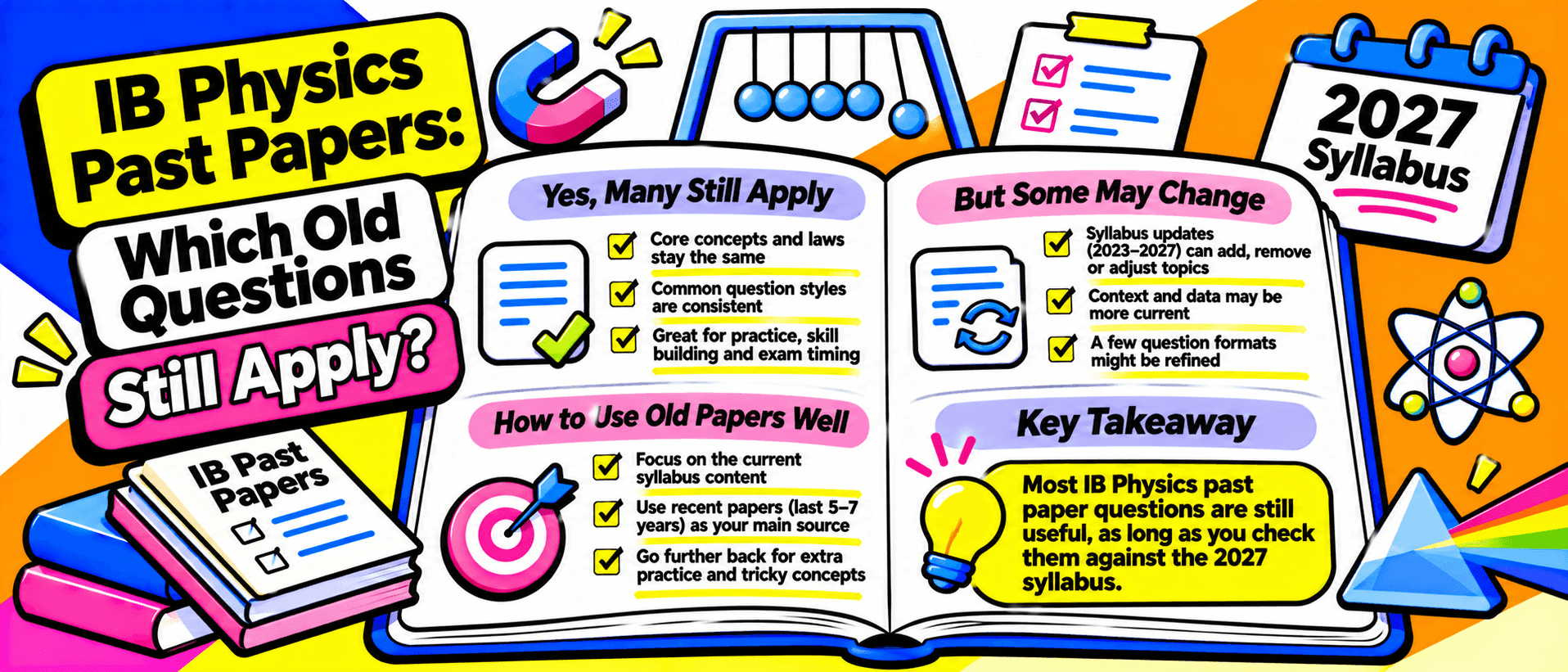
IB Physics Past Papers: Which Old Questions Still Apply?
You open a 2022 IB Physics examination paper and recognize the mechanics. Then a question refers to an option you have never studied, or a practical-data section appears under the old Paper 3 heading. Is the entire paper outdated, or can you still use it for revision?
IB Physics old syllabus past papers remain valuable, but only when you select questions against the course first assessed in 2025. The physics behind Newton's laws has not changed. The examination structure, topic organization and specific syllabus expectations have.
In an April 2026 r/IBO discussion, students debated whether older questions were worthwhile. You need a crosswalk from each old question to a current learning objective.
What Changed in the 2025 IB Physics Syllabus?
The previous Physics course was first assessed in 2016 and used eight core topics, four additional higher level topics and a choice of one option. The revised course, first assessed in May 2025, organizes material into five themes: Space, time and motion; The particulate nature of matter; Wave behaviour; Fields; and Nuclear and quantum physics.
The IB's current Physics guide emphasizes connections among forces, energy and particles. Some content was retained, some changed level, some moved from options into the compulsory syllabus, and some is no longer prescribed.
Use the current guide's detailed understandings and guidance, not merely the heading, when deciding whether an old question applies.
Old vs New Physics Papers: The Examination Crosswalk
| Older course, through 2024 | Current course, from 2025 | How to reuse old questions |
|---|---|---|
| Paper 1: multiple-choice questions | Paper 1A: multiple-choice questions | Reuse in-syllabus concepts, then practise the current format |
| Paper 2: short and extended responses | Paper 2: short and extended responses | Reuse aligned calculations and explanations |
| Paper 3, Section A: data and practical skills | Paper 1B: data-based questions | Select graph, uncertainty and experimental-analysis practice |
| Paper 3, Section B: one chosen option | No separate options paper | Reuse only content explicitly included in current themes |
This is a revision crosswalk, not a claim that examination components are interchangeable. The old structure comes from the IB's 2016 Physics HL subject brief. The new structure is specified in the current guide.
For the revised course, Paper 1A contains 25 multiple-choice questions at SL or 40 at HL; Paper 1B contains 20 marks of data-based questions at both levels. The two sections are completed in one sitting lasting 90 minutes at SL or 120 minutes at HL. Paper 2 is worth 55 marks over 90 minutes at SL, and 90 marks over 150 minutes at HL. Paper 3 no longer exists as a separate examination.
Which Older Topic Questions Are Still Worth Practising?
Match the concept and level, not the old topic number.
| Older question area | Current destination | Revision decision |
|---|---|---|
| Motion, forces, momentum, work and energy | A.1 to A.3 | Usually strong practice at the appropriate level |
| Thermal transfers and gas behaviour | B.1 and B.3; related HL B.4 | Use after checking the required depth |
| Direct-current circuits | B.5 | Keep questions aligned with listed circuit models |
| Waves, diffraction and interference | C.2 and C.3 | Useful, but check SL and HL distinctions |
| Gravitation, electric and magnetic fields | D.1 to D.3 | Keep aligned subparts, including HL depth where relevant |
| Radioactive decay, fission and quantum ideas | E.1 to E.4 | Filter closely because older particle-physics coverage differs |
| Old option questions | Selected A, C and E topics | Check individually; never assume all option material transfers |
A 2021 projectile-motion problem might match A.1; a series-and-parallel resistance problem might match B.5. Check the mathematical detail, not just the chapter name.
SL students must also filter out HL-only demands. The current syllabus roadmap uses different markings for topics taught to all students, topics with additional HL material and topics reserved for HL. One old HL problem can contain a perfectly useful SL opening followed by an irrelevant higher-level extension.
What Happened to the Old Physics Option Topics?
This is where students waste the most revision time. The previous course offered Relativity, Engineering physics, Imaging and Astrophysics as options, examined in Paper 3. The current course has no separate option selection, but portions of former option material now sit within compulsory themes.
Relativity: Current topic A.5, Galilean and special relativity, is HL only. Appropriate questions from the former relativity option can provide useful HL practice after checking the exact requirements.
Engineering physics: Rotational or rigid-body ideas may match current A.4, which contains material for all students plus additional HL content. Other engineering-option questions may go beyond the new guide.
Astrophysics: Stellar properties, the Hertzsprung-Russell diagram and related calculations appear in E.5, Fusion and stars, for both SL and HL. Do not assume every old astrophysics problem is relevant. The current guide explicitly states, for example, that Cepheid variables are not required.
Imaging: This old option does not continue as an intact topic. Some wave principles remain relevant, but specialized imaging questions should be checked against C.2 and C.3 rather than automatically added to your practice list.
The same caution applies to material from older core or higher-level topics. The new guide does not prescribe every former particle-physics detail. It also states that alternating-current circuits are not required under B.5. Save advanced out-of-scope questions for enrichment rather than treating them as examination priorities.
How to Use Old Paper 1 for Physics Paper 1A Practice
Old multiple-choice questions are especially useful for checking conceptual understanding quickly. Build a set of questions on current A.1 kinematics, B.5 circuits or D.1 gravitational fields, then solve them using the current course's equation and data booklet.
Do not practise only by sitting an untouched old Paper 1 and calculating a percentage. Its topic mix and time allocation do not reproduce the current Paper 1A. A low score could reflect excluded content rather than poor understanding; a high score might miss new topics entirely.
The revised Paper 1A permits a calculator and requires a clean Physics data booklet. Practise the official new-syllabus specimens alongside older questions. Old percentages do not predict current grades.
Can Old Paper 3 Questions Help With Paper 1B?
Yes, selectively. Old Paper 3 Section A developed skills such as extracting values from graphs, handling uncertainties, interpreting experimental patterns and evaluating procedures. These overlap with the data skills assessed in today's Paper 1B.
But Paper 1B is not simply Paper 3 renamed. It is part of the combined Paper 1 assessment, and its format and question design are defined by the new syllabus. Some older experimental situations, required knowledge or styles of response may not match.
For an original practice exercise, imagine a cooling experiment with temperature measurements taken every minute. Ask yourself: What are the axes and units? What trend does the graph suggest? Does the evidence support a proposed model? What measurement limitation matters? Those questions train transferable skills without reproducing an IB copyrighted question.
After practising old practical questions, use current specimens to learn the actual presentation, commands and level of detail expected in Paper 1B.
When Old Paper 2 Questions Still Work
Paper 2 remains the main home for structured calculations and extended explanations. Older questions linking momentum, energy and forces can train multi-stage reasoning particularly well. Questions on electric fields, waves or radioactive decay may also be useful when they match the current guide.
Mark each subpart separately. You might keep parts (a) and (b) of a problem while omitting a final section that depends on retired content. Check the old markscheme to learn how the calculation was reasoned through, but don't assume its exact allocation applies to the new paper.
A practical technique is to write the corresponding current topic code beside every retained question. For example, an in-syllabus conservation-of-energy problem might receive “A.3.” If a question crosses A.3 and D.1, label both. This makes your revision set searchable and exposes gaps in your coverage.
A Four-Stage System for Choosing Past-Paper Questions
1. Start with current specimens. Ask your teacher for official 2025-syllabus papers and authorized markschemes. Identify the format of Paper 1A, Paper 1B and Paper 2 before using the old archive.
2. Tag older questions. Label them Keep, Partly useful or Skip for now. Base the label on current understandings, guidance and your SL or HL level, not on how difficult the question looks.
3. Practise by objective. Combine a handful of older conceptual questions with current data and structured-response questions. Revisit topics missing from the older papers, including B.2 Greenhouse effect, using new-syllabus resources.
4. Finish with a current-format timed session. Older questions teach the physics, but recent papers teach its present assessment structure. Use time limits and mark allocations from the revised course when assessing readiness.
Record each question reference, current topic code, error type and next practice task in a revision log.
Where Can You Find Reliable IB Physics Practice Papers?
The IB publishes official specimen papers for the revised course, including questions and markschemes for both levels. The IB's sample exam papers page is another starting point. Teachers can obtain further authorized materials through the Programme Resource Centre, while past examination papers are available through the IB's official purchasing channels.
Avoid unauthorized copies. A teacher-curated selection with current syllabus labels is better than an unsorted archive.
Final Checklist: Is This Old Question Relevant?
- Does the underlying concept appear in the current Physics guide?
- Is its mathematical depth correct for my SL or HL course?
- Does it require an old option or retired detail?
- Can I answer it using the current syllabus and data booklet?
- Am I using it for conceptual practice or incorrectly treating it as a current-format mock?
- Have I also practised questions written for first assessment in 2025?
Final Thoughts
IB Physics old syllabus past papers are not obsolete, but neither are they a ready-made replacement for current exams. Reuse strong questions on mechanics, circuits, waves, fields and nuclear physics. Be selective with old Paper 3 material, optional topics and subparts whose content has changed. Most importantly, practise the revised Paper 1A, Paper 1B and Paper 2 formats separately.
Choose questions that match what you are expected to know now.
Table of contents
Share
Related reading
- IB Physics Paper 1B: Data Analysis and Graph QuestionsPrepare for IB Physics Paper 1B with worked graph and uncertainty questions, experimental design tips, data analysis and practical strategies for exam day.
- IB Physics Paper 2: Multi-Step Question StrategiesMaster IB Physics Paper 2 questions with worked multi-step examples, data booklet tips, partial-mark strategies, and a practical time plan for exam day.
- IB Physics HL vs SL: The Maths That Changes EverythingChoosing IB Physics HL or SL? Compare maths demands, extra HL topics, current exam papers and university requirements to make a confident subject decision.
- How to Study IB Past Papers and Markschemes ProperlyLearn how to study IB markschemes effectively with past-paper strategies, self-marking, error logs, topic-wise practice and a repeatable revision workflow.
- IB Business Paper 2: How to Evaluate 10-Mark QuestionsLearn to evaluate IB Business Paper 2 10 markers using case evidence, stakeholder trade-offs, and supported recommendations. Improve your exam answers today.