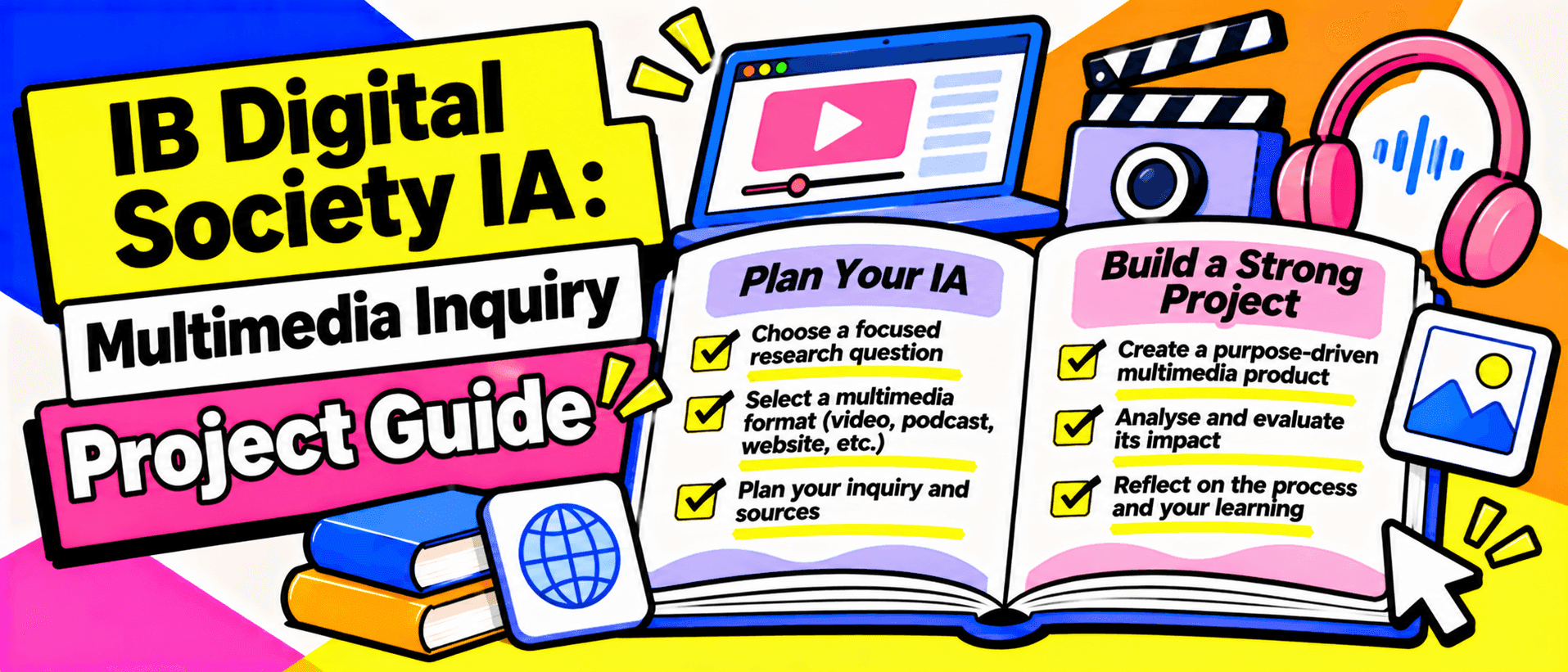
You want to investigate how artificial intelligence, social media or another digital technology is changing society. You have identified an interesting issue and collected several articles.
But how do you turn that research into an IB Digital Society Internal Assessment?
Do you need to develop an application? Conduct interviews? Produce a documentary? What exactly should appear in the multimedia presentation?
These questions matter because the IB Digital Society IA is an individual inquiry project, not a traditional research essay or a software development assignment.
According to the IB Digital Society curriculum, updated on 6 March 2026, students investigate the impacts and implications of digital systems on people and communities.
They communicate their findings through a documented inquiry process and recorded multimedia presentation.
The challenge is connecting technology to real human experiences while examining evidence, conflicting perspectives and possible future developments.
This guide explains the official IA requirements, assessment criteria, research methods and presentation structure, including an original inquiry example about artificial intelligence in recruitment.
What Is the IB Digital Society IA?
Digital Society is a Group 3 Individuals and Societies subject available at Standard Level and Higher Level.
The course examines how digital technologies influence relationships, institutions, identities and communities.
Both SL and HL students complete the same internal assessment task.
The official Digital Society guide confirms the following requirements.
| Assessment detail | Official requirement |
|---|---|
| Assessment task | Individual inquiry project |
| Maximum marks | 24 |
| Final grade weighting at SL | 30% |
| Final grade weighting at HL | 20% |
| Recommended project time | 30 hours |
| Inquiry process document | Maximum 1,500 words |
| Multimedia presentation | Maximum 10 minutes |
| References | Separate required list |
The project must be completed individually. Collaborative submissions are not permitted.
The assessment does not require students to build a digital product, develop an AI system or write computer code.
Instead, students investigate an issue involving a digital system and evaluate its significance for people and communities.
Understand the Three Required IA Components
The 2027 IB examiner instructions identify three compulsory submissions.
1. Inquiry process document
This written document explains the research focus and critically discusses claims and perspectives from three selected sources.
It must not exceed 1,500 words.
2. Recorded multimedia presentation
This is the main presentation of the student's analysis, evaluation and conclusions.
It must not exceed 10 minutes.
3. Reference list
Students must acknowledge the research and media materials used throughout the project, including images, audio and video produced by others.
Appendices are not required.
The written document and presentation have different assessment purposes. Students should not treat the presentation as a narrated copy of the inquiry process document.
How Is the Digital Society IA Marked?
The assessment uses five criteria, with a total of 24 marks.
| Criterion | Marks | Assessed component |
|---|---|---|
| A: Inquiry focus | 3 | Inquiry process document |
| B: Claims and perspectives | 6 | Inquiry process document |
| C: Analysis and evaluation | 6 | Multimedia presentation |
| D: Conclusion | 6 | Multimedia presentation |
| E: Communication | 3 | Multimedia presentation |
| Total | 24 |
The written document contributes nine marks, while the presentation contributes fifteen.
This distribution reveals an important priority.
Collecting information is not enough. Students must use that information to develop an evidence-supported argument and communicate meaningful conclusions.
Criterion D specifically rewards new understanding, supported insights and consideration of emerging trends and future developments.
A presentation that only summarises existing information will struggle to demonstrate the full range of assessed skills.
Step 1: Choose a Focused Digital Society Inquiry
Digital Society offers considerable freedom when choosing a topic.
The official course guidance includes digital technologies such as artificial intelligence, data systems, algorithms, networks, media and autonomous technologies.
However, a broad topic is not the same as a workable inquiry.
Consider these examples.
| Broad topic | More focused inquiry question |
|---|---|
| Artificial intelligence | To what extent can independent audits address risks in AI-assisted recruitment? |
| Social media | How do recommendation algorithms influence exposure to political information among young adults? |
| Digital privacy | How does facial recognition in public spaces affect privacy and institutional accountability? |
| Digital education | How might AI-assisted feedback affect students' independence and access to learning support? |
| Online platforms | How do content moderation decisions affect freedom of expression in a particular online community? |
These are original research directions, not automatically approved IA questions.
A strong inquiry should identify a digital system, a specific real-world example and the people or communities affected.
It should also be manageable within a 10-minute presentation.
Step 2: Connect Concepts, Content and Contexts
The Digital Society course integrates three important elements.
Concepts include change, expression, identity, power, space, systems, and values and ethics.
Content includes data, algorithms, computers, networks and the internet, media, artificial intelligence, and robots and autonomous technologies.
Contexts include cultural, economic, environmental, health, human knowledge, political and social settings.
Students should identify which connections are relevant to their investigation.
For example, an inquiry into automated recruitment could examine:
| Element | Possible connection |
|---|---|
| Concept: Power | Employers and applicants may have unequal access to information |
| Concept: Values and ethics | Fairness and accountability in employment decisions |
| Content: Artificial intelligence | Automated systems used to assess job applicants |
| Content: Data | Information used to produce applicant scores or classifications |
| Context: Economic | Employment opportunities and hiring practices |
| Context: Social | Unequal impacts on different applicant groups |
The objective is not to mention every concept in the syllabus.
It is to explain meaningful connections that help answer the inquiry question.
Worked Example: AI-Assisted Recruitment in New York City
Consider an original project built around this question:
"To what extent do bias audits and transparency requirements address the ethical risks of automated hiring systems in New York City?"
The real-world example is New York City's Local Law 144 of 2021, which regulates certain automated employment decision tools.
According to the New York City Department of Consumer and Worker Protection, employers using covered tools must meet requirements relating to bias audits and candidate notification.
Enforcement began in July 2023.
This provides a specific digital society inquiry because it connects an identifiable technology-related practice, public regulation and the interests of affected communities.
The student could investigate how these requirements aim to improve transparency while evaluating their limitations.
This is an original project design, not a completed student investigation.
Step 3: Research Three Meaningfully Different Sources
Criterion B requires students to discuss the claims and perspectives of three sources in the inquiry process document, explaining why each source is useful.
A valuable combination includes sources with different purposes and forms of evidence.
For the automated recruitment example, consider these verified resources.
| Source | Perspective and usefulness |
|---|---|
| NYC Department of Consumer and Worker Protection | Explains the law, employer obligations and the regulator's interpretation |
| US Department of Justice guidance on AI hiring | Explains how hiring technologies can create disability discrimination risks |
| New York State Comptroller's December 2025 audit | Evaluates how effectively the city enforced the legal requirements |
These sources provide complementary forms of evidence.
The city explains what the rules require.
The Department of Justice identifies particular accessibility and discrimination concerns.
The state audit examines enforcement problems.
Students could also use the US National Institute of Standards and Technology's AI Risk Management Framework to examine broader risk management principles.
The three-source discussion is not a restriction on the total number of sources used in the project. Additional relevant sources may support the presentation and must be acknowledged.
Step 4: Evaluate Sources Instead of Summarising Them
A weak source discussion might say:
The New York City website explains the rules, so it is reliable.
This identifies information but offers limited evaluation.
A stronger discussion would explain:
The NYC Department of Consumer and Worker Protection is useful because it administers the relevant legal requirements and explains how covered employers should comply. However, this regulatory explanation does not independently establish whether employers consistently follow those requirements or whether the audits prevent discriminatory outcomes.
This considers the source's origin, purpose, usefulness and limitations.
The December 2025 State Comptroller audit offers evidence for further evaluation.
Its investigators examined enforcement between July 2023 and June 2025 and identified weaknesses in the complaint-handling and compliance-review process.
These findings complicate the assumption that introducing a regulation automatically produces effective oversight.
A strong inquiry should distinguish the existence of a policy, its implementation and evidence of its actual outcomes.
Step 5: Analyse Impacts on Different People
Criterion C evaluates the student's own sustained analysis of how digital systems affect individuals and communities.
For automated recruitment, several stakeholder groups are relevant.
| Stakeholder | Potential benefit | Potential concern |
|---|---|---|
| Employers | More efficient application screening | Incorrect or unfair decisions and compliance costs |
| Job applicants | Potentially faster processing | Limited understanding of automated assessments |
| Applicants with disabilities | Possible accessible digital alternatives | Systems that fail to accommodate different abilities |
| Technology providers | Opportunities to develop recruitment tools | Responsibility for system design and reliability |
| Regulators | Greater visibility through published audit information | Challenges identifying and investigating non-compliance |
These are analytical possibilities, not claims that every hiring system produces each outcome.
The US Department of Justice explains that automated assessments may disadvantage qualified people with disabilities when the assessment measures an impairment rather than the skills required for a job.
This supports an important distinction: a system can be technologically efficient without necessarily being equitable.
The strongest analysis explains how particular effects occur and who experiences them.
Step 6: Develop a Balanced Evaluation
A strong Digital Society IA should not simply conclude that technology is beneficial or harmful.
For the recruitment example, students might consider the following argument.
Independent bias audits and candidate notices can improve accountability by requiring employers to examine certain outcomes and disclose information about automated assessments. However, compliance requirements do not guarantee that all forms of unfairness will be identified or corrected.
This argument can be developed using the official evidence.
New York City's guidance states that its bias audit rules specify particular demographic calculations, but the law does not itself require a specific response to an adverse audit finding.
Meanwhile, the 2025 state audit identified difficulties in enforcement.
The student can therefore evaluate how regulatory design, implementation and technical limitations interact.
The analysis should avoid unsupported claims that every recruitment algorithm is biased or that auditing eliminates discrimination.
Evaluation means weighing the strength of evidence and explaining the conditions under which outcomes may differ.
Step 7: Write an Effective Inquiry Process Document
The official guide requires two labelled sections in this order.
| Required section | Recommended maximum |
|---|---|
| Inquiry focus | 300 words |
| Claims and perspectives | 1,200 words |
| Combined official maximum | 1,500 words |
The inquiry focus explains the question, the real-world example and connections to course concepts, content and contexts.
The claims and perspectives section discusses three selected sources and justifies their usefulness, including their limitations and how they relate to one another.
Students should include the word count for each section.
These section allocations are recommended maxima, while 1,500 words is the compulsory overall limit.
Do not use most of the document simply describing the background of the technology.
The source evaluation needs sufficient space to demonstrate research quality.
Step 8: Plan the 10-Minute Multimedia Presentation
The presentation must be a recorded multimedia file, with three required sections presented in order:
Introduction, Analysis and evaluation, Conclusion.
The following is a suggested timing structure.
| Presentation section | Suggested time |
|---|---|
| Introduction and inquiry significance | 1 minute |
| Explain the digital system and real-world example | 1 minute |
| Analyse impacts using evidence and stakeholder perspectives | 4 minutes |
| Evaluate implications and limitations | 2 minutes |
| Conclusion, emerging trends and future developments | 2 minutes |
| Total | 10 minutes |
This is a planning framework, not an official timing allocation.
For the recruitment example, a student could include a simple diagram explaining how automated applicant screening works, a comparison of stakeholder perspectives and a short visual summary of the audit findings.
The media should support the argument.
Decorative animations and visually complex slides are not substitutes for evidence.
Step 9: Make the Presentation More Than a Slideshow
The IB permits different combinations of text, still images, video and sound.
The guide requires audible recorded commentary and permits text-to-speech where the underlying text is the student's own work.
Useful multimedia elements might include:
- A diagram explaining the digital system.
- A timeline of relevant policy developments.
- A graph created from accurately cited published data.
- A brief, appropriately licensed video excerpt.
- Clearly labelled evidence comparing stakeholder perspectives.
Every visual should have a purpose.
For example, a timeline might help explain the difference between the adoption of New York City's law and the subsequent evaluation of its enforcement.
A graph should represent genuine sourced data, not invented statistics.
Keep text legible, audio clear and the complete recording within the 10-minute limit.
Step 10: Write a Conclusion That Adds New Insight
Criterion D is worth six marks.
The conclusion must explain what the inquiry has revealed and consider emerging trends or future developments.
A weak conclusion might say:
AI has benefits and risks. Governments should regulate it.
A more developed conclusion could argue:
The New York City example suggests that transparency and auditing requirements can create formal accountability mechanisms, but their effectiveness depends on how compliance is monitored and whether identified risks lead to meaningful changes. Future developments in automated recruitment may increase the importance of independent evaluation, accessible assessment alternatives and effective enforcement.
This is an illustrative conclusion, not an officially marked response.
It synthesises the inquiry and identifies relevant future questions without claiming to predict the industry's development.
A strong ending should demonstrate how the student's understanding evolved through the investigation.
Step 11: Address Ethical and Academic Integrity Issues
Digital Society inquiries often involve privacy, sensitive information and contested claims.
Students should consider whether their research methods could harm or expose other people.
If collecting interviews or survey responses, obtain appropriate school approval and informed consent.
Avoid publishing identifiable applicant information, confidential employment records or private social media content without permission.
Do not upload another person's personal data into an AI tool merely to test how the system might classify them.
Students must also document their own research and analysis honestly.
The 2027 examiner instructions confirm that sources used in the presentation, including images and audio, must be included in the reference list.
Citations should also appear at the point where sourced material is used.
For digital media, this may involve on-screen attribution, written captions or verbal acknowledgement.
Common Digital Society IA Mistakes
Several mistakes can weaken the project.
Choosing an overly broad question: "How does AI change society?" is too large for a ten-minute inquiry.
Describing technology without analysing people: Explain consequences for individuals, communities and institutions.
Using three sources with identical perspectives: Select evidence that helps examine different claims and limitations.
Confusing correlation with causation: A reported difference does not automatically prove that an algorithm caused it.
Treating multimedia as decoration: Images and audio should clarify evidence and reasoning.
Ignoring future developments: The conclusion must consider emerging trends or possible future implications.
Exceeding submission limits: Examiners do not assess material beyond the prescribed word and time limits.
Submitting collaborative work: The IA is an individual investigation, even when students discuss ideas during preparation.
The IB Digital Society guide makes clear that inquiry quality, critical evaluation and effective communication are central to the assessment.
Final IB Digital Society IA Checklist
Before submitting, confirm that:
- Your inquiry question is focused and researchable.
- You have identified a specific real-world digital system or example.
- The inquiry connects relevant course concepts, content and contexts.
- Your process document evaluates three sources and their perspectives.
- The written document does not exceed 1,500 words.
- Your presentation includes introduction, analysis and evaluation, and conclusion.
- Your analysis explains impacts on people and communities.
- Your conclusion addresses new understanding and future developments.
- Your recorded multimedia presentation is no longer than 10 minutes.
- All research, visuals, audio and other sourced materials are acknowledged.
Final Verdict: What Makes a Strong Digital Society IA?
The IB Digital Society IA is an investigation into how digital systems influence the world people live in.
A strong project begins with a focused question and a specific real-world example.
It then examines credible sources, compares perspectives and evaluates the consequences of digital technologies for different groups.
The multimedia presentation should transform that research into a clear and evidence-supported argument, rather than simply reproduce the information collected.
You do not need to build an application, create complex animations or investigate the most advanced technology available.
A focused inquiry into a familiar digital system can provide meaningful depth when its social implications are carefully examined.
Choose a specific issue, question the evidence, consider who is affected and use multimedia to communicate what your inquiry genuinely reveals.
For definitive requirements, consult the IB Digital Society curriculum, the official Digital Society subject guide and the 2027 examiner instructions.
Table of contents
Share
Related reading
- MYP Personal Project Report: Structure and Evidence GuidePlan your MYP personal project report with the three criteria, examples of evidence, ATL skills, success criteria and an original outline. Explore the guide.
- How to Plan a PYP Unit of Inquiry That Actually WorksBuild stronger PYP Units of Inquiry with a practical planning guide, free planner template, assessment tips, and an official IB worked example. Start here.
- MYP Digital Design ePortfolio: Criteria and ExamplesMaster the MYP Digital Design ePortfolio with Criteria A to D, original portfolio examples, design specifications, testing methods and evaluation tips.