You recognise the first equation in a Physics Paper 2 question. Then the next part introduces a curved track, a changing force or an unfamiliar field. Suddenly, what looked like a mechanics problem requires three different ideas, and ten minutes disappear before you reach the final calculation.
That experience appeared in the April 2026 IB Physics HL exam discussion. Several students described extended questions that consumed time needed for later parts. The solution is not to memorise more isolated equations. It is to recognise how IB Physics Paper 2 questions connect concepts and to organise your working so each step advances the solution.
This guide uses original problems, not reproduced IB exam questions, to demonstrate the process.
What Does IB Physics Paper 2 Actually Test?
Under the Physics curriculum first assessed in 2025, Paper 2 contains short-answer and extended-response questions. Both SL and HL students need to apply physics to unfamiliar situations, interpret information and explain reasoning. HL also covers additional higher level content.
| Paper 2 | Standard level | Higher level |
|---|---|---|
| Examination time | 1 hour 30 minutes | 2 hours 30 minutes |
| Total marks | 55 | 90 |
| Final course weighting | 44% | 44% |
| Question types | Short and extended response | Short and extended response |
These details come from the official IB Physics guide. A calculator is permitted and students must have access to a clean Physics data booklet. Unlike the older syllabus, the current course has Paper 1A, Paper 1B and Paper 2, with no separate Paper 3.
The difficulty is often not the equation itself. A question can require you to obtain a speed using energy, then use that speed to calculate a force or predict motion in a field.
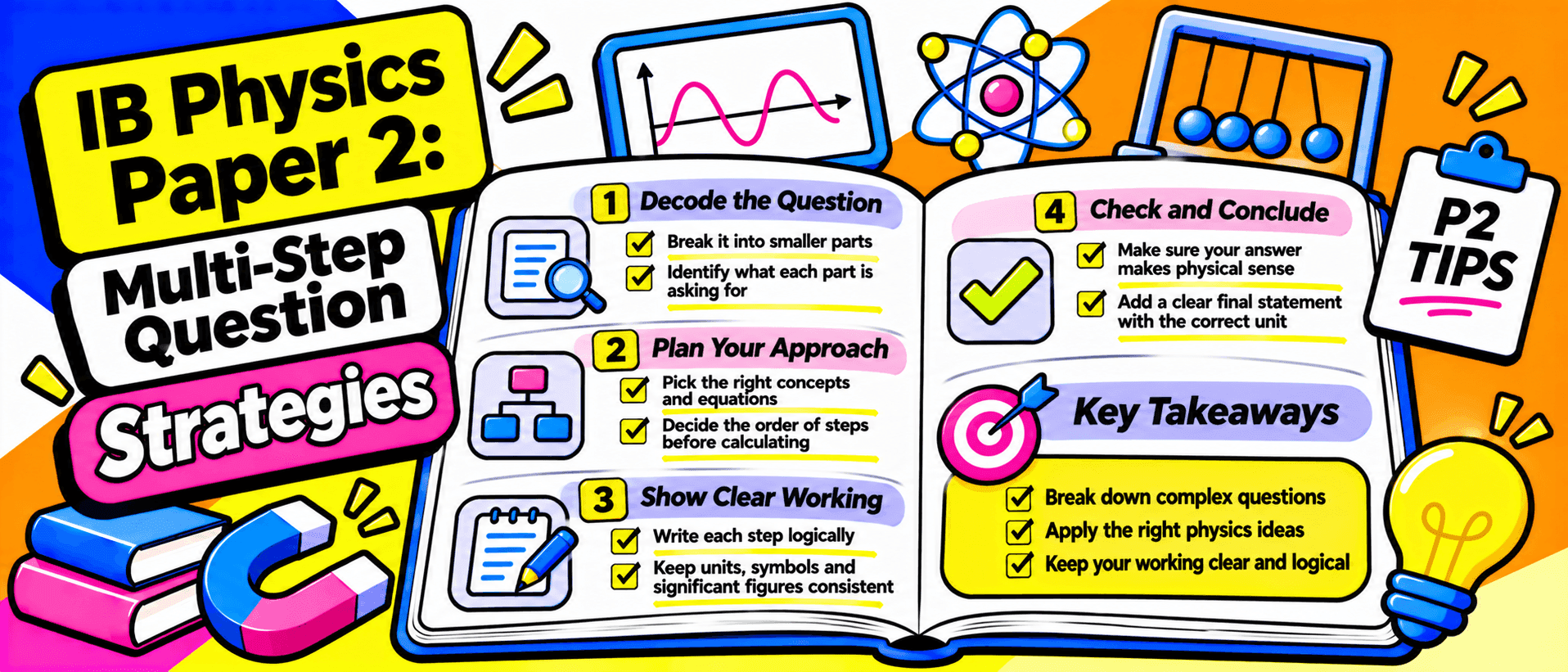
Use a Five-Step Method for Structured Physics Questions
Step 1: Identify the final quantity. Underline what each part asks you to calculate or explain. Write its symbol and unit before doing algebra. If a question asks for force, the target is not necessarily the first quantity you can calculate.
Step 2: Extract givens and assumptions. List numerical values with SI units. Mark words such as released from rest, uniform field, negligible resistance or constant acceleration. These often tell you which model applies.
Step 3: Draw the physical situation. A quick energy diagram, free-body diagram or motion sketch prevents sign errors. Show directions of forces and indicate where the object starts and finishes.
Step 4: Work backward from the target. Ask what intermediate quantity is needed. If you need centripetal force, you may need speed first; if you need magnetic radius, you may need the speed after electrical acceleration.
Step 5: Show the chain and check it. Write the general equation, substitute values, calculate, attach units and ask whether the result is physically reasonable. Keep extra digits in intermediate calculations and round at the end.
Worked Problem 1: Connecting Energy and Circular Motion
Original practice question: A 2.0 kg block is released from rest at a height of 1.5 m above the lowest point of a track. Friction dissipates 6.0 J before it reaches that point. The track's radius of curvature at the bottom is 0.80 m. Take gravitational field strength as 9.8 N kg⁻¹.
Find the block's speed at the bottom and the normal contact force there.
Part A: Find speed using energy. The block starts with gravitational potential energy and no kinetic energy. Friction removes energy, so it would be incorrect to write simply mgh = ½mv².
mgh − 6.0 = ½mv²
(2.0)(9.8)(1.5) − 6.0 = ½(2.0)v²
The kinetic energy at the bottom is 23.4 J. Therefore v = 4.84 m s⁻¹.
Part B: Find the contact force. At the lowest point, the centre of curvature lies above the block. The normal force acts upward and weight downward. Newton's second law in the radial direction gives:
N − mg = mv²/r
N = (2.0)(9.8) + (2.0)(4.837²)/0.80 = 78.1 N.
Why this is multi-step: Energy determines speed, but circular motion determines the required net radial force. The normal force is greater than the weight because it must both counter gravity and supply upward centripetal acceleration. Writing N = mv²/r alone would miss the contribution of gravity.
Worked Problem 2: Linking Electric Potential and Magnetic Fields
Original practice question: A proton starts from rest and is accelerated through a potential difference of 600 V. It then enters a uniform magnetic field of 0.20 T at right angles to its velocity. Find its entry speed and the radius of its circular path. Use proton mass 1.67 × 10⁻²⁷ kg and charge magnitude 1.60 × 10⁻¹⁹ C. Ignore relativistic effects.
Part A: Convert electrical energy into kinetic energy. The electric field gives the proton kinetic energy equal to the charge multiplied by the potential difference:
qV = ½mv²
v = √(2qV/m) = √[2(1.60 × 10⁻¹⁹)(600)/(1.67 × 10⁻²⁷)]
Thus v = 3.39 × 10⁵ m s⁻¹.
Part B: Connect magnetic force to circular motion. Because the velocity is perpendicular to the field, the magnetic force has magnitude qvB. It supplies the centripetal force:
qvB = mv²/r, so r = mv/(qB).
r = [(1.67 × 10⁻²⁷)(3.39 × 10⁵)]/[(1.60 × 10⁻¹⁹)(0.20)] = 1.77 × 10⁻² m.
The path radius is approximately 1.8 cm. The magnetic field changes the direction of the proton's velocity, not its speed, because magnetic force is perpendicular to its motion.
Why this is multi-step: The radius equation needs a speed that the question does not provide. The previous energy calculation produces that missing value. This is the connection you should look for when a long question changes topic halfway through.
How to Use the Physics Data Booklet Without Wasting Time
The physics data booklet is a reference, not a substitute for recognising which law applies. Learn where mechanics, fields, waves and thermal relations appear before the exam. Use your school's current booklet rather than an outdated syllabus version.
Practise with it beside you, but resist turning every question into a search for matching symbols. A useful habit is to describe the physics verbally before looking up a formula: “potential energy becomes kinetic energy,” or “the net inward force produces circular acceleration.”
Check definitions and units too. A symbol such as r may mean separation in one expression and radius of curvature in another. Always connect the equation to the diagram.
Can You Earn Partial Marks if Your Final Answer Is Wrong?
Often, but partial marks are not automatic. The IB uses question-specific analytic markschemes for relevant responses. Depending on the item, valid equations, substitution, intermediate reasoning or an explanation may receive credit even if the final number is incorrect. Whether a later answer can receive credit after an earlier error depends on that particular markscheme.
Make your work assessable. Rather than writing only “78.1 N,” show the radial force equation and substitution. For explanation questions, link the physical cause to the effect instead of dropping in a memorised definition.
If you cannot finish a calculation, write a relevant equation with defined quantities and then move on. Avoid inventing steps or adding irrelevant formulas: a clear, incomplete method is more useful than a page of disconnected mathematics.
Time Management for Physics HL Paper 2
The HL paper has 150 minutes for 90 marks, averaging roughly 1.67 minutes per mark. SL has 90 minutes for 55 marks, also roughly 1.64 minutes per mark. These are planning averages, not official IB time allocations.
A practical HL approach is to reserve about five minutes for an initial scan and ten for checking. That leaves approximately 135 minutes for solving, or 1.5 minutes per mark. A question worth eight marks then has a working budget of around twelve minutes, with flexibility for reading and extended explanations.
If you are stuck, draw the diagram, write the governing relation and mark the part to revisit. Move to another accessible subpart when possible. Returning later is usually better than sacrificing several short questions to one difficult final step.
Use short checkpoints during practice: after 30 minutes, compare your progress with the marks attempted, not merely the number of pages turned. A long question can have several independent, answerable sections.
Build Multi-Concept Practice, Not Just Topic Revision
Topic-by-topic drills remain valuable for learning individual laws. But IB Physics multi-step calculations also require mixed practice. Pair energy with forces, electric potential with charged-particle motion, or electrical power with thermal transfer. After each problem, note which result became the input to the next step.
Twice a week, choose one extended question and complete it under a reasonable time limit. Then correct it using its markscheme, highlighting where you lost time: interpreting the context, selecting an equation, algebra, calculation or explanation. Ask your teacher for current-syllabus questions through the official IB Questionbank or the school's permitted specimen and past-paper resources.
A revision log with three columns, sticking point, missing connection and next practice, makes errors actionable. If you repeatedly confuse magnetic force with electric work, your next session should target that transition, not another generic set of magnetic-field questions.
Common Mistakes in Physics Structured Responses
The most costly mistakes are often predictable: substituting before choosing a direction, forgetting that friction changes mechanical energy, treating centripetal force as an additional separate force, and carrying incorrect units into the final answer.
Another is overexplaining easy parts while leaving later calculations blank. Match your response to the command term. “State” generally needs brevity; “explain” needs a physical reason; “calculate” needs a transparent mathematical route. The IB Physics guide includes a glossary of command terms worth reviewing.
Final Checklist Before Paper 2
- I can identify known quantities, unknowns and assumptions quickly.
- I can sketch force, energy and field situations with clear directions.
- I know how to use one result in the next stage of a calculation.
- I have practised using the correct Physics data booklet.
- I write equations, substitutions, units and concise explanations.
- I move on when stuck and leave time to revisit unfinished parts.
Final Thoughts
Long IB Physics Paper 2 questions become more manageable when you treat them as connected stages rather than one enormous problem. Start from the target, identify the physical laws, calculate intermediate quantities and communicate the chain clearly. Practise that sequence across multiple syllabus themes, and time pressure becomes something you can plan for rather than react to.
Table of contents
Share
Related reading
- IB Physics Paper 1B: Data Analysis and Graph QuestionsPrepare for IB Physics Paper 1B with worked graph and uncertainty questions, experimental design tips, data analysis and practical strategies for exam day.
- IB Physics Past Papers: Which Old Questions Still Apply?Find which IB Physics old syllabus past papers still apply. Compare the 2025 syllabus, Paper 1A, Paper 1B and Paper 2, and practise smarter with our guide.
- IB Physics HL vs SL: The Maths That Changes EverythingChoosing IB Physics HL or SL? Compare maths demands, extra HL topics, current exam papers and university requirements to make a confident subject decision.
- IB History Paper 2: Cold War Essay Writing StrategiesMaster IB History Paper 2 Cold War essays with an original comparative plan, source-based examples, historiography and exam techniques. Start revising today.
- IB Psychology Paper 2 2027: How to Answer Every QuestionMaster IB Psychology Paper 2 2027 with annotated sample answers, class practical guidance, unseen study evaluation and practical exam timing advice for 2027.