
What is a Definite Integral?
Imagine you need to find the area of a curved plot of land — not a neat rectangle or triangle, but something with a curved boundary. This is exactly the kind of problem that definite integrals were designed to solve.
A definite integral is a mathematical tool that calculates the accumulated value of a function over a specific interval . It is written as:
where is the lower limit, is the upper limit, is the function being integrated, and indicates integration with respect to .
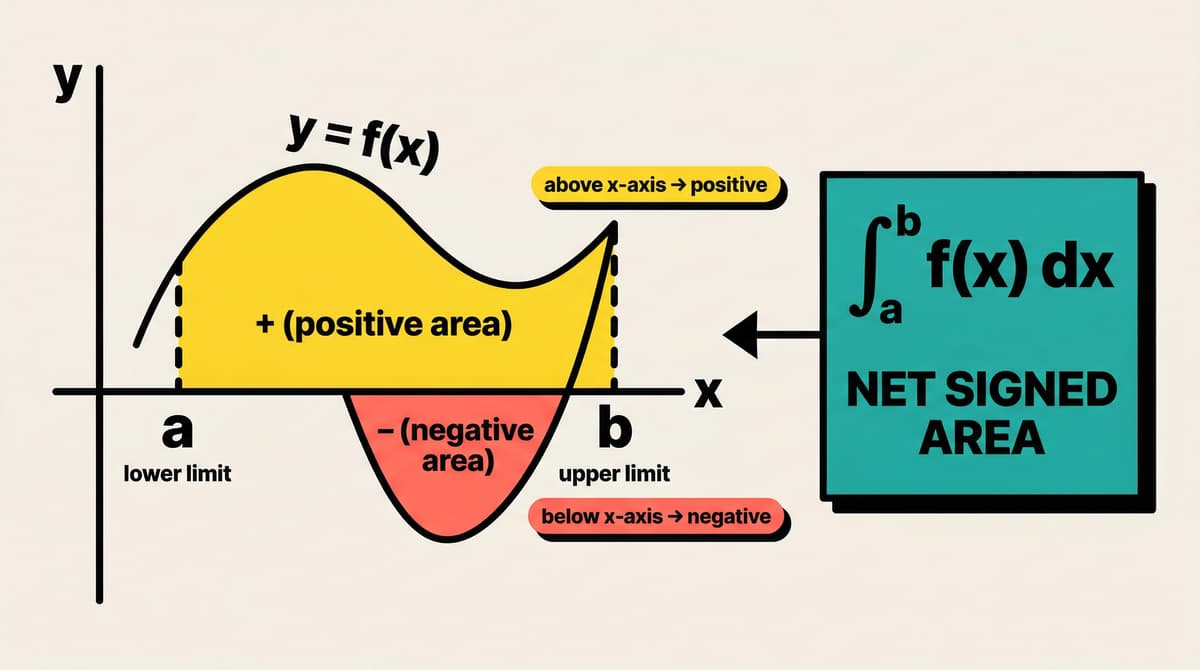
Geometrically, the definite integral represents the net signed area enclosed between the curve and the -axis, from to .
- Regions above the -axis contribute positive area.
- Regions below the -axis contribute negative area.
A very common misconception: the definite integral does not always equal the total area between the curve and the -axis. It gives the net area — positive and negative regions can cancel each other out. You must handle this carefully when the curve dips below the -axis.
The Fundamental Theorem of Calculus
The Fundamental Theorem of Calculus (FTC) is the cornerstone result that links differentiation and integration — two ideas that might seem unrelated at first.
If is an antiderivative of (meaning ), then:
The definite integral equals the change in the antiderivative evaluated at the upper and lower limits.
This is often written using bracket notation:
The process for evaluating a definite integral analytically:
- Find the antiderivative of (no constant needed for definite integrals).
- Substitute the upper limit into .
- Substitute the lower limit into .
- Compute .
You do not need to include the constant of integration when evaluating definite integrals. Since you are computing , any constant would cancel out anyway.