
Introduction: From Secants to Tangents
One of the most elegant ideas in all of mathematics is this: you can find the exact slope at a single point on a curve by taking a limit. Before we get there, it helps to understand what a derivative actually represents geometrically.
Imagine drawing a straight line through two points on a curve. This is called a secant line, and its slope gives the average rate of change of the function between those two points. Now imagine sliding one point closer and closer to the other — the secant line rotates, and in the limit, it becomes the tangent line at that point. The slope of that tangent line is the instantaneous rate of change: the derivative.
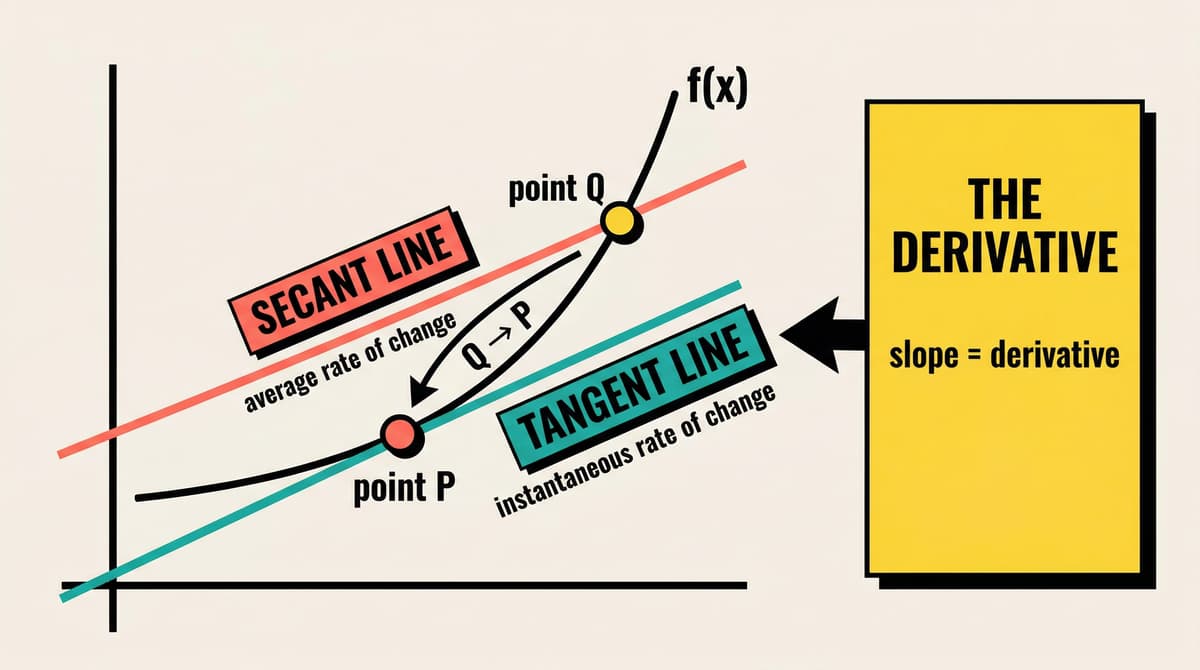
This transition from average to instantaneous rate of change is the heart of differential calculus, and it is made rigorous through the concept of a limit.
Limits: The Language of Calculus
Before defining the derivative formally, we need to be comfortable with limits.
The limit of a function as approaches a value is the value that gets arbitrarily close to as gets arbitrarily close to (but does not necessarily equal ). Written as:
Limits can either converge (approach a finite value) or diverge (grow without bound or fail to settle on any value).
Convergent limit: Consider
Direct substitution gives , which is indeterminate. Factor the numerator:
The limit converges to .
Divergent limit: Consider
As , the function ; as , it . The two one-sided limits disagree, so the limit diverges (does not exist).
A key algebraic technique for evaluating limits that produce is to factor and cancel the offending term. This is exactly the strategy used in first principles differentiation.