
What is a Matrix?
A matrix is a rectangular array of numbers, symbols, or expressions arranged in rows and columns. Matrices are typically denoted by capital letters such as , , or .
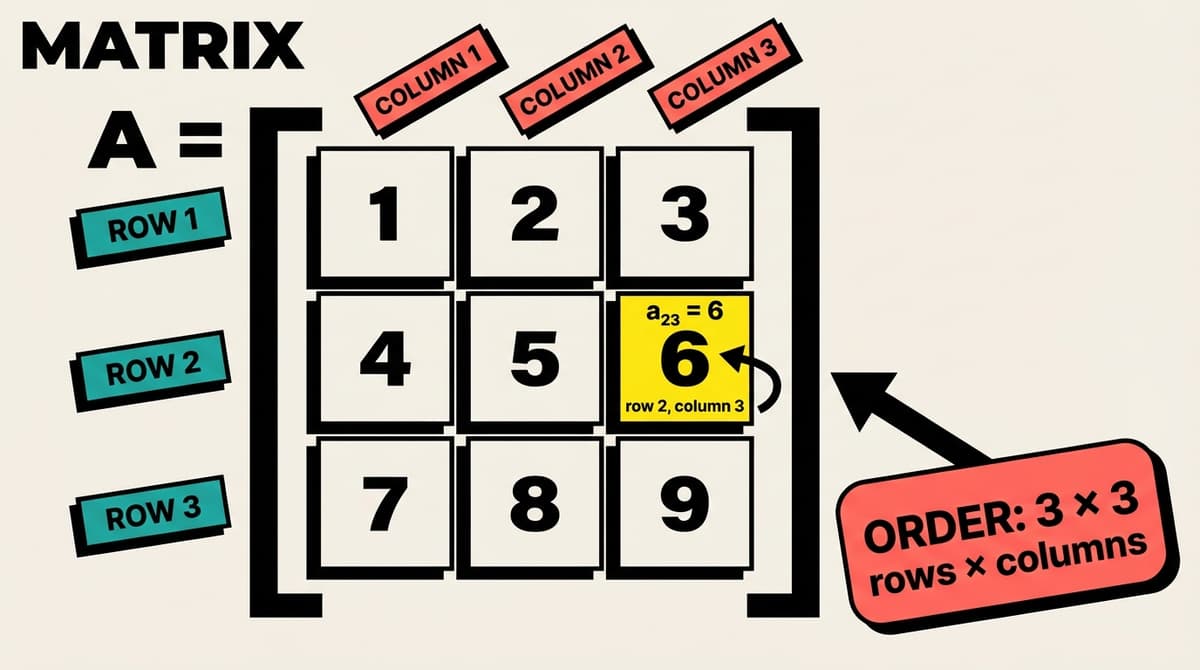
The individual entries inside a matrix are called elements. The horizontal lines of elements are rows, and the vertical lines are columns.
The order (or dimension) of a matrix is written as , where is the number of rows and is the number of columns.
Always state order as rows × columns — never the other way around. A matrix has 2 rows and 3 columns, not 3 rows and 2 columns.
The element in row and column of matrix is commonly written as . So refers to the element in the 2nd row, 3rd column.
Consider the matrix:
This is a matrix. The element (row 2, column 3).
Special Matrices
There are several important types of matrices you need to recognise:
Square Matrix: A matrix where the number of rows equals the number of columns (i.e., ). For example, a or matrix.
The identity matrix is an square matrix with 1s on the main diagonal and 0s everywhere else. It acts as the multiplicative identity: for any compatible matrix .
The identity matrix is:
The zero matrix is a matrix in which every element is zero. Adding the zero matrix to any matrix (of the same order) gives : .
Think of the identity matrix as the matrix equivalent of the number 1, and the zero matrix as the matrix equivalent of the number 0. These analogies hold for addition and multiplication but be careful — matrix algebra has important differences from ordinary arithmetic.