
What Are Eigenvalues and Eigenvectors?
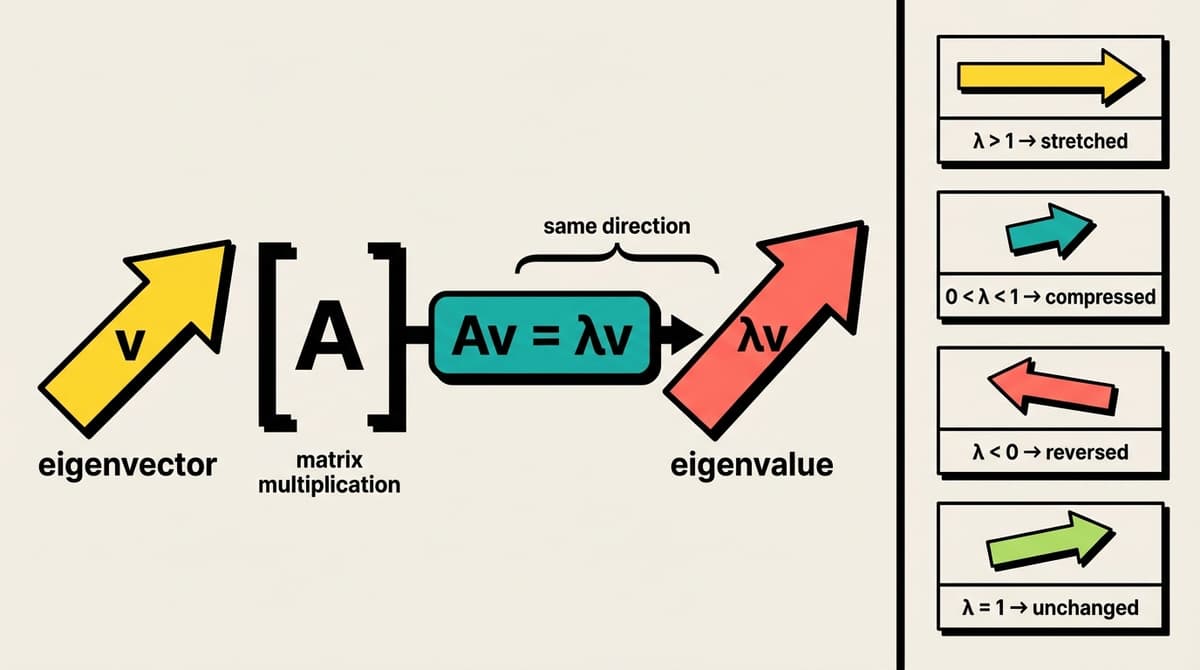
Most matrix-vector multiplications change both the direction and magnitude of a vector. But for certain special vectors — called eigenvectors — multiplication by a matrix only scales the vector, leaving its direction unchanged (or exactly reversed).
A non-zero vector is an eigenvector of a square matrix if multiplying by produces a scalar multiple of :
The scalar is the corresponding eigenvalue.
The scalar such that for some non-zero vector . The eigenvalue tells you by how much the eigenvector is stretched, compressed, or reflected.
Key observations:
- If : the eigenvector is stretched
- If : the eigenvector is compressed
- If : the eigenvector is reversed in direction and scaled
- If : the eigenvector is unchanged by the transformation
- If : the eigenvector is mapped to the zero vector by (note: is singular in this case, and the eigenvector lies in the null space of )
An eigenvector must be non-zero by definition. The zero vector is excluded because holds trivially for any , which is not useful or meaningful.
Syllabus scope: For IB AI HL (AHL 1.15), you are only required to find eigenvalues and eigenvectors for matrices. All examples and exam questions will involve matrices unless otherwise stated.
The Characteristic Polynomial
To find eigenvalues, we rearrange the equation :
For this to have a non-zero solution , the matrix must be singular (non-invertible), which means its determinant must be zero:
This equation is called the characteristic equation, and the expression is the characteristic polynomial.
For a matrix , the characteristic polynomial is:
Note that is the trace of and is the determinant of , so:
The eigenvalues are the roots of this quadratic, which can be found by factoring or using:
Memorise the pattern: characteristic polynomial = . This saves time setting up the determinant calculation from scratch every time.